
Social & Behaviour Issues in Neurotypicals
Communication issues, unusual behaviours, and compliance acquiescence disorder

Stop ignoring us
I‘ve been reading a couple of books, one of which was published in 2020, and the other in 2021.
Both of these recent academic books list issues with Autistic behaviours, and both refer to ABA as a “practice that can be helpful”, despite the fact that Autistic people themselves describe it as harmful and abusive.
Some of the “issues” listed are:
- Avoids or resists physical contact
- Cannot be comforted by others during distress
- Does not understand jokes, sarcasm, or teasing
- Flaps hands, rocks body, or spins self in circles
- Struggles with eye contact
I’m certainly not the first to see the irony in the fact that neurotypicals, who are a hot mess themselves, continue to use their neurotype as the gold standard, an ideal for which all others should strive.
We all have struggles, so perhaps we neurodivergent people can use the knowledge and training we’ve received over our collective lifetimes to help neurodivergent people become more “high functioning”.
I offer my contribution.
Disclaimer
Please note: this is intended as light-hearted humour and friendly teasing of a privileged majority, it is not intended to be mean-spirited or hurtful.
The NT majority has spoken about us (Neurodivergent and disabled people) in this manner for eons. This turning of the tables is intended to help people see how it would feel to be on the receiving end; perhaps enabling them to understand how hurtful and unhelpful it is.
It’s also very important to note that, although these traits are more common in neurotypicals, they are also present in many Autistics. Being a spectrum means there is significant variation in how Autistic traits present in individuals.
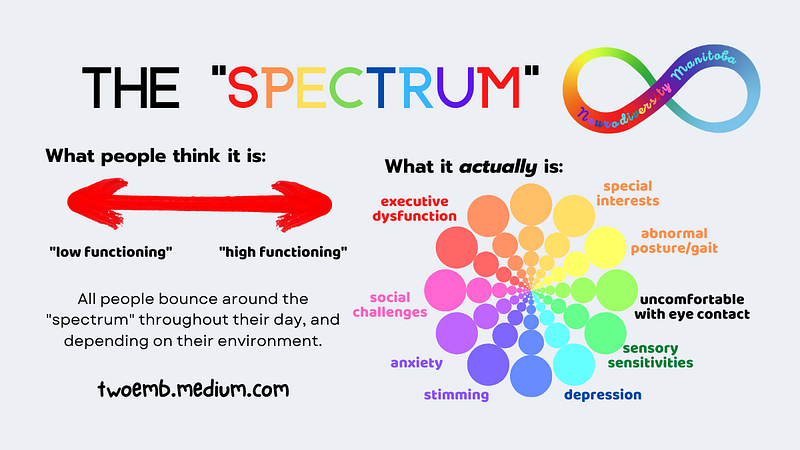
First, we must define our disability, so that we may list our criteria and fix what ails the neurotypical community.
Social Communication Issues and Unusual Behaviours in Neurotypicals:
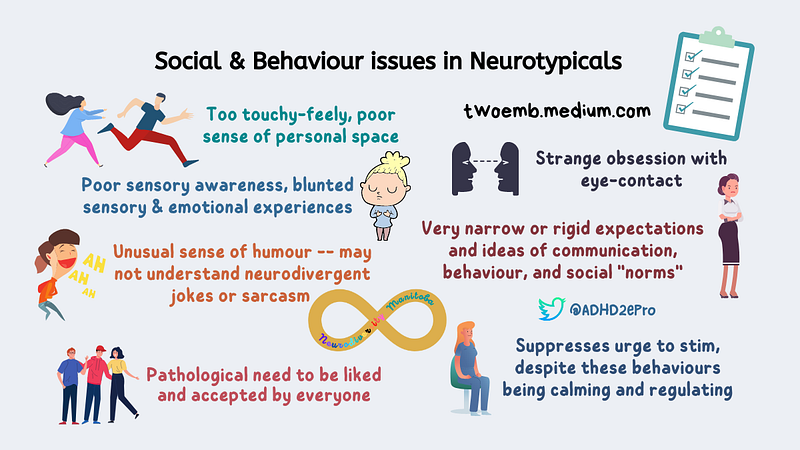
- May have a blunted sensory experience and miss out on some of the more subtle aspects of their environment.
- Often too touchy-feely, may not have a solid understanding of personal space.
- Often expects others to immediately feel better after a hug or pat on the back, rather than allowing others space to express and experience their feelings.
- Often appears uncomfortable if people do not express their feelings in particular ways, using particular facial expressions and/or body language.
- Paradoxically, also frequently appears uncomfortable when people express their feelings intensely, especially in the form of overt behaviours.
- Often communicates using indirect or unclear language, may speak in code or use cryptic messaging, rather than stating what they mean outright.
- May have a strange sense of humour — may not understand neurodivergent jokes, sarcasm, or teasing.
- Displays overly rigid body movements, appears self-conscious about stimming behaviours, tries to hide them rather than utilizing these effective self-soothing strategies.
- May have a strange obsession with making eye contact, and may expect — even demand — that others do the same, causing social and communication difficulties.
- May have an unhealthy need, or even obsession with, being liked and accepted by everyone.
- Overly concerned with appearances and social “niceties”: values stoicism and the ability to follow arbitrary social rules.
Insistence on sameness & compliance
Many neurotypicals (NTs) struggle with the idea that not everyone experiences the world in the same way they do — it likely comes from being part of the privileged majority, which can cause pathological behaviours.
Many NTs also look down upon others for being different, seemingly desiring a more neurologically and behaviourally homogenous society — a society which reflects their own ideals even more than it already does.
Confoundingly, NTs have unspoken social rules, but become upset with people who break those rules, despite the fact they were explicitly not directly communicated to anyone.
On the extreme end of the spectrum, neurotypical behaviour may be classified as Compliance Acquiescent Disorder (C.A.D.), criteria for which was developed by an educator named Norm Diamond.
According to Norm Diamond, symptoms of Compliance Acquiescent Disorder (CAD) include:
“…defers to authority, actively obeys rules, fails to argue back, knuckles under instead of mobilizing others in support, and stays restrained when outrage is warranted.”
— Norm Diamond
There is Hope!
If someone you love may be neurotypical, or even have C.A.D., there is help and there is hope.
For example, applied behavioural analysis (ABA) is a type of therapy that can improve social, communication, and learning skills in neurotypical people, through the use of reinforcement strategies.
If your partner is too touchy-feely and wants constant physical contact, or is making an unhealthy amount of eye contact, try using planned ignoring. This means you refuse to engage with them until they give you a respectful amount of personal space and a significantly reduced amount of eye contact.
You'll need to encourage, maybe even force, your neurotypical loved one to be exposed to all different types of communication styles, regardless of their comfort level — the earlier the better. Remember, this is the world they live in and they’ll have to get used to it.
If you’re in a social situation and they try to leave, physically force them to stay. It may be difficult, but it’s okay because you’ll give them a treat afterward. They’ll be glad you did this when, in the future, they have better social skills as a result of the trauma you inflicted upon them. Trauma definitely leads to better social skills.
Teach them how to stim*, even if you have to physically manipulate them, or force their body to move in self-soothing ways. I’m certain it’s still self-soothing even though you’re forcing them — they have to do this — otherwise, they’ll never learn.
If they don’t learn now, they could spend the rest of their life listening to angsty music, using alcohol, drugs, meaningless sex, or other self-destructive behaviours to avoid expressing and dealing with their feelings.
If these approaches don’t work, you may need to seek the help of a professional.
*A note on stimming
Stimming is self-stimulatory or self-soothing behaviour. Many neurotypicals find stimming problematic, particularly in public situations, despite the fact that it can help with emotional regulation.
Note #2: The exception to this is when stimming is sold in a mass-marketed format that neurotypicals have to pay money to learn.
For example, “emotional freedom techniques” (EFT) Tapping, which is stimming, but sold as an evidence-based self-help tool, rather than a tool that people have been using to help themselves from the beginning of time. For some reason, neurotypicals think the former is better than the latter.
© Jillian Enright, Neurodiversity MB
When you join medium, as a member you’ll have access to unlimited reads for only $5 per month. If you use my referral link, I’ll earn a small commission, and you’ll earn my undying gratitude.
Related Stories
Reference
Bach, D., Groesbeck, G., Stapleton, P., Sims, R., Blickheuser, K., & Church, D. (2019). Clinical EFT (Emotional Freedom Techniques) Improves Multiple Physiological Markers of Health. Journal of evidence-based integrative medicine, 24. https://doi.org/10.1177/2515690X18823691


