
Neurodivergence and the Politics of Self-Control
ADHD, autism, twice exceptionality, and the benefits of intensity

Living With Intensity
My son and I are intense. We’re passionate people. We feel profoundly, we experience deeply, and we get really excited about some things.
Sometimes we have difficulties with interrupting others, being excessively restless, making careless mistakes, or being disruptive to others. We don’t mean to, our brains just work on hyperdrive and it’s hard to reel these things in.
I remember as a child being told I was too loud, talked too much, and I remember being chastised for interrupting people. As an adult, I still get excited and my voice probably gets a bit loud. I still interrupt people occasionally too, but I am working on it.
I don’t do it to be rude, I get excited about the conversation, and my brain and body forge ahead before I have a chance to slow my roll.

Giftedness and over-excitability
My son and I are both twice-exceptional (2e), meaning we are gifted and have disabilities. In addition to ADHD and associated impulsivity, we also both experience overexcitabilities (O.E.s) related to gifted neurology.
“Overexcitabilities are an integral part of the gifted child’s essential self.”
— Daniels & Piechowski
Behaviours and characteristics that frequently typify the five forms of overexcitability (OE) can be described briefly as follows:
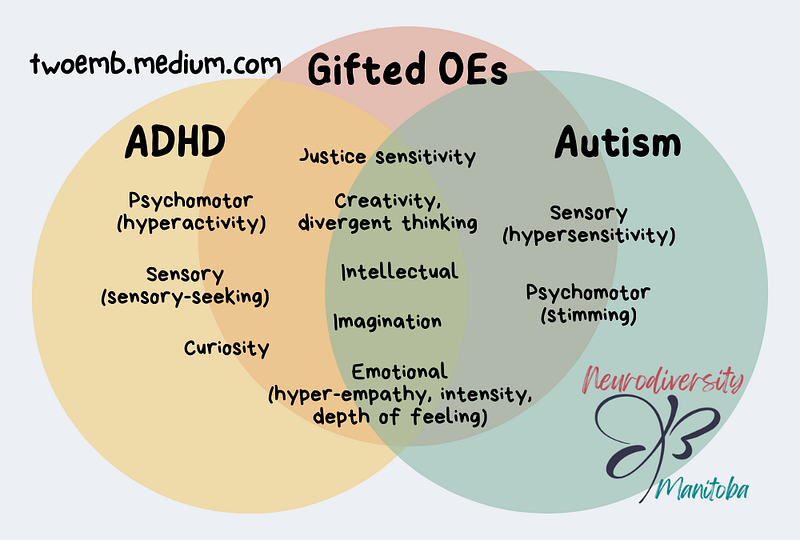
- Psychomotor — movement, restlessness, drivenness, an augmented capacity for being active and energetic.
- Sensual (sensory) — enhanced refinement and aliveness of sensual experience.
- Intellectual — thirst for knowledge, discovery, questioning, love of ideas and theoretical analysis, search for truth.
- Imaginational — vividness of imagery, richness of association, facility for dreams, fantasies, and inventions, endowing toys and other objects with personality (animism), preference for the unusual and unique.
- Emotional — great depth and intensity of emotional life expressed in a wide range of feelings, great happiness to profound sadness or despair, compassion, responsibility, self-examination.
Nearly all of these overexcitabilities are also found in Autistics and people with ADHD.
“Psychomotor over-excitability is significantly correlated with high intelligence.”
— Daniels & Piechowski
On the hunt for dopamine
Neurodivergent brains often process dopamine differently from neurotypical brains. Dopamine is a neurotransmitter that affects our experience of rewards, motivation, and satisfaction. Brains release dopamine in anticipation of something pleasurable and is sometimes referred to as a reward neurochemical.
Neurotypical brains process dopamine more efficiently and effectively compared to neurodivergent brains, including and perhaps especially, those with ADHD. This means we have more difficulty feeling motivated to complete a task we do not find enjoyable, and everyday things that neurotypical folks might enjoy are much less interesting for us.
Take small talk, for example. A lot of neurodivergent people dislike small talk, particularly those of us who are autistic and have ADHD. I hate small talk. I often find it painfully boring and, frankly, a waste of time. I understand there is a social aspect to exchanging pleasantries and being friendly, but small talk is not friendly to me, it usually feels artificial and performative.
Anyway, mini-rant aside, a lot of neurotypical people like and engage in small talk. When they do, my eyes start to glaze over and my brain wanders to something more interesting. Conversely, when a conversation turns to something that really interests me, I become excited and animated.
I love deep conversations. I really enjoy intellectual discussion and debate. I can recall many occasions where I was debating an interesting topic with others and people reacted as though I were becoming “too” passionate. I wasn’t angry or getting upset, I was genuinely and enthusiastically enjoying the exchange.
“I love getting into intense conversations with other people where it’s not just small talk. Sometimes I get too intense”
— Dr. Thomas Brown
Frequently it seems neurotypical people become uncomfortable when others show what they perceive to be too much emotion, even when it’s “positive” emotions, such as excitement or joy — especially when neurodivergent people express these emotions in ways that the neurotypical majority find unusual or peculiar.
Essentially, they want us to tone it down and not get too worked up about things so they can remain in their comfort zone.
“Overexcitability is often viewed by others as overreacting or as inappropriate behaviour needing to be tempered.”
— Daniels & Piechowski
The Artifice of Self-Control
Self-control, especially emotional self-control, is something that has become highly valued in North American culture and beyond. This need and desire for self-control harkens back to the First World War and the Industrial Revolution that followed.
During the war, personality testing was developed in an attempt to weed out soldiers who were more susceptible to “shell shock”, which is now understood as PTSD.
Following the war, these personality inventories were modified for the corporate world, a practice that still exists today. Many large companies utilize standardized screening to help them find the “best” workers — not the most skilled or intelligent, but the most cooperative, conforming and controlled.
As a result, a diversity of neurological types has become something to be feared, avoided, and pathologized, rather than embraced as an attribute or asset.
These tests were designed to filter out employees who would cause trouble or create disturbance, rather than as a means for seeking out the brightest and most creative workers.
Self-control is defined as “the ability to be in command of one’s behaviour and to restrain or inhibit one’s impulses. In circumstances in which short-term gain is pitted against long-term greater gain, self-control is the ability to opt for the long-term outcome.”
What this definition doesn’t (and can’t) specify is whose long-term greater gain is being considered. When it comes to psychological testing and the general desire for self-control, the benefactors are usually employers, society at large, and those who hold positions of power and authority.
“Self control may support society’s interests more than our own.” — Dr. Matthew Lieberman
If you think this is an old problem, take a look at our modern education system: one that chases the holy grail of standardized testing.
The primary route to securing gainful employment is through our public school system, whose prevalent use of standardized testing and screening can be exploited to identify and re-route children who deviate from the norm.
Our education system trains future workers to be compliant, obedient, and not disruptive. Those who make it through to secure employment are then brow-beaten into subservience by being told they must behave in a “professional” manner, where “professional” is often another code for compliant and obedient.
“The very concept of what counts as ‘professional’ is rooted in the desire for social control.” — Dr. Devon Price
Disingenuous and performative
When I said small talk is performative, I wasn’t exaggerating for effect. In fact, I’m essentially incapable of being fake, whether or not it might be for my own or someone else’s “benefit”.
Don’t get me wrong, I can be well-mannered, and I don’t go out of my way to be rude to people intentionally. However, the expectation that we treat others with a basic level of respect and courtesy has extended far beyond social niceties.
To begin with, the definitions of “nice” or polite are completely subjective. The concept of emotional control has devolved from the skill of regulating strong emotions so as not to act out in an aggressive manner. Emotional control has become a desired ability to respond with emotion publicly in a way that is deemed appropriate by Western elites.
Emotional regulation, emotional intelligence, and self-control are touted as important skills for all to have.
In its genuine form, absolutely, it is adaptive to be able to understand and regulate one’s own emotions. Unfortunately, the mainstream propaganda around emotional regulation is nothing more than monetizing the concept of self-control.
“…a lack of self-control isn’t always a bad thing because it may provide the basis for spontaneity, flexibility, expressions of interpersonal warmth, openness to experience, and creativity.” — Jack Block
Indeed, one only needs to do an online search of the term “improving emotional intelligence,” and the results are filled with websites and companies selling psychological tools and online courses.
Aside from selling a product, another purpose of this commercial version of emotional intelligence is the manipulation of others to achieve personal or employers’ goals. Actually, that still boils down to capitalism and selling a product, but in this case, the product is oneself or one’s employees.
Normal is subjective
“…‘normalcy’ describes an ideal type rather than the literal norm, with all its potential for divergence and messy boundaries.”
— Mitzi Waltz
Civilization has come a long way since World War I and the Industrial Revolution, yet as a society, we continue to romanticize and epitomize characteristics that were advantageous during war times.
What’s wrong with being passionate, why does it make neurotypicals uncomfortable, and why do we want to dampen peoples’ spirits? Passion is what drives people, it’s what motivates us to act.
Sure, I might be a little overly enthusiastic when debating a subject I find interesting, but so what? It’s time we stop seeing differences as problems and start seeing how they enrich our lives and are valuable to society as a whole.
© Jillian Enright, Neurodiversity MB
Related Stories
When you join medium, as a member you’ll have access to unlimited reads for only $5 per month. If you use my referral link, I’ll earn a small commission.
References
Bates, A. (2017) The management of ‘emotional labour’ in the corporate re-imagining of primary education in England. International Studies in Sociology of Education, 26(1), 66–81. doi.org/10.1080/09620214.2016.1175959
Block, J. (2002). Personality as an Affect-processing System: Toward An Integrative Theory (1st ed.). Psychology Press. https://doi.org/10.4324/9781410602466
Brown, T. E. (2021). ADHD and Asperger Syndrome in Smart Kids and Adults: Twelve stories of struggle, support, and treatment. Routledge.
Daniels, S. & Piechowski, M. (2009). Living With Intensity. Great Potential Press, Inc.
Gibby, R. E., & Zickar, M. J. (2008). A history of the early days of personality testing in American industry: An obsession with adjustment. History of Psychology, 11(3), 164–184. https://doi.org/10.1037/a0013041
Gillebaart, M. (2018). The ‘Operational’ Definition of Self-Control. Frontiers in Psychology, 9, 1231. 10.3389/fpsyg.2018.01231
Lieberman, M. (2012, April 23). The Hidden Doublespeak of Willpower and Self-control. Who do we control the self for? (Blog). Psychology Today. https://www.psychologytoday.com/nz/blog/social-brain-social-mind/201204/the-hidden-doublespeak-willpower-and-self-control
Price, D. (2021). Laziness Does Not Exist. Simon & Schuster, Inc.
Saline, S. (2018). What Your ADHD Child Wishes You Knew: Working together to empower kids for success in school and life. TarcherPerigee.
Volkow, N. D., Wang, G. J., Kollins, S. H., Wigal, T. L., Newcorn, J. H., Telang, F., Fowler, J. S., Zhu, W., Logan, J., Ma, Y., Pradhan, K., Wong, C., & Swanson, J. M. (2009). Evaluating dopamine reward pathway in ADHD: Clinical implications. JAMA: The Journal of the American Medical Association, 302(10), 1084–1091. https://doi.org/10.1001/jama.2009.1308
Waltz, M. (2020). The production of the ‘normal’ child: Neurodiversity and the commodification of parenting. In Bertilsdotter Rosqvist, H., Chown, N., & Stenning, A. (Eds). Neurodiversity Studies: A new critical paradigm. Routledge.
Wood, V., & Laycraft, K. (2020). How Can We Better Understand, Identify, and Support Highly Gifted and Profoundly Gifted Students? A Literature Review of the Psychological Development of Highly-Profoundly Gifted Individuals and Overexcitabilities. Annals of Cognitive Science, 4. https://doi.org/10.36959/447/348


