
How Executive Dysfunction Impacts Daily Life
How executive functions relate to ADHD, Autism, and other divergent brains.
If you’ve done any reading on neurodivergent brains, you’ve probably come across this term called “executive function”. When people refer to executive function, they are talking about how our brains work to perform certain tasks.
Humans have highly developed brains and our frontal lobes are responsible for overseeing a lot of higher-order thoughts and actions. Executive functions enable us to plan for the future, focus our attention, remember instructions or information, and regulate our thoughts, emotions, and behaviours.
Defining Executive Functions
There is no single, accepted definition of executive functions (EFs). However, most experts agree that EFs are complex, and they are needed to execute tasks in the service of accomplishing a goal.
For example, Barkley defines executive functioning as a “complex construct that encompasses a variety of cognitive abilities that allow for impulse control, strategic planning, cognitive flexibility, and goal-directed behaviour.”
That’s a fancy way of saying that some cool stuff happens in your brain that allows you to exert self-control, plan for your future in a thoughtful way, and adapt to changes in your environment. You can use these previous experiences to guide your behaviour toward attaining long-term goals.
Saline once suggested that “executive functions are a “set of complex brain functions needed to achieve and accomplish goals that exist all over the brain but predominantly in the prefrontal cortex.”
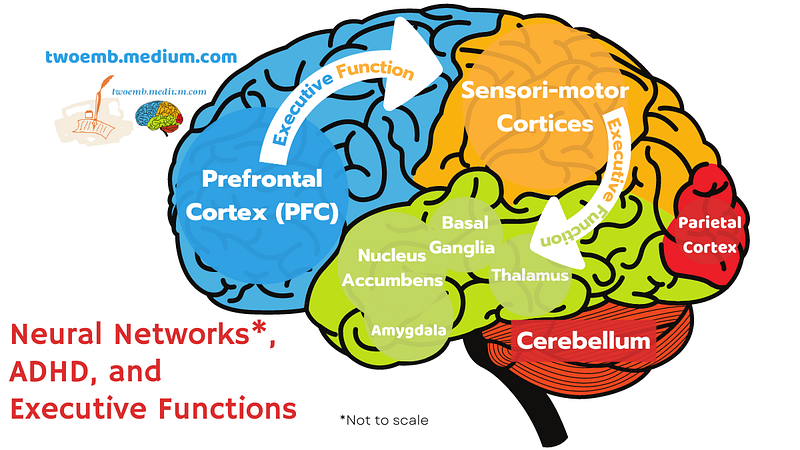
This sentence might seem a bit out of order as our functions occur in various parts of the brain, and not just in one’s goals. The prefrontal cortex (PFC) is the region most responsible for our executive functioning.
That is also why the PFC is the executive here. It’s supposed to be in charge most of the time while allowing other parts of the brain to take over on occasion. The delegation — that’s part of good leadership.
More simply, as Brown noted, EFs are:
“….a complex set of brain functions that serve as each person’s self-management system.”
It’s a little over-simplified, but fundamentally correct. For our visual learners, here is a lovely brain model that is most definitely not to scale:
The Five Executive Function Categories
Various experts have come up with their own categories for EFs with slightly different explanations, but they line up quite well, as most of them say the same thing in slightly different ways.
Thus, EFs are broken into roughly five categories:
- Inhibition (impulse control, self-regulation)
- Cognitive flexibility and problem-solving 2.5) Hyperfocus
- Working memory (hindsight and foresight)
- Organization and time management
- Emotion regulation
Executive Function and ADHD
Everyone with ADHD has some difficulty with executive functioning, but it does not mean we struggle with each one of these categories. For example, some of us have more trouble with time management, while others have more difficulty with emotional regulation.
Conversely, not everyone with EF challenges has ADHD. Executive functioning challenges can occur with other brain differences as well, such as autism, depression, learning disabilities, and FASD among others.
Diving Deep With the 5 Executive Functions
1) Inhibitory Control
I will start with inhibition because it plays an important role in nearly all executive functions.
Inhibition is defined as “the process of restraining one’s impulses or behaviour, either consciously or unconsciously, due to factors such as lack of confidence, fear of consequences, or moral qualms,” similar to impulse control, or self-regulation.
Conversely, Nigg defined it as:
“…resisting doing something you are pulled to do for the sake of a later goal.”
Here, inhibition is more than self-restraint in the face of temptation. It also regulates one’s thoughts, emotions, and behaviour with the future in mind.
As Barkley also mentioned, “those with ADHD will be as impulsive with their primary emotions as they are with their motor or behavioural responses” (Barkley, 2015).
It seems that Nigg’s definition of self-regulation really encompasses the many ways in which inhibition is involved in various aspects of our executive functioning.
“Self-regulation means the capacity to optimize our behaviour, thinking and attention, and emotional experience and expression.”

When we think of self-control, we often think only of our outward behaviours. For example, keeping unkind thoughts or opinions to ourselves, or resisting the urge to raise our voice when we are feeling angry or frustrated.
Inhibition goes further than that, and our EF impacts more than our externalized behaviour. Inhibition impacts our focus, attention, and emotions.
As Barkley stated:
“Response inhibition refers to the ability to withhold a cognitive or behavioural impulse that may be inaccurate or maladaptive.”
When people say that those of us with ADHD are easily distracted or have trouble focusing, what they’re actually saying is that we are less capable of inhibiting our responses to extraneous stimuli.
I don’t have trouble with paying attention, in fact, I have quite the opposite: I pay attention to ALL of the things. While a neurotypical person might be able to focus on the person speaking to them, my ADHD brain picks up on every extraneous cue as well.
If I am sitting in a coffee shop with a friend, I can pay attention to what they’re saying to me, but my brain pays attention to everything else around us as well.
I see that there is a couple arguing in the corner, a staff member that has closed the bathroom for cleaning, and I have just noticed that my friend got new glasses but I also don’t want to interrupt her.
I notice the body language of all the staff behind the counter, the subtle looks they exchange with each other when a customer is being rude, or when they’re annoyed with one of their coworkers.
I notice the typo on one of the shop’s signs, the kind person who held the door open for another, and….did that person just park in an accessible parking spot without a permit?

It’s no wonder I am exhausted after socializing.
2) Cognitive Flexibility and Problem Solving
Cognitive flexibility is the human ability to adapt cognitive processing strategies —such as thinking and planning — to face new and unexpected conditions in the environment.
Cognitive flexibility also allows us to switch between tasks and to adapt to changing environments, a process often referred to as task set-shifting or task switching.
Sometimes we call this “thinking on our feet” or being adaptable. People who struggle with EF challenges may experience anxiety, irritability, or distress over unexpected changes.
People who seem to need things a certain way may appear controlling on the surface, but this often stems from their brain’s inability to quickly switch tracks and come up with alternative plans or solutions.
“Children with ADHD have less ability to be mentally flexible and to problem solve.”
Cognitive flexibility and set-shifting also allow us to take another’s perspective, see things from more than one point of view, or approach a problem in a different way.
People with cognitive rigidity may have difficulty coming up with alternative solutions to simple, straightforward problems. However, neurodivergent people often think outside the box and can come up with unique solutions to complex problems.
2.5) Cognitive Rigidity and Hyperfocus
Another aspect of cognitive rigidity, or difficulty with task-switching, is hyperfocus.
Hyperfocusing is defined as a clinical phenomenon of “locking on” to a task in patients with ADHD who have difficulty shifting their attention from one subject to another, especially if the subject is about their interests.
For example, when I’m writing an article, I am usually hyperfocused. I get so absorbed in my research and writing that I lose track of time, forget to eat or drink, or even go to the bathroom for hours at a stretch.
While I was writing this story I realized that it was 1 pm and I hadn’t eaten anything yet. I put something in the microwave to warm up, then went back to work. I forgot about my food, then found it an hour later when I went to reheat my cup of coffee.
That is a daily occurrence, and it also brings me to the next EF: working memory.
3) Working Memory
I believe Adele Diamond said it best:
“….[Working memory is] holding information in mind and mentally working with it.”
Holding information is extremely difficult for me. I cannot look at a phone number, quickly memorize it, and then enter it into my contacts, or write it down accurately.
I have to remember 3 or 4 numbers at a time and write it down in chunks.
I actually used to think I was terrible at math for this very reason: I cannot hold numbers in my mind and work with them. However, once I identified this weakness and compensated for it, I realized that I actually liked math and that am not so bad at it after all.

Another part of working memory is the ability to remember past experiences, relate them to the one you are currently facing, and use information from the previous scenario to inform your decision-making in the present.
Dr. Barkley had described this process as one that “permits propositions or simulations of behaviour that are internally generated to be evaluated and selected or rejected quickly and internally without having to wait for the exposure to external consequences”.
If you’ve ever read a choose-your-own-adventure book, you’ve probably taken a peek at the different scenarios ahead of time, to make an ideal choice. I know I have.
That’s how I interpret Dr. Barkley’s description above: in your mind, you play out the different options available in a particular scenario and imagine their likely outcomes based on your past experiences, then choose the best one.
That takes a lot of executive functioning.
The other way this plays out is in the phenomenon of walking into a room and forgetting why you were going in there in the first place — except this happens daily, or probably even hourly.
I constantly get sidetracked onto something new and forget what I was supposed to be doing. I regularly forget where I put my phone, glasses, keys, book — my everything.

4) Planning, Prioritization, and Organization
I suck at prioritization. Rather, my brain knows how to prioritize, I just struggle to follow through from the highest priority to the lowest in chronological order.
Niggs said it best:
“This EF category addresses….difficulties individuals may have organizing tasks and materials, estimating time, prioritizing tasks, and getting started on work-like tasks.”
The struggle is real, my friends. I know what needs to be done. I know how to do it. I know I should be doing it…. but I’d rather do this other thing instead, and I get stuck in a rut.
People with EF disorders aren’t lazy or irresponsible — our brains are wired differently. More accurately, they just run differently. Our brains don’t process the same amount of dopamine as neurotypical brains.
This is important because dopamine is a neurotransmitter that affects pleasure, rewards, motivation, and satisfaction.
The neuroscience behind it all is very complex, but some people with EF disorders, like ADHD, have lower dopamine receptor availability.

Dopamine is a neurotransmitter released when your brain anticipates something good is going to happen. If your brain doesn’t process adequate dopamine in anticipation of having a nice, clean kitchen, then it’s a lot harder to motivate yourself to do the dishes.
The other EFs in this category are time management and awareness. People with ADHD have alterations in time perception, such as difficulty estimating the passage of time.
This impacts me because I seem to always underestimate how much time something will take, whether it is driving somewhere, or completing a task before I have to leave for a scheduled appointment.
I have to set a ridiculous number of reminders on my phone because I’ll lose track of time and forget that I will need to leave soon. Otherwise, I’d look up and realize I was supposed to leave 10 minutes earlier.
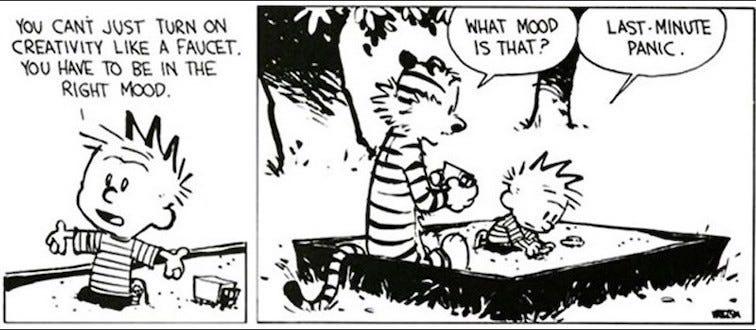
This is part of the reason why neurodivergent people panic over minor issues, like a change in plans, but are cool under pressure. Our brains don’t speed up the dopamine release until it’s ‘go’ time, and then we truly embody grace under fire.
5) Emotion Regulation
I saved the biggest EF for last. Challenges with emotional regulation are arguably the most impactful aspect of being neurodivergent, yet they seem to be the least well understood.
According to Hinshaw, emotion regulation encompasses the following abilities:
- Inhibiting inappropriate behaviour affiliated with strong emotion
- Self-soothing physiological arousal induced by strong affect
- Refocusing attention
- Organizing for coordinated action and service for an external goal
Difficulty with emotional regulation is not even listed in the DSM-5 criteria for ADHD. Similarly, the DSM-5 describes Autism Spectrum Disorder (ASD) as “deficits in social-emotional reciprocity” and “reduced sharing of emotions”, yet does not address the emotional intensity and reactivity.
Emotional control and modulation of emotions are difficult for many neurodivergent individuals, including — and maybe particularly — those of us with ADHD and autism.
Let’s hark back to the lovely brain model from earlier:

When our prefrontal cortex (PFC) is under-developed (or doesn’t function in the same way as it does in the neurotypical majority), then the neural pathways outlined above are impacted.
The amygdala is the most important region related to emotion, but our amygdala requires input from the PFC to regulate those emotions.
Reduced activity in the PFC, combined with increased activation of the amygdala, during emotional events has been demonstrated in both ADHD and autism.
As Barkley explained, emotions generated by the amygdala are inadequately regulated by the PFC in those with ADHD:
“These higher level regions provide for self-control and take over the emotions in the service of longer-term goal-directed, hierarchically organized, and socially acceptable behaviour.”
Parting Thoughts
I’m 38 years old now, and my neurobiology has (almost) caught up with my neurotypical peers. That doesn’t mean my brain is “normal” as I will always be neurodivergent, but it does mean that my brain has matured.
My PFC has matured, meaning that my ADHD symptoms are presented differently, and I also take medication as prescribed by my doctor.
These, combined with tools and strategies I’ve developed have allowed me to be more in control of my emotions — most of the time. I’m certainly not perfect, but I’ve worked hard and was fortunate to finally figure out what was different about my brain and learn how to work with it.
© Jillian Enright, Neurodiversity MB
Small self-promotion
If you would like to I have a webinar available for purchase on my website which covers all the essential information about executive functions, especially as they relate to Autism and ADHD.

When you join medium, as a member you’ll have access to unlimited reads for only $5 per month. If you use my referral link, I’ll earn a small commission.
Related Stories
References
Barkley, R. A. (2005). ADHD and the nature of self-control. The Guilford Press.
Barkley, R. A. (2015). Attention-deficit hyperactivity disorder: A handbook for diagnosis & treatment. The Guilford Press.
Brown, T. E. (2021). ADHD and Asperger syndrome in smart kids and adults: Twelve stories of struggle, support, and treatment. Routledge.
Buttelmann, F., & Karbach, J. (2017). Development and plasticity of cognitive flexibility in early and middle childhood. Frontiers in Psychology, 8(1), 1040. doi:10.3389/fpsyg.2017.01040
Cañas, J. (2006). Cognitive Flexibility. In International encyclopedia of ergonomics and human factors (pp. 297–300). Routledge. doi:10.13140/2.1.4439.6326
Dajani, D. R., & Uddin, L. Q. (2015). Demystifying cognitive flexibility: Implications for clinical and developmental neuroscience. Trends in Neurosciences, 38(9), 571–578. https://doi.org/10.1016/j.tins.2015.07.003
Diamond, A. (2013). Executive functions. Annual Review of Psychology, 64(1), 135–168. doi:10.1146/annurev-psych-113011-143750
Friedman, N.P., & Robbins, T.W. (2021). The role of prefrontal cortex in cognitive control and executive function. Neuropsychopharmacology. doi:10.1038/s41386-021-01132-0
Hinshaw, S. P. (2003). Impulsivity, emotion regulation, and developmental psychopathology: Specificity versus generality of linkages. Annals of the New York Academy of Sciences, 1008(1), 149–159. doi:10.1196/annals.1301.016
Ibrahim, K., McCarthy, G., & Sukhodolsky, D. G. (2020). Neural mechanisms of emotional dysregulation. Encyclopedia of Autism Spectrum Disorders. Springer. doi:10.1007/978-1-4614-6435-8_102453-1
Lovecky, D. V. (2004). Different minds: Gifted children with AD/HD, Asperger syndrome, and other learning deficits. Jessica Kingsley.
Mazefsky, C. A., Herrington, J., Siegel, M., Scarpa, A., Maddox, B., Scahill, L., & White, S. W. (2013). The role of emotion regulation in autism spectrum disorder. Journal of the American Academy of Child & Adolescent Psychiatry, 52(7), 679–688. doi:10.1016/j.jaac.2013.05.006
Morawetz, C., Bode, S., Baudewig, J., & Heekeren, H. R. (2017). Effective amygdala-prefrontal connectivity predicts individual differences in successful emotion regulation. Social Cognitive and Affective Neuroscience, 12(4), 569–585. doi:10.1093/scan/nsw169
Nigg, J. (2017). Getting ahead of ADHD: What next-generation science says about treatments that work — and how you can make them work for your child. The Guilford Press.
Ozel-Kizil, E. T., Kokurcan, A., Aksoy, U. M., Kanat, B., Sakarya, D., Bastug, G., Colak, B., Altunoz, U., Kirici, S., Demirbas, H., & Oncu, B. (2016). Hyperfocusing as a dimension of adult ADHD. European Neuropsychopharmacology, 24(1), S707-S708. doi:10.1016/j.ridd.2016.09.016
Saline, S. (2018). What Your ADHD Child Wishes You Knew: Working together to empower kids for success in school and life. TarcherPerigee.
Volkow, N. D., Wang, G. J., Kollins, S. H., Wigal, T. L., Newcorn, J. H., Telang, F., Fowler, J. S., Zhu, W., Logan, J., Ma, Y., Pradhan, K., Wong, C., & Swanson, J. M. (2009). Evaluating dopamine reward pathway in ADHD: Clinical implications. JAMA: The Journal of the American Medical Association, 302(10), 1084–1091. doi:10.1001/jama.2009.1308
Wiggins, L. D., Rice, C. E., Barger, B., Soke, G. N., Lee, L. C., Moody, E., Edmondson-Pretzel, R., & Levy, S. E. (2019). DSM-5 criteria for autism spectrum disorder maximizes diagnostic sensitivity and specificity in preschool children. Social Psychiatry and Psychiatric Epidemiology, 54(6), 693–701. doi:10.1007/s00127-019-01674-1


