
ADHD Awareness
ADHD symptoms the DSM-5 misses
Help understanding the real-life symptoms of ADHD
What is ADHD?
According to the CDC, ADHD is one of the most common neurodevelopmental disorders in childhood, but it continues to impact people throughout their adult lives.
October is ADHD Awareness Month, and increased awareness and understanding of signs and symptoms has caused more people to question whether they might have ADHD.
If you’re wondering if you or your child might have ADHD, obviously the best source of individualized information is a medical professional. Unfortunately, there are many who don’t have access to proper assessment or support options, so I aim to make information more accessible.
I’ll share what the Diagnostics and Statistical Manual (DSM-V) lists as criteria for ADHD, and then I will share symptoms that the DSM-V has missed.
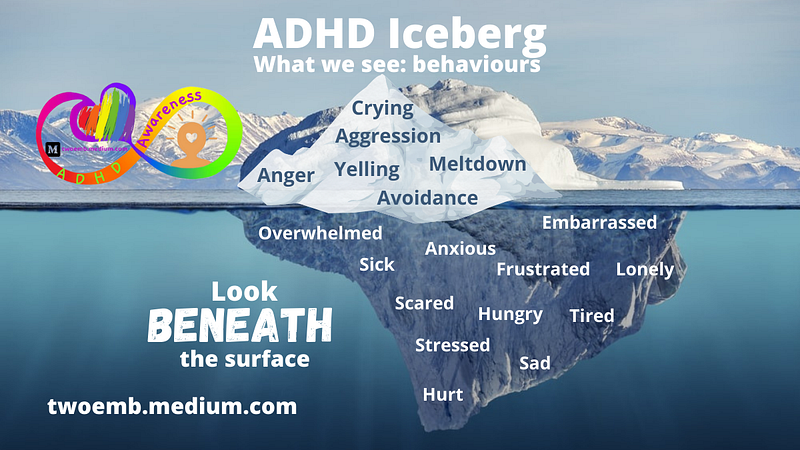
This information is based on extensive research as well as personal and professional experience.
I share this for informational purposes only, as each person’s experience with ADHD will be different.
DSM-5 ADHD Criteria
People with ADHD show a persistent pattern of inattention and/or hyperactivity–impulsivity that interferes with functioning or development:
Inattention
Six or more symptoms of inattention for children up to age 16 years, or five or more for adolescents age 17 years and older and adults; symptoms of inattention have been present for at least 6 months, and they are inappropriate for developmental level:
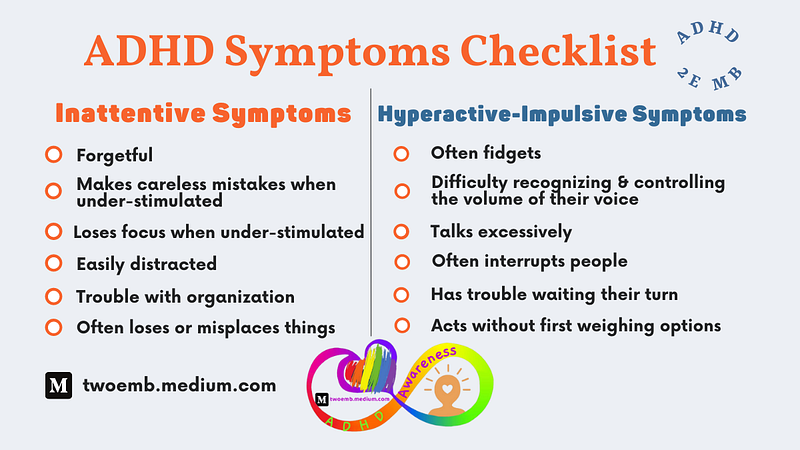
- Often fails to give close attention to details or makes careless mistakes in schoolwork, at work, or with other activities.
- Often has trouble holding attention on tasks or play activities.
- Often does not seem to listen when spoken to directly.
- Often does not follow through on instructions and fails to finish schoolwork, chores, or duties in the workplace (e.g., loses focus, side-tracked).
- Often has trouble organizing tasks and activities.
- Often avoids, dislikes, or is reluctant to do tasks that require mental effort over a long period of time (such as schoolwork or homework).
- Often loses things necessary for tasks and activities (e.g. school materials, pencils, books, tools, wallets, keys, paperwork, eyeglasses, mobile telephones).
- Is often easily distracted.
- Is often forgetful in daily activities.
Hyperactivity and Impulsivity
Six or more symptoms of hyperactivity-impulsivity for children up to age 16 years, or five or more for adolescents age 17 years and older and adults; symptoms of hyperactivity-impulsivity have been present for at least 6 months to an extent that is disruptive and inappropriate for the person’s developmental level:
- Often fidgets with or taps hands or feet, or squirms in seat.
- Often leaves seat in situations when remaining seated is expected.
- Often runs about or climbs in situations where it is not appropriate (adolescents or adults may be limited to feeling restless).
- Often unable to play or take part in leisure activities quietly.
- Is often “on the go” acting as if “driven by a motor”.
- Often talks excessively.
- Often blurts out an answer before a question has been completed.
- Often has trouble waiting their turn.
- Often interrupts or intrudes on others (e.g., butts into conversations or games).
In addition, the following conditions must be met:
- Several inattentive or hyperactive-impulsive symptoms were present before age 12 years.
- Several symptoms are present in two or more settings, (such as at home, school or work; with friends or relatives; in other activities).
- There is clear evidence that the symptoms interfere with, or reduce the quality of, social, school, or work functioning.
- The symptoms are not better explained by another mental disorder (such as a mood disorder, anxiety disorder, dissociative disorder, or a personality disorder).
- The symptoms do not happen only during the course of schizophrenia or another psychotic disorder.
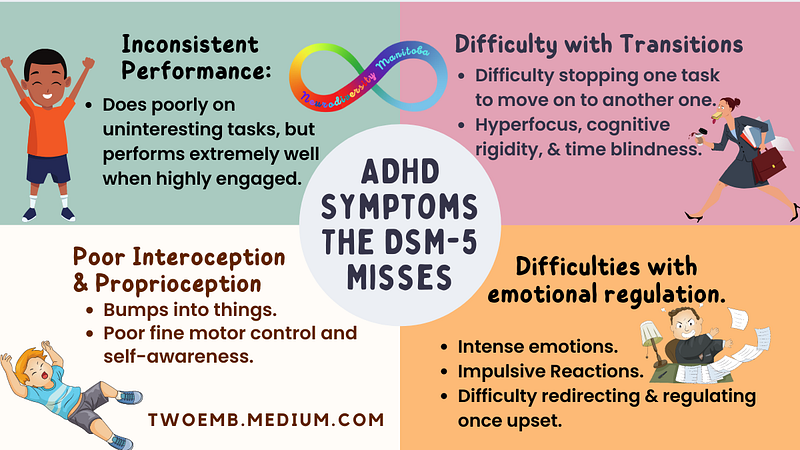
What the DSM-V Misses
These are based on extensive research, as well as personal and professional experience. These are not prescriptive, simply descriptive.
What I mean by that is, if you have ADHD that doesn’t mean you will experience all of these, and if you experience any of these, that does not automatically mean you have ADHD.
These symptoms are common with a number of overlapping disorders and neurotypes, but that does often include ADHD.
Inconsistent Performance
- Does poorly on tasks perceived as uninteresting due to rushing through and missing key details.
- When interested and engaged, performs extremely well with great attention to detail.
Difficulty with Transitions
- Difficulty stopping one task to move on to another one.
- Hyperfocus to the point of forgetting to do things like eat, drink, or use the bathroom for a long period of time.
- Cognitive rigidity, i.e. “black and white” thinking, seeing things in polar extremes, such as either all good or all bad.
Poor Interoception and Proprioception
- Often bumps into things.
- Frequently trips going up the stairs.
- Poor fine motor control (i.e. does not enjoy the physical act of writing).
- Poor self-awareness, doesn’t recognize hunger, thirst, or emotions until they are extreme.
- Difficulty estimating how much force something will need (often “heavy handed” in the literal sense).
- Note: one can have excellent gross motor skills — a strong athlete, for example — and still have poor fine motor skills.
Time Blindness
- People with ADHD perceive time less accurately than neurotypical people.
- We tend to under-estimate how much time a task will take, as well as how much time has passed.
Difficulties with emotional regulation.
- Experiences intense emotions for longer than most developmental peers.
- Difficulty inhibiting inappropriate behaviour affiliated with those strong emotions.
- Difficulty redirecting attention away from source of intense emotions.
In other words, you may have big feelings and big reactions.
Sensory Processing Differences
- Increased or decreased sensory processing abilities and sensory sensitivities, often both in the same person.
- Some people are hypo-sensitive and some people are hyper-sensitive, and some people are hyper-sensitive in some senses yet hyper-sensitive in others.
- Increased sensory sensitivity can lead to sensory overwhelm or overload, which can increase a person’s irritability and anxiety, and lower their frustration tolerance.
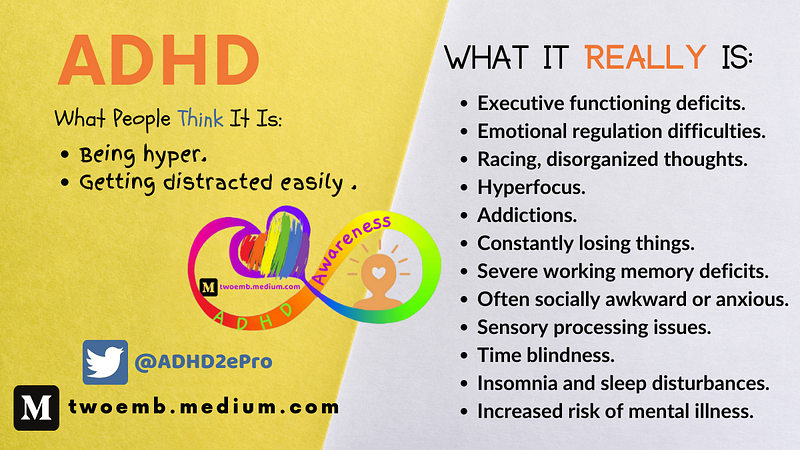
Now What?
If you’re new to understanding ADHD and these symptoms sound very familiar, you know what to do: talk to your doctor.
In the end, so many behavioural-based diagnoses are up to clinical judgement, and clinical judgement comes with… well, judgement. Which means it also comes with biases.
There is extensive evidence that certain populations are under-served, under-diagnosed, and under-supported when it comes to healthcare.
Specific to ADHD in North America, research has shown that female-presenting patients (Pinkerton, 2021) and non-white patients (Slobodin & Masalha, 2020) have a more difficult time being assessed for, diagnosed with, and provided supports for ADHD.
Symptoms also show up very differently in female-presenting and non-binary individuals compared to cis-male patients (Mowlem et al., 2019). ADHD symptoms also show up differently in caucasian patients than they do in non-white people (Garb, 2021).
So if your doctor doesn’t take you seriously, get a new one. And if you can’t get decent healthcare, self-diagnosis is absolutely valid. The only problem is that self-diagnosis does not allow you access to certain supports or treatment, including medication.
If you think you may have ADHD and it is negatively impacting your life, keep pushing. The good news is that there is a large online ADHD community you can turn to for advice, support, and camaraderie.
For local resources for assessment and diagnosis, visit my website.
Good luck!
© Jillian Enright, Neurodiversity MB
When you join medium, as a member you’ll have access to unlimited reads for only $5 per month. If you use my referral link, I’ll earn a small commission, and you’ll earn my undying gratitude.
Related Stories
References
American Psychiatric Association. (2013). Diagnostic and Statistical Manual of Mental Disorders, 5th edition. American Psychiatric Association.
Garb, H. N. (2021). Race bias and gender bias in the diagnosis of psychological disorders. Clinical Psychology Review, 102087, 0272–7358. https://doi.org/10.1016/j.cpr.2021.102087
Mowlem, F.D., Rosenqvist, M.A., Martin, J. et al. (2019). Sex differences in predicting ADHD clinical diagnosis and pharmacological treatment. European Child & Adolescent Psychiatry 28, 481–489. https://doi.org/10.1007/s00787-018-1211-3
Pinkerton, M. (2021). The Underdiagnosis of Attention-Deficit/Hyperactivity Disorder (ADHD) in Young Females. Capstone Showcase, 102. https://scholarworks.arcadia.edu/showcase/2021/pa/102
Slobodin, O., & Masalha, R. (2020). Challenges in ADHD care for ethnic minority children: A review of the current literature. Transcultural Psychiatry, 57(3), 468–483. https://doi.org/10.1177/1363461520902885
Zheng, Q., Wang, X., Chiu, K. Y., & Shum, K. K. (2020). Time Perception Deficits in Children and Adolescents with ADHD: A Meta-analysis. Journal of Attention Disorders. https://doi.org/10.1177/1087054720978557


