
ADHD Awareness
ADHD, Actually: The Struggle is Real
Research reveals how life-altering ADHD really is… and what you can do about it
ADHD is about so much more than difficulty sitting still or paying attention
So. Much. More.
Despite decades of information being available to anyone and everyone, including doctors, teachers, and the general public, there is still a lot of misinformation out there. It’s ironic — okay, a bit sad and frustrating too — that one of the most common childhood disorders is one of the least well understood. So misunderstood, in fact, we have several stories dedicated to challenging myths about ADHD.
The CDC (U.S.) indicates that 9.4% of children aged 2–17 years are diagnosed with ADHD. Statistics Canada states that 5% of school-aged children (presumably aged 5–17) are diagnosed with ADHD. The Centre for ADHD Awareness, Canada (CADDAC) states that ADHD is the most prevalent childhood psychiatric disorder in Canada and remains under-recognized and under-diagnosed, despite being the most treatable psychiatric disorder in Canada.
So, what is ADHD, if not a case of “the wiggles”? If it’s not simply a matter of needing to focus more or get more organized, then what exactly is it?
ADHD is Life-Altering
We will only touch upon a couple of the most life-impacting symptoms of ADHD in this article, but of course, each person’s experience with ADHD will be different and there are many other symptoms that affect people’s everyday lives.
Executive Functioning Issues
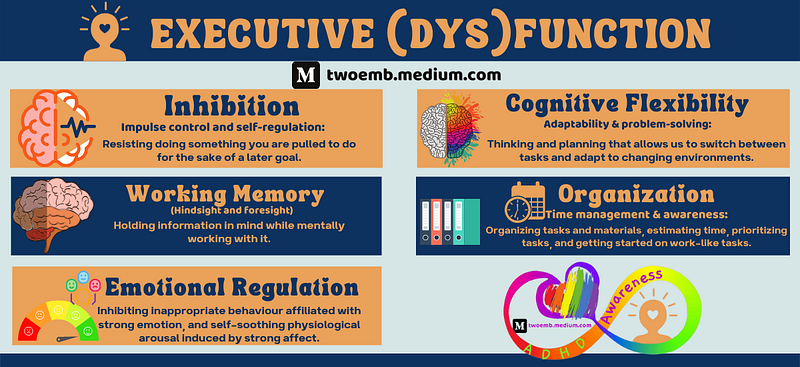
Two major factors impacting the life of children (and adults) with ADHD both stem from Executive Functioning difficulties:
Impulse Control
Impulse Control is the ability to pause between the action and reaction. “Response inhibition refers to the ability to withhold a cognitive or behavioural impulse that may be inaccurate or maladaptive” (Barkley, 2015).
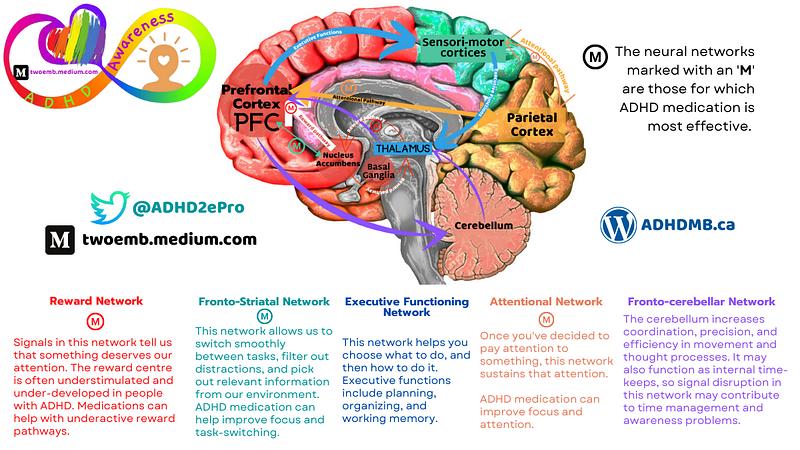
When people seem to act without thinking, it is not because they’re careless or thoughtless. Certain parts of the ADHD brain develop approximately 30% slower (on average) than a typical brain (Shaw et al., 2007). This includes the Prefrontal Cortex (PFC), an area of the brain responsible for impulse control and complex decision-making.
Emotional Dysregulation
Emotional regulation can be very difficult for some people with ADHD, and can have a significant impact on their lives, including their relationships.
A child who becomes angry easily and lashes out aggressively is unfairly labelled a “ bad” kid. They’re not a bad kid.
They’re not even an aggressive kid, they’re a child experiencing emotional dysregulation whose behaviour is being expressed in an aggressive manner in that moment because they haven’t yet developed the ability to self-regulate. Their neurobiology may not even be developed adequately for them to have the physical brain structures to do so.
The distinction is important: children are not their behaviour, and when that behaviour stems from a disability or neurodifference, they are not always in control of said behaviour.
Actually, neurotypical children are still not always in control of their behaviour for the same reason: their neurobiology isn’t supposed to be developed to that extent yet.
A person with ADHD cannot help if they have an underdeveloped amygdala, the part of the brain largely responsible for emotional regulation.

Add Them All Together…
Impulsivity and emotional regulation are very much interconnected: Combine the experience of intense emotions due to an underdeveloped amygdala, plus difficulty pausing to evaluate prior to acting due to an underdeveloped PFC, plus difficulty using memories of previous events to consider the possible consequences of said actions (also due to that underdeveloped PFC causing difficulty with hindsight and working memory)… those are a lot of brain-based challenges to work against in order to exert what we call “self-control”!
What we call self-control really comes from a combination of neurobiology and learned skills. Dr. Russell Barkley defines impulse control as the ability to control your emotions and behaviour so they don’t interfere with your goals.
So Now What?
Good question.
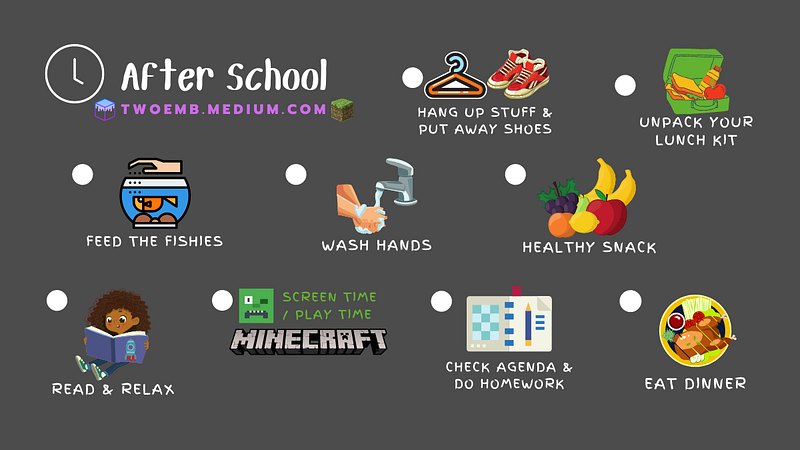
Use visual cues and reminders
Use attractive visual imagery (Barkley, 2005), and I’m not talking about a list of household or classroom rules posted on the fridge or bulletin board in black-and-white.
I am referring to bright, colourful, eye-catching pictures that are portable and that you can update frequently. Even beautiful artwork quickly fades into the background as our brains habituate to its presence, so it goes with visual cues.
Provide in-the moment guidance
“The most useful treatments will be those that are in place in natural settings at the point of performance where the desired behaviour is to occur” (Barkley, 2005).
As Dr. Barkley explains, ADHD is a disability of behavioural performance rather than a deficit in in knowledge. Teaching children more rules and expectations, or giving them more information to remember, will not help.
What will help is a trusted, caring person being present during those challenging scenarios and providing guidance right then and there.
Rehearse and Remind
You can role-play problematic scenarios with your child and help them practice alternative ways of handling situations that may repeat themselves. If there are particular difficulties that come up often, adults can coach the child immediately prior to entering that context.
For example, my son loves physical education class, but he very easily becomes overstimulated by the excitement, loud noises, and a less structured class environment. This is the case for a lot of students.
Before entering the gym, a teacher might ask the class to remember out loud the expectations while participating in their activities.
“Okay, my friends, who can give me three examples of ways we can be safe and respectful during our phys. ed. class?”
- When we enter the gym, we go and sit in the circle in the middle and get ready to hear the instructions.
- We keep our hands and equipment to ourselves, unless it’s part of the sport or game we are playing.
- We demonstrate sportsmanship by saying good game when we are done and using kind words with our peers
“Thank you! Let’s go have some fun.”
Set yourselves up for success
The areas of the brain impacted by ADHD develop approximately 30% later in children with ADHD (Shaw et al., 2007). If your child is 10 years old, you might expect their impulse control to be closer to that of a 7 year old. This is not at all to say that the child is any less intelligent, it simply means that certain areas of their brain mature slower, which in turn impacts their thinking and behaviour.
In contexts where a child could not reasonably be expected to skillfully exercise impulse control, it would be helpful to adapt their environment.

Practical Examples
When your child is just learning to walk, you may put fragile or dangerous items out of their reach for safety. If you are trying to eat less junk food, you might buy less, so that you are not tempted by treats in your kitchen cupboard. These are examples of setting ourselves up for success by adapting our own environment to help us achieve our goals.
If a child struggles to control the urge to grab items off the shelves in stores, we may give them something to carry, ask them to push the shopping cart, or ask them to hold our list and help us pick the items we do need.
Role Model, Empathize, and Validate
Many of us with ADHD are highly perceptive. Often times, because we are less able to regulate our attention (Barkley, 2015), we notice everything in our immediate environment. This means we are distractible, but it also means we can be highly observant.
Generally speaking, children learn more from watching our actions and behaviour (observational learning; Ramirez, 2015), and this might be even more true for children with ADHD. Anecdotally, it is certainly the case for my son.
Helping children develop and utilize emotional regulation tools is a complex, life-long process, too involved to outline in a short paragraph or blog post.
Here are some of the important ways in which children learn and develop these important life skills:
- Developing secure, accepting, loving relationships with caring adults and learning from their examples.
- Those caring adult relationships are the basis for learning co-regulation and beginning to learn how to self-regulate.
- Developing a self-awareness, learning our triggers, signals of early dysregulation, and what strategies work best to help us self-regulate.
- Being seen, heard, and validated when we are dysregulated.
Empathy and validation are so powerful, we wrote an entire article on that subject alone.
Related Stories
References
Barkley, Russell A. (2015). Attention-Deficit Hyperactivity Disorder: A Handbook for Diagnosis & Treatment. The Guilford Press.
Barkley, R. A., & Peters, H. (2012). The Earliest Reference to ADHD in the Medical Literature? Melchior Adam Weikard’s Description in 1775 of “Attention Deficit” (Mangel der Aufmerksamkeit, Attentio Volubilis). Journal of Attention Disorders, 16(8), 623–630. https://doi.org/10.1177/1087054711432309
Barkley, Russell A. (2005). ADHD and the Nature of Self-Control. The Guilford Press.
Brown, Thomas, E. (2013). A New Understanding of ADHD in Children and Adults: Executive Function Impairments. Routledge.
Kofler, M. J., Rapport, M.D., Bolden, J., Server, D.E., Raiker, J.S., & Alderson, R.M. (2011). Working memory deficits and social problems in children with ADHD. Journal of Abnormal Child Psychology, 39, 805–817.
Ramirez, Kylie (2015, March 30). Monkey see, monkey do: Model behavior in early childhood. Michigan State University. https://www.canr.msu.edu/news/monkey_see_monkey_do_model_behavior_in_early_childhood.
Shaw, P., Eckstrand, K., Sharp, W., Blumenthal, J., Lerch, J. P., Greenstein, D., Clasen, L., Evans, A., Giedd, J., & Rapoport, J. L. (2007). Attention-deficit/hyperactivity disorder is characterized by a delay in cortical maturation. Proceedings of the National Academy of Sciences of the United States of America, 104(49), 19649–19654. https://doi.org/10.1073/pnas.0707741104.
About the Author
Jillian is a Child Advocate and ADHD coach in Manitoba, Canada. Jillian holds a Bachelor’s degree in Psychology and a diploma in Child and Youth Work, and has been working with neurodiverse children for more than 20 years.


