ADHD Awareness
Challenging Common Myths About ADHD
Demystifying stereotypes and correcting misinformation
I will expand on our most popular blog post of 2020, 7 Ways ADHD is Misunderstood, by further discussing and debunking prevalent ADHD myths.
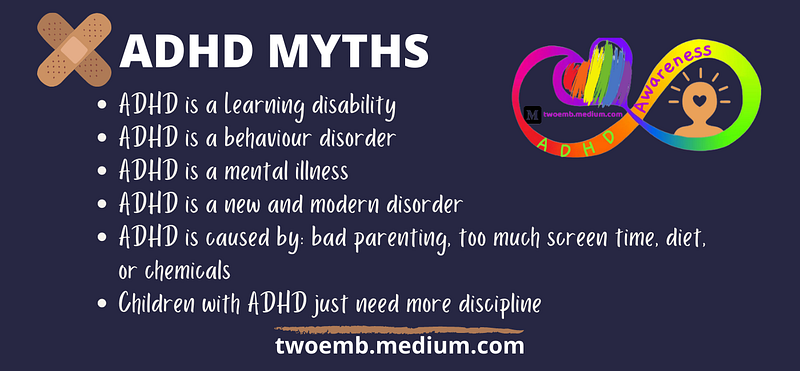
The most common myths I hear about ADHD are:
- ADHD is a learning disability
- ADHD is a behaviour disorder
- ADHD is a mental illness (or “mental disorder”)
- ADHD is a modern disorder (i.e. “ADHD didn’t exist back in my day!”)
- ADHD is caused by: bad parenting, too much screen time, diet, chemicals, etc.
- Children with ADHD just need more discipline
Stop me if you’ve heard this one before…
I read inaccurate statements like these almost every day online and have experienced the harmful effects of these faulty beliefs from adults who should know better, such as teachers, principals, and other professionals.
In this blog post, we’ll take a look at each of these myths and explain why they are just that: Myths. Untrue. Inaccurate. Perpetuating, believing, and acting upon these misguided concepts can cause harm to neurodiverse people, particularly children.
ADHD is not a learning disability
ADHD is highly comorbid, co-occurring, with learning disabilities (DuPaul et al., 2013), but is not in and of itself a learning disability. ADHD does not cause intellectual disabilities and has no direct impact on IQ (Kaplan et al., 2020).
ADHD is not a mental illness either. ADHD is a neurobiological or neurodevelopmental disorder, meaning it impacts the way the brain grows, develops, and functions (we’ll repeat this a few times because it’s an important point for people to remember).
ADHD is not a behaviour disorder
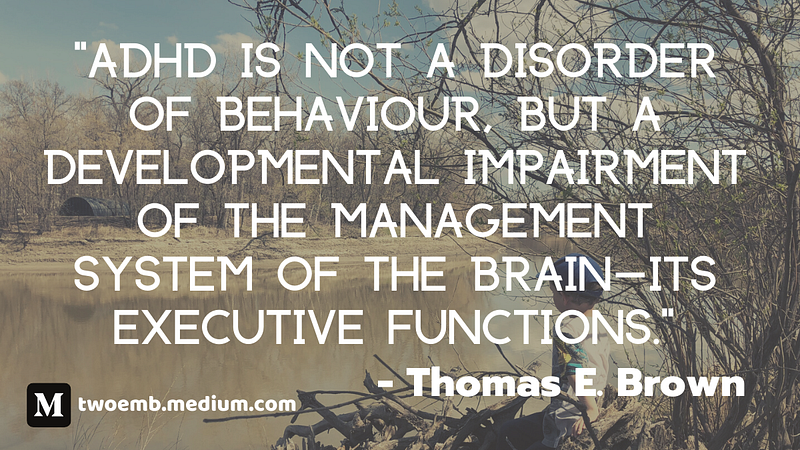
“ADHD is NOT a disorder of behaviour, but a developmental impairment of the management system of the brain — its executive functions.”
— Thomas E. Brown
Children with ADHD may behave impulsively, reacting before thinking things through, which may result in more undesirable or unexpected behaviours. This, however, is a symptom of the Executive Functioning difficulties caused by ADHD, and not an act of willfulness or intentional misbehaviour on the part of the child.
ADHD is not even a modern disorder
ADHD is a neurobiological or neurodevelopmental disorder, meaning it impacts the way the brain grows, develops, and functions. It has been around for as long as humans have had brains (so, like, forever); ADHD just didn’t receive its current name until scientists got around to understanding more about it.
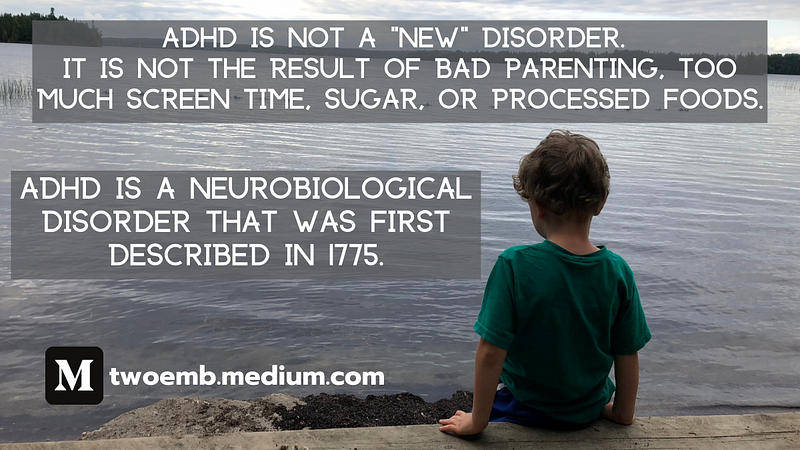
ADHD is not new. It was first described in the medical literature all the way back in 1775 (Barkley & Peters, 2012). That was well over years 200 years ago, so attempts to blame ADHD and its symptoms on too much screen time or too much sugar fall flat.
I wrote much more about this in another story called The History of ADHD.
ADHD is NOT caused by bad parenting
Yes, the way we support children and respond to their needs will certainly effect how much or little their disability impacts their life on a daily basis. However, children are born with ADHD, it is not caused.
Wait, I take that back.
ADHD is primarily caused by genetics. It is highly heritable (meaning it is easily passed down from biological parent to child). It is estimated to have a heritability of 75%, which is considered very high.
ADHD is a neurobiological or neurodevelopmental disorder, meaning it impacts the way the brain grows, develops, and functions.
While some behaviours during pregnancy (such as smoking, for example) can increase the risk of neurodevelopmental problems in the developing baby, a child is born with the brain they are born with, and subsequent parenting choices or parenting styles do not cause ADHD to somehow develop.
Children with ADHD do NOT simply “need more discipline”
Let’s be honest here, when adults say a child “needs more discipline”, what they usually mean is punishment (or retribution). They want to teach that kid a lesson.
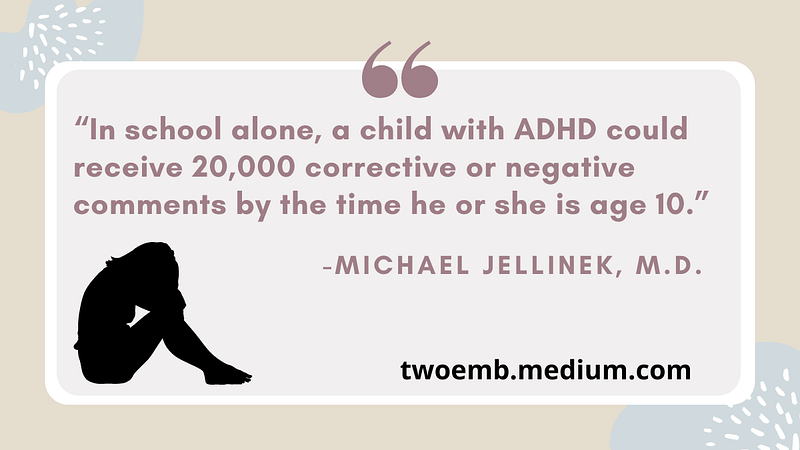
It is estimated that children with ADHD could receive as many as 20,000 corrections or negative comments before the age of 10 (Jellinek , 2010) in school alone. So if a child is repeatedly given negative messages about behaviours largely outside of their control due to their neurobiological development, then what lesson are we teaching them?
Children with ADHD often have difficulty connecting actions with their ensuing consequences, especially when those consequences are delayed, due to difficulties with Executive Functioning.
What excessive discipline or negative messaging can do is cause low self-concept. In 2013, Mazzone et al. found that children and adolescents with ADHD have lower self-esteem than children without. Unfortunately, being frequently berated and shamed for behaviours that are largely outside of their control is bound to have that effect on children’s self-worth.
Why Does It Matter?
It matters. A LOT. Like, a whole heck of a lot.
When it is understood that a child is dealing with a brain-based disability, that their unexpected or undesired behaviours are not intentionally malicious, then we can move from blaming the child for being born with a differently wired brain to having compassion for their struggles.
When we acknowledge and accept that there is a lot about their difficulties that they cannot control, and that children with ADHD need support to manage the symptoms of their disability, then we can come beside them instead of at them. They’ll finally have an adult (or adults, plural, hopefully!) on their side, after potentially years of feeling like a “ bad” kid, but not knowing how to do any better.
Instead of expecting the children to do better, first we the adults must do better. Then the children will feel better, then they can learn the skills they need, and only then can they do better.

© Jillian Enright, Neurodiversity MB
Related Articles
Stereotypes Harm Children with ADHD
Responding to ADHD Doubters, by Dr. Sharon Saline
When you join medium, as a member you’ll have access to unlimited reads for only $5 per month. If you use my referral link, I’ll earn a small commission, and you’ll earn my undying gratitude.

References
Barkley, R. A., & Peters, H. (2012). The Earliest Reference to ADHD in the Medical Literature? Melchior Adam Weikard’s Description in 1775 of “Attention Deficit” (Mangel der Aufmerksamkeit, Attentio Volubilis). Journal of Attention Disorders, 16(8), 623–630. https://doi.org/10.1177/1087054711432309
Brown, Thomas E. (2013). A New Understanding of ADHD in Children and Adults. Routledge.
DuPaul, G. J., Gormley, M. J., & Laracy, S. D. (2013). Comorbidity of LD and ADHD: Implications of DSM-5 for Assessment and Treatment. Journal of Learning Disabilities, 46(1), 43–51. https://doi.org/10.1177/0022219412464351
Jellinek, Michael, S. (2010, May). Don’t Let ADHD Crush Children’s Self-Esteem. Clinical Psychiatry News, pp. 12.
Kaplan, B. J., Crawford, S. G., Dewey, D. M., & Fisher, G. C. (2000). The IQs of Children with ADHD Are Normally Distributed. Journal of Learning Disabilities, 33(5), 425–432. https://doi.org/10.1177/002221940003300503
Mazzone, L., Postorino, V., Reale, L., Guarnera, M., Mannino, V., Armado, M., Fatta, L., De Peppo, L., & Vicari, S. (2013). Self-esteem evaluation in children and adolescents suffering from ADHD. Clinical Practice and Epidemiology in Mental Health, 9, Article 96–102.
About the Author
Jillian is an ADHD 2e Coach and Child Advocate in Manitoba, Canada.
Jillian has a diploma in Child & Youth Work and a Degree in Psychology, as well as being the parent of an amazing 2e/ADHD child.