ADHD Awareness
Harmful ADHD Stereotypes
Challenging Common ADHD Myths
ADHD Awareness and Education
ADHD is the most prevalent childhood disorder in Canada, yet many people, including professionals who work with children, have only the most basic understanding of what it is. Worse, many people still hold outdated and stereotypical beliefs about ADHD and how it impacts people’s lives.
October is ADHD Awareness Month, so I will share the top three essential facts I wish everyone understood about ADHD, with some help from an expert, Dr. Russell Barkley.
Harmful Myth #1: “ADHD is not a legitimate Disability”
It absolutely is, 100%, and don’t ever let anyone tell you otherwise.
ADHD has nothing to do with having too much sugar, too much screen time, or not enough discipline. Some ill-informed (or uneducated) people try to brush it off as “he just needs more exercise”.
No.
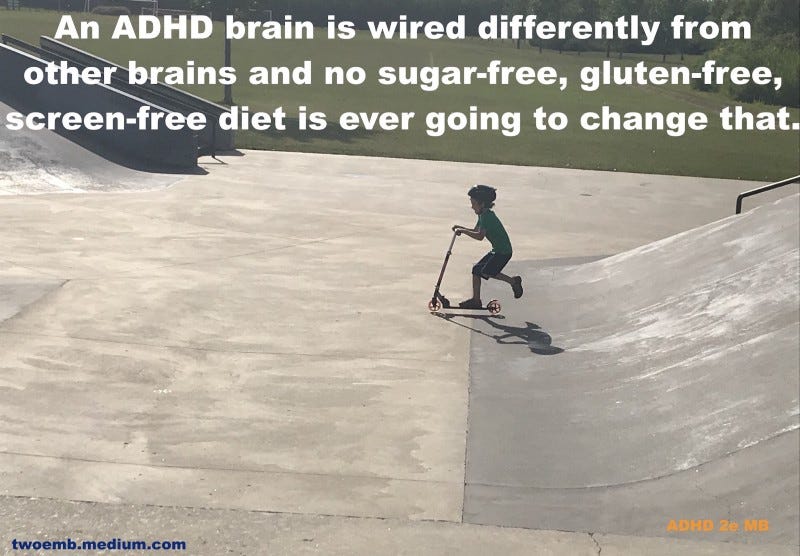
An ADHD brain is wired differently from other brains, and a sugar-free, gluten-free, screen-free diet is never going to change that.
I clearly remember the judgemental looks and behaviours of some small-minded parents from my son’s old rural school. The assumption that we were somehow “bad” parents because our son was born with a differently wired brain hurt us, but they hurt him even more.
When adults are ill-informed, whether intentional or not, they pass their ignorance on to children. Children hear the negative comments, they read the body language, they pick up on and internalize much of it.
Teachers who don’t understand, and don’t seek to understand, what ADHD really is risk significant negative impacts on their neurodiverse students. When adults focus only on children’s behaviour, assume it is willful as opposed to being part of their disability, they damage their self-esteem and self-concept.
Harmful Myth #2: ADHD is a behaviour disorder or a mental illness.
Also no.
ADHD is a chronic (meaning life-long), neuro-developmental disability.
Dr. Russell Barkley explains it better than I can:
Note: Dr. Russell Barkley has very strong opinions on ADHD. Being a psychiatrist, he focuses on the medical model, which can sometimes come across as quite pessimistic. In some of his works, Dr. Barkley also promotes a behaviourist approach to “modifying” behaviour and ADHD 2e MB does not advocate for behaviourism.
Please take what you need from the information he presents and leave the rest. Dr. Barkley has such a wealth of information about ADHD, it is worth sitting through (or fast-forwarding through) a few statements or concepts that you may find disagreeable.
Harmful Myth #3: ADHD is just being distractible and hyper
Once again, hard no.
“Attention Deficit” is a misnomer
(in other words, it’s a stupid name, and Dr. Russell Barkley agrees):
4. ADHD is a disorder of regulation, and it is NOT a deficit in knowledge.
ADHD is difficulty with emotional regulation, physical regulation, and attentional regulation.
ADHD is an incredibly complex disorder that is too often oversimplified as “trouble sitting still” or “difficulty paying attention”.
It is also assumed that children with ADHD haven’t been taught right from wrong, and if only we would “have a talk” with them, that would set them straight.
No.
Children with ADHD can recite the classroom and household rules better than anybody, because they’ve heard them repeated over and over (and over) again. They are not lacking in knowledge about the rules, they are lacking in knowledge about how to follow the rules when their impulsivity has them acting before they have time to think.
ADHD impacts so many aspects of peoples’ lives and the fact that ADHD is stigmatized and misunderstood continues to make life that much more difficult for those who have it.
© Jillian Enright, Neurodiversity MB
Related Articles
ADHD, Actually: The Struggle is Real
Further Resources
Dr. Sharon Saline recently published a blog post about ADHD myths: Responding to ADHD Doubters.
The Centre for ADHD Awareness, Canada (CADDAC) has some excellent information on their website.
About the Author
Jillian is an ADHD 2e Coach and Child Advocate in Manitoba, Canada.
Jillian has a diploma in Child & Youth Work and a Degree in Psychology, as well as being the parent of an amazing 2e/ADHD child.
Visit and facebook.com/NeurodiversityMB to learn more.
If you need help educating your child’s school, your family, or with general ADHD coaching or advocacy, please feel free to contact me.