
Emotions Are Important And Adaptive
Emotions are natural and necessary human responses

People often use phrases like “you seem angry” as a way of discrediting the point a person is making. Being intense or having emotional investment in something does not detract from the evidence or devalue a person’s perspective. Caring about the subject being debated or discussed does not invalidate one’s point of view.
Emotions are human. Emotions are necessary. Certainly there is a difference between purely emotion-based arguments and those driven by facts and logic, but the two are not mutually exclusive.
A person can be both passionate and well-informed on a subject. In fact, one’s interest and enthusiasm can lead a person to become incredibly well-educated on a particular topic.
Emotional dysregulation is not always pathological
Instead of teaching children that all feelings are normal and tell us something important about our bodies and our environment, we inadvertently teach children that some emotions are “good” and some are “bad”.
For example, when children are taught social-emotional skills in school, sometimes the curriculum used is the Zones of Regulation, or something similar, where emotions are categorized into colour-coded zones: blue, green, yellow, and red.
The curriculum itself does not specify that some zones are good and some are bad, but often adults using these systems — whether intentionally or unintentionally — convey that the green zone is good and the others are bad.
For those who don’t know, the green zone is where one is feeling happy, relaxed, calm, ready to learn, comfortable, etc. Sounds like a good place to be, right?
Yellow and red zones tend to be the emotional zones wherein our behaviours get us into trouble — but it’s not the feelings that cause us difficulty, it’s our response to the feelings.
When adults continually invalidate or punish children for being in the yellow or red zones, rather than teach them skills for acknowledging, validating, and then managing those emotions, children can’t learn more effective ways of coping when they’re feeling angry or frustrated.
“We want children to view all feelings with equanimity, not with shame, since they are all adaptive.” — Dr. Mona Delahooke
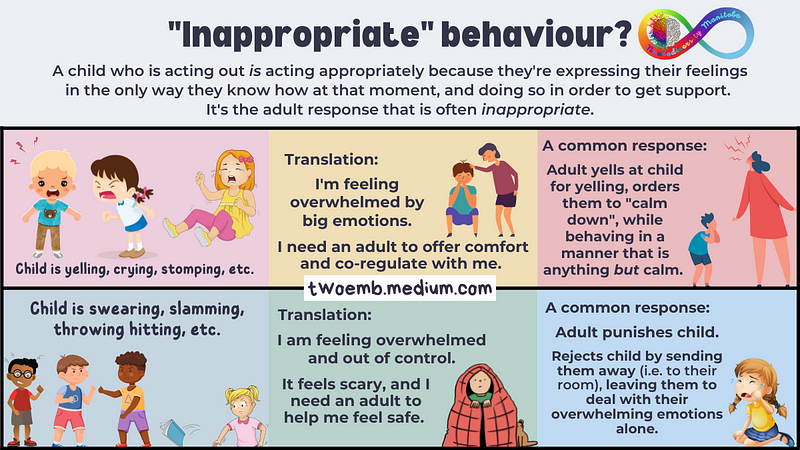
A child who is acting out is acting appropriately because they’re expressing their feelings in the only way they know how at that moment, and doing so in order to get support.
It’s the adult response that is often inappropriate (we’re human too!)
Emotions are necessary for survival
I was doing research for another article, trying to find a scientific definition of emotional dysregulation. Instead what I found was a series of peer-reviewed sources pathologizing intense feelings.
For example, the American Psychological Association defines emotional dysregulation as:
“an extreme or inappropriate emotional response to a situation; it may be associated with bipolar disorders, borderline personality disorder, autism spectrum disorder, psychological trauma, or brain injury.” — APA Dictionary of Psychology
Really, APA, all emotional dysregulation is extreme or inappropriate?
If someone tried to kidnap my son and I beat the hell out of the bad guy, then remained shaken up for days, weeks, even months afterward, wouldn’t that be a reasonable response? The instinct to protect my child and revert to fight mode would be adaptive in that horrible (but hypothetical) scenario.
It’s not our emotions that are extreme or inappropriate, it’s our behavioural responses to those emotions which can lead to trouble.
If, instead, someone cut in line at the coffee shop and I flipped out and assaulted them over a latte, that would be an extreme response. Feeling angry about someone being an asshole is not inappropriate.
Yes, different people have different nervous systems, and some of us experience emotions a lot more intensely than others. This can lead to more extreme behavioural responses, and can cause more suffering for the individual.
“Emotions signal the meaning of an event to us.” — Hughes & Gurney-Smith
Shit happens
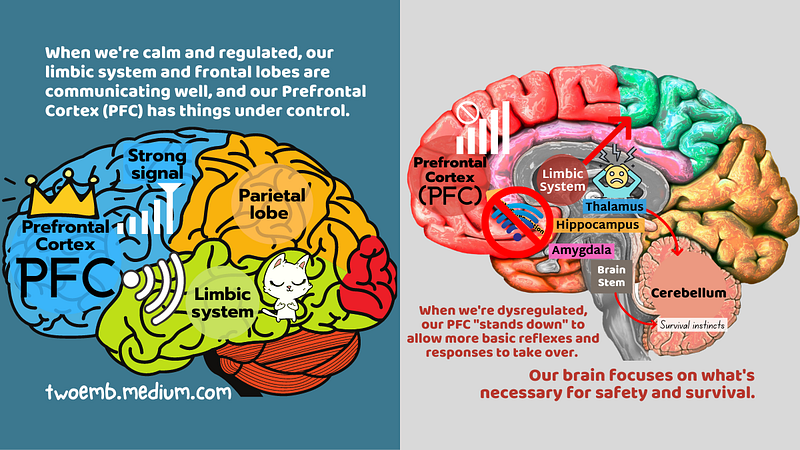
We all become dysregulated sometimes. This happens when the demands in our environment are greater than our ability to deal with them in a calm, skillful manner at that moment in time.
We may cry, shout, stomp our feet, slam doors, or withdraw and shut down. However we respond, when we’re dysregulated, we are less able to think clearly and logically, and are less in control of our thoughts and actions.
The difference is that some of us experience more adverse events, trauma, and stress in our lives. Some people develop healthy, adaptive ways of coping with their emotions, while others do not.
If a person has developed heightened emotional responses as a result of chronic stress or trauma, this too is an adaptive response. When our environment is dangerous or scary, we spend much of our time in survival mode out of necessity.
Once we are in a safe environment, it is not so easy to turn down this alert system, and this is when we become hypervigilant and chronically dysregulated.
“When the amygdala is chronically or repeatedly activated, it starts messing up its predictions about what’s scary and what’s not. The amygdala begins sending false alarms to the other parts of your brain about things that shouldn’t actually be scary.” — Dr. Burke Harris
As Jenny Mundy-Castle, M.S.T, Ed.Spec, ENL, Ed.Lead put it, we have to make mountains out of molehills, because every molehill truly is a mountain.
Situational vs chronic dysregulation
Becoming chronically dysregulated is very different from experiencing situational dysregulation, yet all the scientific research I have found thus far describes any dysregulation as pathological.
Nearly all the research I found on emotional dysregulation was related to borderline personality disorder (BPD), depression, suicidality, and PTSD.
Our emotions are how we make sense of the events in our lives. Emotions help keep us safe, allow us to form connections with important people in our lives, and allow us to feel joy.
Being human means experiencing a wide range of emotions and sometimes getting swept away by them. Sometimes we’ll need a life preserver, and others we can hang on and enjoy the ride.
© Jillian Enright, Neurodiversity MB

When you join medium, as a member you’ll have access to unlimited reads for only $5 per month. If you use my referral link, I’ll earn a small commission, and you’ll earn my undying gratitude.
Related stories
References
Burke Harris, N. (2018). The Deepest Well: Healing the long-term effects of childhood adversity. Houghton Mifflin Harcourt.
Delahooke, M. (2022). Brain-Body Parenting: How to stop managing behaviour and start raising joyful, resilient kids. HarperCollins.


