
Education-Sponsored Gaslighting
Some social-emotional programs are ableist and invalidating

Ever had someone tell you you’re overreacting?
How’d that work out for you?
Did you immediately stop and say “y’know what? You’re right! I was totally blowing this out of proportion, I’m sorry. I will immediately calm myself down and no longer be upset now that you have informed me this is not a big deal.”
Or are you more like me, where a comment like that would elicit a stream of profanities at loud volume, complete with contemptuous body language and wild gesticulation?
If many of us would absolutely hate being told we’re overreacting, why do we constantly do this to others, especially children? In fact, we have entire social-emotional learning programs designed with gaslighting built right in.
For example, you may have seen something like this in an elementary school or classroom:
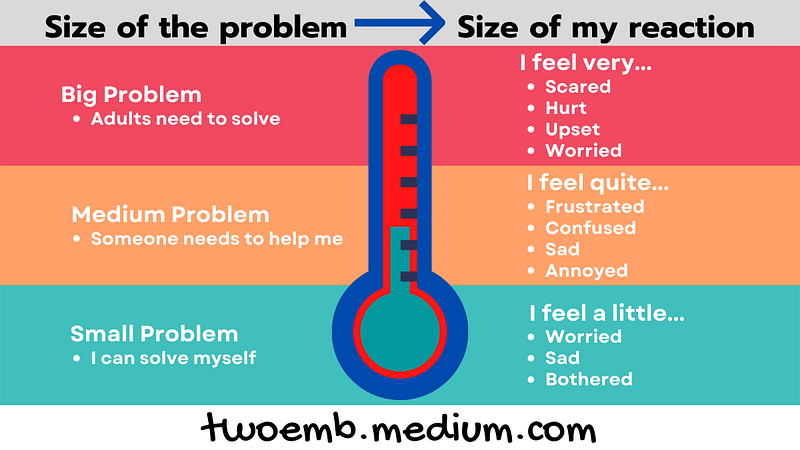
What’s wrong with this?
On the surface, it seems like a good idea: help people identify the specific problem they’re experiencing, take a step back and evaluate whether the problem is really as big as they think it is, then proceed accordingly.
Except…
We seem to forget that feelings and emotions are, by definition, not rational. When we experience intense emotions, this communicates to our nervous system there is a problem.
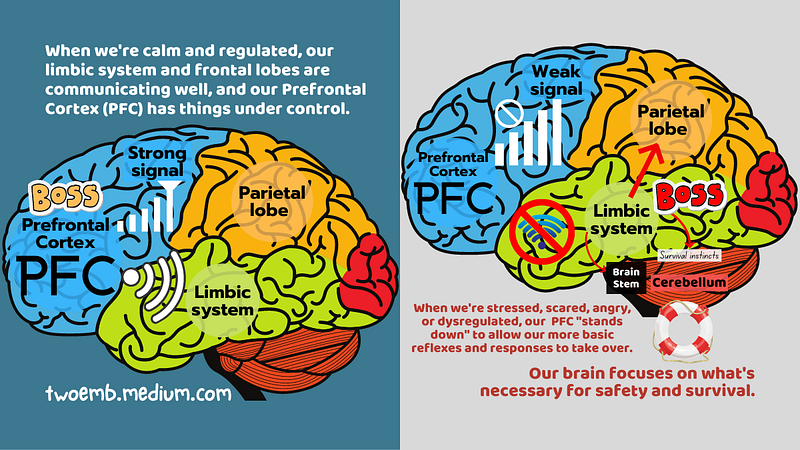
When we become stressed this sends us into fight-or-flight mode. In survival mode, our frontal lobes stand down and let our instincts take charge.
Our frontal lobes include the Prefrontal Cortex (PFC), the part of the brain responsible for logic, complex decision-making, self-control, and rational thought. The PFC is the cell tower that sends and receives signals from all over the brain and helps direct the flow of information to the relevant centres.
The limbic system is the emotion centre of the brain, and includes the amygdala, the area of the brain associated with fear and emotion-driven behaviour. Further back, the cerebellum is responsible for reflexive movements — those actions we take automatically, without even thinking about them.
When our PFC reduces its signal and lets our instincts take over, this means we’re not able to process helpful feedback such as “you’re overreacting”. In that state, we’re not able to self-reflect or self-evaluate because our brain and body are using all available resources to focus on securing our safety.
In these moments, what a very upset person needs is a calm, caring presence to help them regulate. Sometimes that means saying nothing at all, just offering comfort in whatever way works best for that individual.
“We’re able to settle so much better when we have someone who will regulate with us.” — Dr. Jody Carrington
Alright, so you help the person regulate, and then evaluate the size of the reaction compared to the size of the problem…. right?
Wrong.
We don’t choose our nervous systems
Everybody’s brain and body respond differently to stressors, and what one person finds upsetting another may find enjoyable. Some people love rollercoasters, spicy foods, fast cars, and spontaneity — others, not so much.
Sweet versus salty. Phobias, fears, and fetishes. Dark versus bright. Loud versus quiet… you get the idea.
What causes one person to become dysregulated could be something others actually enjoy. For example, my best friend has arachnophobia, she is terrified of spiders. If there is a spider in her house she becomes fearful and anxious.
If I were to tell her she were “overreacting”, she might just throw her shoe at me instead of at the spider (and I would totally deserve it).
My family and I are a bunch of animal lovers, right down to creepy crawlies, and none of us finds spiders offensive or scary.
So for me, a spider in my hair would be in the “green zone”, a small problem that I could easily deal with myself. For my friend, a spider in her hair would be a red-zone emergency requiring immediate assistance before she has a heart attack.
We invalidate children all the time
“Who cares if you have the blue cup or the green cup?” “It doesn’t matter where you sit, just take the open spot.” “You get what you get, and you don’t get upset.”
What if they do get upset? What if they do care which cup they get and where they sit?
If a child is having a meltdown because their favourite shirt is in wash and they’ll just have to pick something else to wear, but that is just not possible because it has to be that shirt — regardless of our opinion on the matter, their feelings are 100% real.
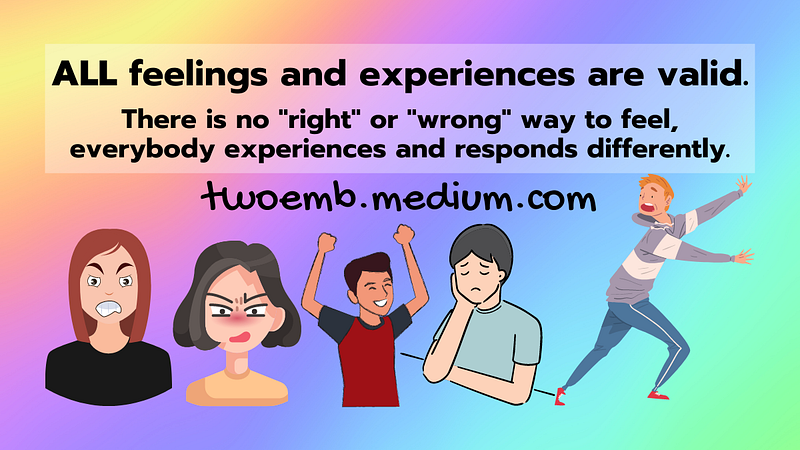
“When another is not receptive to our inner world, and doesn’t attempt to make sense of that inner experience and respond as best they can in a timely and effective manner, we can feel misunderstood, dismissed, unloved, and invisible.” — Siegel & Bryson
Whether I think it’s silly to get upset over a spider or the colour of a cup is irrelevant. The importance of anything and everything is entirely subjective depending on our nervous systems, socialization, and cultural influences.
What’s important is validating the person’s feelings and offering support. If the person is your child, you can later (when they’re calm and regulated), work with them to develop some strategies for helping them calm their bodies when they feel dysregulated.
“We can’t make sense of a consequence or be taught a single thing when we’re dysregulated.” — Dr. Jody Carrington
Teaching emotion regulation skills does not require us to agree with someone’s reason for being upset. We cannot be reflective, introspective, or engage in problem-solving until we are one again receiving regulating signals from our Prefrontal Cortex (PFC).
Neuroception
Neuroception refers to our brain and body subconsciously evaluating and checking our environment for signs of threat or safety. As Dr. Porges explains in Polyvagal Theory, this occurs outside of our awareness.
“The detection of a person as safe or dangerous triggers neurobiologically determined prosocial or defensive behaviours.” — Dr. Porges
Some people’s brains respond more quickly to a perceived threat than others, meaning it doesn’t take much to interfere with the signal between the limbic system and PFC, or for the PFC to stand down and let instincts take over.
There are a number of reasons this can happen. Chronic stress and trauma can change the way the brain responds, making the limbic system over-reactive as a necessary adaptation to the environment.
“When the amygdala is chronically or repeatedly activated, it starts messing up its predictions about what’s scary and what’s not. The amygdala begins sending false alarms to the other parts of your brain about things that shouldn’t actually be scary.” — Dr. Burke Harris
Also, when we focus on encouraging children to become more self-aware, to manage their feelings, and to self-regulate — all of which are important skills — we can lose sight of the bigger picture.
If a child is experiencing a lot of intense feelings and is having difficulty regulating their emotions, perhaps there’s a very good reason for this. In fact, there always is a very good reason for anybody experiencing any emotions, including children. Unfortunately adults tend to assume children are either intentionally acting out, or are overreacting.
“We look only at how we can help students be more resilient, without considering why they need resilience.” — Alex Shervin Venet
The concept of overreacting is entirely subjective.
Neurodevelopment
Neurodevelopmental differences can also lead to differences in the way the brain develops and operates. For example, in ADHD brains the PFC develops approximately 30% later compared to those without ADHD, which can lead to difficulties in regulating our emotions.
As we well know, neither trauma, nor our early neurodevelopment, are something over which we have control. Our subconscious evaluation of our environment is not something over which we have control. Our involuntary reflexive responses are also not within our control (hence the word involuntary).
What is seen as an “appropriate” response changes based on our societal norms and cultural expectations. Sometimes self-control and stoicism are valued, other times exuberance and enthusiasm are welcomed and encouraged — and quite often there isn’t a logical explanation for which is appreciated and which is considered objectionable.
Telling someone the size of their reaction did not match the size of the problem is incredibly invalidating. This sends the message that their feelings and experience are less important than our socio-cultural expectations.
When someone is repeatedly told that their emotional responses are “over the top” or “irrational”, they start to question their own experiences and eventually stop trusting their own feelings. They’ll begin looking to others to see how they “should” respond, rather than having authentic experiences.
This causes us to hide our genuine feelings, which robs us of the opportunity to work through those feelings and then problem-solve if needed. Instead, we suppress our emotions to avoid social judgment and repercussions, but doing so has negative impacts on our physical and mental health.
A significant amount of effort is required to suppress emotional responses. Bottling up our feelings is not the same as processing and regulating our emotions. When we use up resources to contain our feelings, we don’t have the energy left to regulate, problem-solve, or learn from our experiences.
Who benefits?
Working with children can be incredibly exhausting. I’ve never been a teacher, but I’ve worked in schools and classrooms, and I’ve seen and experienced first-hand how difficult it is to remain regulated, focused, engaged, and present for an entire day.
Children are amazing. They’re also demanding, sometimes loud, energetic, curious, and their priorities are not the same as those of adults (which is developmentally appropriate, but makes teaching them more difficult).
I can understand the allure of programs and classroom management strategies that make children more compliant, I do, but research has clearly shown that they are harmful and not helpful for children.
“Students don’t become dysregulated by appointment, they need immediate response to regulate them safely.” — Dr. Lori Desautels
So who benefits from teaching children to control their emotions, to “calm down” and quiet down? To behave calmly, rationally, and to exert self-control? The adults, of course. It is much easier for us when children follow our directions and are regulated.
What is our priority, then? Is our priority to have calm and compliant children, or is it to foster genuine emotional safety and skills?
“They hope that teaching children to regulate their feelings will make it easier for adults to manage them.” — Dr. Val Gillies
In a fantastic article critiquing social-emotional aspects of learning programs (called SEAL), Dr. Val Gillies explains these programs contain a narrow view of “normal” and “rational” emotional expression.
These programs quite often neglect to consider cultural and social differences in the way families and communities support children’s emotional development. This risks pathologizing behaviours of already marginalized students. What is “normal” for one person, family, or cultural group is not the same as what’s typical for others.
Regulate, don’t ruminate
I’m not advising we wallow in our feelings, nor that we ruminate on upsetting events in our lives or in the world at large. What I am saying is that all feelings, experiences, and emotional responses are legitimate and should be validated and accepted.
When we reject someone’s emotions, we make them feel rejected at a time when they need love and support the most.
We can’t control our reflexes, nor what is happening at a subconscious level, but we can provide each other with comfort and caring, and we can help each other work through emotions and solve problems. This will help us develop the skills which allow us to respond more adaptively.
© Jillian Enright, Neurodiversity MB
Related Stories
When you join medium, as a member you’ll have access to unlimited reads for only $5 per month. If you use my referral link, I’ll earn a small commission, and you’ll earn my undying gratitude.
If you’d prefer give a one-time tip, you can support my writing on Ko-Fi — also, it’s free to follow me on Facebook and LinkedIn!
References
Burke Harris, N. (2018). The Deepest Well: Healing the long-term effects of childhood adversity. Houghton Mifflin Harcourt.
Carrington, J. (2020). Kids These Days: A game plan for (re)connecting with those we teach, lead, and love. IMpress Books.
Delahooke, M. (2019). Beyond Behaviors: using brain science and compassion to understand and solve children’s behavioral challenges. PESI Publishing.
Desautels, L. (2020). Connections Over Compliance: Rewiring our perceptions of discipline. Wyatt-MacKenzie Publishing.
Gillies, V. (2011). Social and emotional pedagogies: critiquing the new orthodoxy of emotion in classroom behaviour management. British Journal of Sociology of Education, 32(2), 185–202. https://doi.org/10.1080/01425692.2011.547305
Patel, J., & Patel, P. (2019). Consequences of Repression of Emotion: Physical Health, Mental Health and General Well Being. International Journal of Psychotherapy Practice and Research , 1(3):16–21. https://doi.org/10.14302/issn.2574-612X.ijpr-18-2564
Porges, S. W. (2017). The Pocket Guide to The Polyvagal Theory: The transformative power of feeling safe. W. W. Norton & Company.
Porges, S. W. (2011). The Polyvagal Theory: Neurophysiological foundations of emotions, attachment, communication, and self-regulation. W. W. Norton & Company.
Ruan, Y., Reis, H.T., Zareba, W. et al. (2020). Does suppressing negative emotion impair subsequent emotions? Two experience sampling studies. Motivation and Emotion 44, 427–435. https://doi.org/10.1007/s11031-019-09774-w
Shaw, P., Eckstrand, K., Sharp, W., Blumenthal, J., Lerch, J. P., Greenstein, D., Clasen, L., Evans, A., Giedd, J., & Rapoport, J. L. (2007). Attention-deficit/hyperactivity disorder is characterized by a delay in cortical maturation. Proceedings of the National Academy of Sciences of the United States of America, 104(49), 19649–19654. https://doi.org/10.1073/pnas.0707741104
Siegel, D. J., & Bryson, T. P. (2020). The power of showing up: How parental presence shapes who our kids become and how their brains get wired. Ballantine Books.
Venet, A.S. (2019). Equity-Centred Trauma-Informed Education. W. W. Norton & Company.


