
Interoception And Emotional Regulation
Recognizing how your emotions physically feel in your body

Have you ever been surprised by the sudden intensity of your own emotions? One minute you thought you were calm, cool, and collected, and the next you were flying off the handle?
Just me, then?
(Hopefully not just me).
If this does happen to you, or to someone you love, it could have something to do with a deficit in interoception.
Interoception
Interoception is defined as the sense of the physiological condition of the body, such as conscious awareness, emotional processes, and behaviour related to afferent physiological information arising from the body.
In other words, interoception helps us understand and feel what’s going on inside our bodies, it is our felt experience of the internal workings of the body. Interoception can refer to experiences such as thirst and hunger, or feeling the need to go to the bathroom.
The prefix, inter, also comes from Latin, meaning interior, inside, or in between. I previously wrote about how proprioception and interoception deficits are common amongst neurodivergent individuals.
Another very important function of interoception is awareness of emotions and how we experience them in our bodies. For example, when we get angry we may experience different physical sensations. Some people may feel tense muscles, others feel hot and their face might flush.
Interoception, and being aware of how our body changes in response to our emotions, is an important first step toward emotional regulation.
Emotional Regulation
Emotional regulation is the ability of an individual to modulate an emotion or set of emotions.
In order to regulate our emotions, we must first be able to perceive feedback from our bodies, communicating to us when there is a change. Recent research concluded that awareness of one’s own bodily feelings is of central importance for the effective regulation of emotional responses.
Here’s something you might see on the walls in elementary schools today:
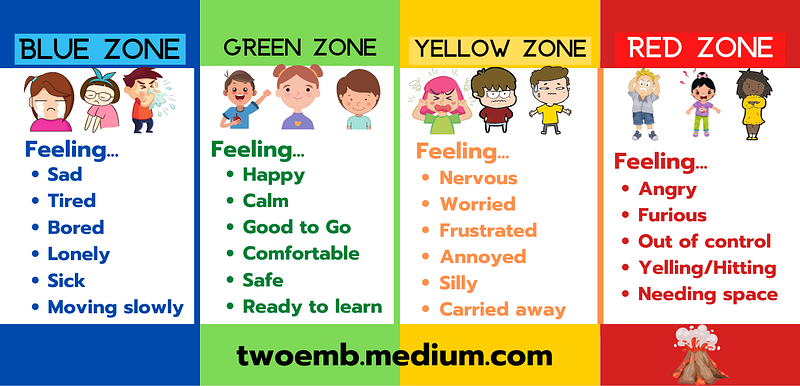
This is a great starting point for children who already know their own physical signs of early dysregulation. Those little hints in our bodies that tell us something isn’t quite right. Do you know yours?
Do you know your subtle, early signs of dysregulation?
Honestly, before we realized my son and I are both neurodivergent, and we started working on these, I thought I was extremely self-aware. We are both highly insightful on an intellectual level and can offer all kinds of useful facts about emotion regulation.
Come to find out, we both have very poor interoception, so we have poor recognition of our early, more subtle signs of dysregulation.
For example, at the end of a stressful day, I would wonder why my neck, shoulders, and jaw were stiff and sore. I didn’t even realize I had been tensing my muscles and clenching my jaw all day.
Here’s what a more helpful physical-and-emotional zones poster might look like (of course, the physical signs will be different for every person):
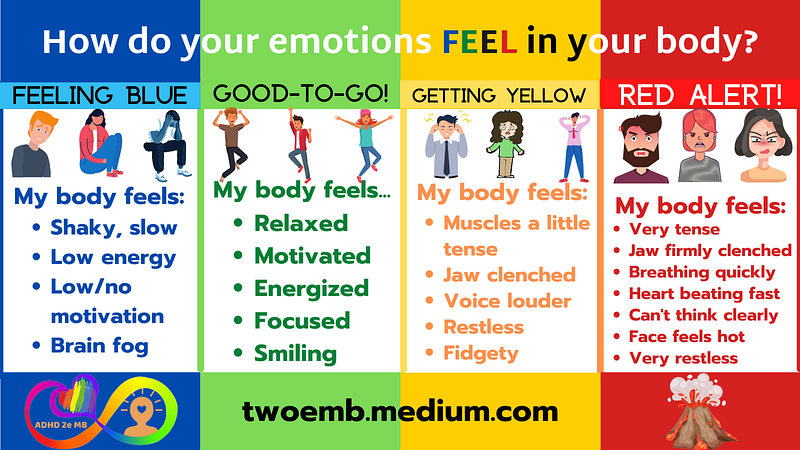
When we’re helping someone develop emotional regulation skills, the first thing we tend to do is come up with plans. For example: when I feel angry, I can do x, y, or z.
My own strategies are:
- Read a book
- Walk my dog
- Drink a cup of coffee
- Listen to music
- Go for a jog
These plans are a great idea, but in order for them to work, the individual has to be able to recognize when they’re just beginning to feel angry (or frustrated, or anxious, or…).
It’s necessary that we engage in our coping, or self-regulation, strategies when we’re in the yellow zone and before we hit the red zone. This means we have to be able to perceive when we’re in the yellow zone.
Before understanding this about myself, I didn’t realize I was getting angry until I was extremely angry. Using the “zones” system, I would have been in the red zone. In this zone, we’re in a fight-flight-or-freeze mode, which causes our entire system to revert back to our reptilian brain.
Our Prefrontal Cortex (PFC) goes offline and hands the controls over to the lower parts of the brain, such as the limbic system, brain stem, and cerebellum. These parts of the brain are responsible for our most basic functions such as movement, alertness, and breathing.
This is an evolutionary necessity because it allows us to rely on our survival instincts. Unfortunately, our “lizard brain” sometimes misreads the situation and kicks into gear when it’s not really necessary. People who have sensitive systems, are neurodivergent, and/or who have experienced trauma, often have highly reactive — or overreactive — brains.
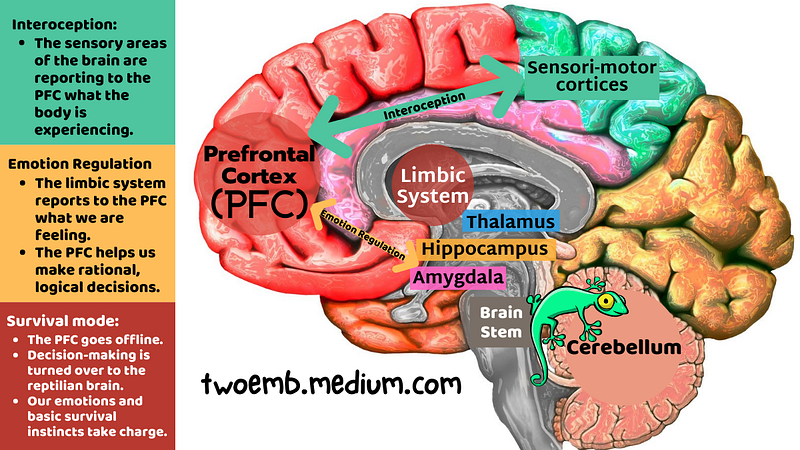
This is necessary when you’re facing a zombie apocalypse or Sharknado, but not so useful when you’re being asked to please turn off the television or pass the salt.
We need to catch ourselves early enough so that we can put our plan into action before our lizard brain takes over and we can no longer access rational decision-making and thinking processes.
Relevance to neurodivergence
There is evidence that people with ADHD and Autism are more likely to have deficits in interoception. This is important to keep in mind when we are asking children, who already have an underdeveloped prefrontal cortex, to utilize skills that are challenging even for adults.
We’re asking people to identify their emotions, remember their coping strategies in the heat of the moment, and then execute their plan. That’s a lot to ask of anyone, let a lone a child, or of anyone who has a neurodevelopmental disorder.
That includes yourself. If you’re an adult who struggles with emotional regulation, first of all, you are most certainly not alone. I used to be extremely hard on myself, which did me no good. I’m still hard on myself, but I now have a better understanding of how my brain works and can use more effective strategies for managing my emotions.
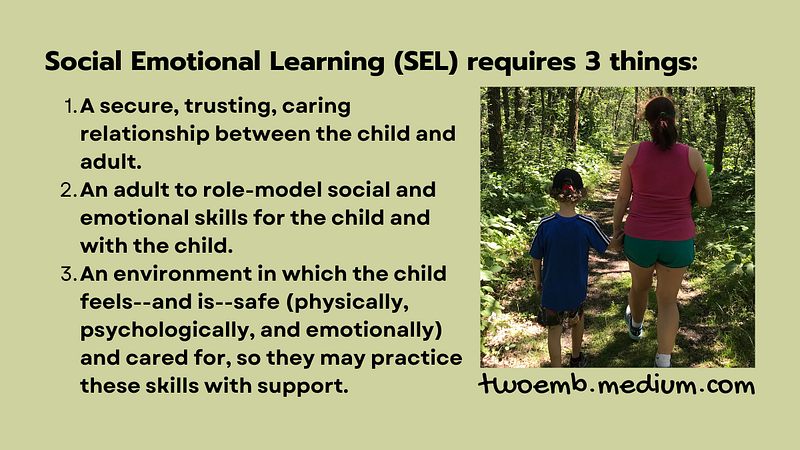
Even more importantly, this helps me co-regulate with my son and role-model healthy ways to deal with big feelings.
© Jillian Enright, Neurodiversity MB
Related Stories
When you join medium, as a member you’ll have access to unlimited reads for only $5 per month. If you use my referral link, I’ll earn a small commission.

References
Ceunen, E., Vlaeyen, J. W. S., Van Diest, I. (2016). On the Origin of Interoception. Frontiers in Psychology, 7, 743. https://doi.org/10.3389/fpsyg.2016.00743
Goodall, E., & Brownlow, C. (2022). Interoception and Regulation: Teaching skills of body awareness and supporting connection with others. Jessica Kingsley Publishers.
Hatfield, T. R., Brown, R. F., Giummarra, M. J., & Lenggenhager, B. (2019). Autism spectrum disorder and interoception: Abnormalities in global integration? Autism, 23(1), 212–222. https://doi.org/10.1177/1362361317738392
Mahler, K. (2016). Interoception: The Eighth Sensory System. AAPC Publishing.
Pinna, T., & Edwards, D. J. (2020). A Systematic Review of Associations Between Interoception, Vagal Tone, and Emotional Regulation: Potential Applications for Mental Health, Wellbeing, Psychological Flexibility, and Chronic Conditions. Frontiers in Psychology, 11, 1792. https://doi.org/10.3389/fpsyg.2020.01792
Schleip, Robert & Jäger, Heike. (2012). Interoception. A new correlate for intricate connections between fascial receptors, emotion and self recognition. Fascia: The Tensional Network of the Human Body. 88–94. Elsevier. https://doi.org/10.1016/B978-0-7020-3425-1.00047-7
Silkenbeumer, J., Schiller, E., Holodynski, M., Kärtner, J. (2016). The Role of Co-Regulation for the development of social-emotional competence. Journal of self-regulation and regulation, 2. https://doi.org/10.11588/josar.2016.2.34351


