avatarJillian Enright

Free AI web copilot to create summaries, insights and extended knowledge, download it at here

7562

Abstract

dmedium.com/v2/resize:fit:800/1*tJ2DjthUE94R0z6Z4Dh-fw.png"><figcaption></figcaption></figure><p id="dabe" type="7">“It’s not easy to help a child feel safe, seen, soothed, and secure when we ourselves feel out of control emotionally.”</p><p id="26fd" type="7">— Siegel & Bryson</p><p id="99dc"><a href="https://readmedium.com/how-to-keep-your-cool-ababce4e29d2"><b>Stay calm</b></a><b>: </b>Keep your body language and voice calm as much as possible. I f you are feeling frustrated, angry, or overwhelmed, ask for support from your co-parent, family member, or a friend if you can.</p><p id="940d">Role-model taking space yourself, or utilizing tools for self-regulation. It’s okay to say “ <i>I’m feeling frustrated right now, I’m going to do [calming strategy], and I will come back to this conversation when I am feeling calm and ready</i>.”</p><p id="3d48">Start low and slow. If a child is in distress, it’s a good idea to <a href="https://www.goodreads.com/book/show/43736726-beyond-behaviors">speak very softly, quietly, gently</a>, and to use as few words as possible.</p><p id="8ff9">When we contain or hold space, we <a href="https://www.goodreads.com/book/show/50232268-the-power-of-showing-up">make it safe for our children</a> to express strong or difficult emotions or thoughts, without reacting ourselves.</p><h2 id="045f">Please do not make threats</h2><ul><li>“If you don’t _______, then _______!”</li><li>This only serves to escalate things and further pushes the child into a fight or flight mode</li></ul><h1 id="895f">Points to Remember:</h1><ul><li><a href="https://readmedium.com/emotional-dysregulation-is-not-always-pathological-bde58c83ec40">Dysregulation</a> can be caused by many factors that are largely outside of the child’s control</li><li>Listen, empathize, validate, and co-regulate</li></ul><p id="9076" type="7">Dysregulation is often caused by factors outside the child’s control.</p><figure id="68be"><img src="https://cdn-images-1.readmedium.com/v2/resize:fit:800/1*qcg5wyyoYK_s_jF4v0Ziaw.png"><figcaption>Image created by author, based on <a href="https://www.youtube.com/watch?v=f-m2YcdMdFw&amp;t=1s">Dr. Dan Siegel’s hand model of the brain</a></figcaption></figure><h1 id="edf3">“Misbehaviour” = STRESS Behaviour</h1><p id="0dbf">When a child is out of control, or is overwhelmed by their emotions, environment, and/or senses, we call the resulting behaviours <i>bottom-up behaviours</i>. These are <a href="https://www.goodreads.com/book/show/43736726-beyond-behaviors">reflexible, automatic responses</a> that do not involve conscious thought.</p><p id="a87b">If a child is highly dysregulated (what we might call experiencing a “<i>meltdown</i>” or “<i>flipping their lid</i>”), they are exhibiting bottom-up behaviours.</p><p id="291c">When someone’s nervous system is in <a href="https://www.goodreads.com/book/show/10353369-the-whole-brain-child">fight or flight mode</a>, they are unable to access and utilize their rational brain. In this state, it is nearly impossible to connect in a caring way with another person.</p><h2 id="40bc">That is NOT the time to:</h2><h2 id="7e84">Discuss their behaviour</h2><ul><li>This will further escalate them</li><li>Their brain is offline and not currently capable of processing that information</li></ul><h2 id="ebb8">Problem solve</h2><ul><li>People cannot problem-solve when the logical and rational part of their brain (PFC) is offline</li><li>This will increase frustration</li></ul><h2 id="9c4e">Use logic to try to talk them out of their feelings.</h2><ul><li><i>…but you love swimming</i>!”</li><li><i>Cmon, you know he didn’t mean that</i></li><li><i>“You’re over-reacting</i></li><li><i>“You’re being silly/dramatic</i></li><li>This is invalidating and the child will not feel heard</li></ul><p id="5583"><b>Feelings are not rational</b>, so don’t expect them to be. A child’s experience is valid and real, even if they seem to us to be over-reacting. Their perception of events may be inaccurate, but their feelings are 100% real.</p><p id="f3b3">The facts and logic can be dealt with once everyone is calm and safe, worry about that later. When a child is upset, logic often won’t work until we have first responded to their emotional needs (Siegel & Bryson, 2011).</p><p id="04f2" type="7">Remember: A child’s feelings may not make sense to us, but they are 100% real.</p><p id="4ecf">Feelings are important and should definitely be recognized as such, but we also should recognize that they are <a href="https://www.goodreads.com/book/show/50232268-the-power-of-showing-up">flowing and changing</a> throughout our lives, and throughout our day.</p><h1 id="989e">Stress = Fight or Flight Response</h1><p id="08c0">When people experience high levels of stress, their brains and bodies go into the fight or flight response.</p><p id="4d58">The subconscious perception of safety and threat underlies these behaviours, which are adaptive and emerge from the instinctive <a href="https://www.goodreads.com/book/show/43736726-beyond-behaviors">drive toward self-protection</a>.</p><p id="f65a">The goal during this time is to help the child feel safe so that they can regulate (aka “calm down”) and get their <a href="https://doi.org/10.1037/bul0000096">PFC</a> back online.</p><p id="1eb1">As <a href="https://www.goodreads.com/book/show/43736726-beyond-behaviors">Dr. Delahooke says</a>, “<i>safety is in the eye of the beholder</i>.” What’s important is the child’s own <i>perception</i> and feeling of safety — not what the adults think <i>should </i>constitute relational or environmental safety.</p> <figure id="b8f1"> <div> <div> <img class="ratio" src="http://placehold.it/16x9"> <iframe class="" src="https://cdn.embedly.com/widgets/media.html?src=https%3A%2F%2Fwww.youtube.com%2Fembed%2Ff-m2YcdMdFw%3Fstart%3D1%26feature%3Doembed%26start%3D1&amp;display_name=YouTube&amp;url=https%3A%2F%2Fwww.youtube.com%2Fwatch%3Fv%3Df-m2YcdMdFw&amp;image=https%3A%2F%2Fi.ytimg.com%2Fvi%2Ff-m2YcdMdFw%2Fhqdefault.jpg&amp;key=a19fcc184b9711e1b4764040d3dc5c07&amp;type=text%2Fhtml&amp;schema=youtube" allowfullscreen="" frameborder="0" height="480" width="854"> </div> </div> </figure></iframe></div></div></figure><h1 id="6d2d">Keep Calm and Regulate On</h1><ul><li>Take a slow, deep breath before responding</li><li>Speak calmly and softy, using as few words as possible</li><li>When the brain is in flight or flight, they won’t hear most of what you are saying.</li><li>The brain will focus in on certain words that either confirm or deny their sense of safety.</li><li>Get down to the child’s level (if safe to do so — keep a safe distance if needed)</li><li>Convey the message “<i>I’m going to help keep you safe</i></li><li>Model the calm you want to see in the child</li></ul><p id="4b5a">An essential part of tolerable stress is whether it has a beneficial or adverse effect depends largely on whether the person <a href="https://www.goodreads.com/book/show/50232268-the-power-of-showing-up">receives the <b>support</b></a> to handle it.</p><h1 id="425e">Points to Remember:</h1><ul><li>Feelings are not rational.</li><li>A child’s experience is valid even if they seem to us to be over-reacting.</li><li>Their feelings are 100% real.</li><li>The facts and logic can be dealt with once everyone is calm.</li></ul><figure id="9461"><img src="https://cdn-images-1.readmedium.com/v2/resize:fit:800/1*sng2l2tY853EC6Yfdw6jkQ.png"><figcaption></figcaption>

Options

</figure><h1 id="6a7e">When the Dust Finally Settles…</h1><ul><li>Try your best not to take the child’s behaviour personally</li><li>Even if they were trying to hit you or calling you names</li><li>You can absolutely express that their behaviour hurt your feelings or made you feel unsafe</li><li>It’s important to remember that the child’s brain is completely offline during a meltdown and they are not in full control of their behaviour</li></ul><h1 id="c9f9">Mona Delahooke and Looking Beyond Behaviours</h1> <figure id="a5a0"> <div> <div> <img class="ratio" src="http://placehold.it/16x9"> <iframe class="" src="https://cdn.embedly.com/widgets/media.html?src=https%3A%2F%2Fwww.youtube.com%2Fembed%2FQ6X3RAOi-ek%3Fstart%3D1%26feature%3Doembed%26start%3D1&amp;display_name=YouTube&amp;url=https%3A%2F%2Fwww.youtube.com%2Fwatch%3Fv%3DQ6X3RAOi-ek&amp;image=https%3A%2F%2Fi.ytimg.com%2Fvi%2FQ6X3RAOi-ek%2Fhqdefault.jpg&amp;key=a19fcc184b9711e1b4764040d3dc5c07&amp;type=text%2Fhtml&amp;schema=youtube" allowfullscreen="" frameborder="0" height="480" width="854"> </div> </div> </figure></iframe></div></div></figure><h1 id="7a82">When considering prevention:</h1><p id="33bf">Think in terms of problem-solving and reconciliation, rather than punishment</p><p id="afb8">Part two (or is it part four?) of our blog series on preventing and supporting children whose behaviour can become quite challenging when they are dysregulated is available <a href="https://readmedium.com/challenging-behaviours-in-children-c0b26d037451">here</a>.</p><p id="08e4">© Jillian Enright, Neurodiversity MB</p><h1 id="4966">Related Articles</h1><div id="473c" class="link-block"> <a href="https://readmedium.com/how-to-keep-your-cool-ababce4e29d2"> <div> <div> <h2>Keeping Our Cool With Our Loved Ones</h2> <div><h3>Strategies for remaining calm when our children are experiencing intense emotions</h3></div> <div><p>medium.com</p></div> </div> <div> <div style="background-image: url(https://miro.readmedium.com/v2/resize:fit:320/1*W-QcDUw0b9aMfyEI0S6QCA.jpeg)"></div> </div> </div> </a> </div><div id="9ea0" class="link-block"> <a href="https://readmedium.com/punishment-does-not-work-e37e7175ba86"> <div> <div> <h2>“Punishment” Does. Not. Work.</h2> <div><h3>Before you read the title and dismiss the premise, I am not advocating for a “permissive” style of parenting.</h3></div> <div><p>medium.com</p></div> </div> <div> <div style="background-image: url(https://miro.readmedium.com/v2/resize:fit:320/1*7lphKed755bR5etCwmiZFg.jpeg)"></div> </div> </div> </a> </div><div id="b982" class="link-block"> <a href="https://readmedium.com/punishments-dont-teach-skills-c709873e3db0"> <div> <div> <h2>Punishments Don’t Teach Skills</h2> <div><h3>Okay, maybe one: They teach people how to be better at avoiding punishment.</h3></div> <div><p>medium.com</p></div> </div> <div> <div style="background-image: url(https://miro.readmedium.com/v2/resize:fit:320/1*k-YmTYDhgD11sofeB4Ozyg.png)"></div> </div> </div> </a> </div><p id="8049"><i>When you join medium, as a member you’ll have access to unlimited reads for only $5 per month. If you use <a href="https://twoemb.medium.com/membership">my referral link</a>, I’ll earn a small commission, and you’ll earn my undying gratitude.</i></p><figure id="8657"><img src="https://cdn-images-1.readmedium.com/v2/resize:fit:800/1*CJSg24mr-ZlpyFoVl4nCig.png"><figcaption></figcaption></figure><p id="6346"><i>If you’d prefer give a one-time tip, you can <a href="https://ko-fi.com/neurodiversitymb">support my writing on Ko-Fi</a> — also, it’s free to <a href="https://facebook.com/NeurodiversityMB">follow me on Facebook</a> and <a href="https://linkedin.com/in/adhd2emb">LinkedIn</a>!</i></p><h2 id="2f54">Learn more</h2><div id="b185" class="link-block"> <a href="https://readmedium.com/exploring-emotional-co-regulation-ec56d43dbebe"> <div> <div> <h2>Exploring Emotional Co-Regulation</h2> <div><h3>Co-regulation is essential for any relationship</h3></div> <div><p>medium.com</p></div> </div> <div> <div style="background-image: url(https://miro.readmedium.com/v2/resize:fit:320/1*Wy0-gvXWeLonIMMHXG7B_g.jpeg)"></div> </div> </div> </a> </div><div id="751f" class="link-block"> <a href="https://readmedium.com/challenging-behaviours-in-children-c0b26d037451"> <div> <div> <h2>Help With Challenging Behaviours in Children</h2> <div><h3>Supporting children and working through challenging behaviours</h3></div> <div><p>medium.com</p></div> </div> <div> <div style="background-image: url(https://miro.readmedium.com/v2/resize:fit:320/1*BjgoCIb35l1nu25Hmy4U0Q.png)"></div> </div> </div> </a> </div><div id="84e7" class="link-block"> <a href="https://readmedium.com/stop-calling-children-defiant-just-stop-2f77df540df6"> <div> <div> <h2>Stop Calling Children “Defiant”</h2> <div><h3>It’s a harmful, inaccurate label that often stigmatizes developmentally and situationally appropriate behaviour</h3></div> <div><p>medium.com</p></div> </div> <div> <div style="background-image: url(https://miro.readmedium.com/v2/resize:fit:320/1*I7g_entq-v_iL03BBvxueg.jpeg)"></div> </div> </div> </a> </div><h2 id="3feb">References</h2><p id="713c">Delahooke, M. (2019). <i>Beyond Behaviors: using brain science and compassion to understand and solve children’s behavioral challenges</i>. PESI Publishing.</p><p id="bdb3">Desautels, L. (2020). <i>Connections Over Compliance: Rewiring our perceptions of discipline</i>. Wyatt-MacKenzie Publishing.</p><p id="afbc">Dixon, M. L., Thiruchselvam, R., Todd, R., &amp; Christoff, K. (2017). Emotion and the prefrontal cortex: An integrative review. <i>Psychological Bulletin, 143</i>(10), 1033–1081. <a href="https://psycnet.apa.org/doi/10.1037/bul0000096">https://doi.org/10.1037/bul0000096</a>.</p><p id="574f">Greene, Ross, W. (2021). <i>Lost &amp; Found: Unlocking collaboration and compassion to help our most vulnerable, misunderstood students, and all the rest</i>. (2nd ed.). Jossey-Bass.</p><p id="cfaa">Shanker, S., &amp; Barker, T. (2016). <i>Self-reg: how to help your child (and you) break the stress cycle and successfully engage with life.</i> Penguin Press.</p><p id="5d9f">Siegel, D. J., &amp; Bryson, T. P. (2020). <i>The power of showing up: How parental presence shapes who our kids become and how their brains get wired</i>. Ballantine Books.</p><p id="4d03">Siegel, Daniel, J., &amp; Bryson, T. P. (2011). <i>The Whole Brain Child</i>. Random House.</p></article></body>

Positive Parenting | Psychology

Misbehaviour is Really Stress Behaviour

Supporting children through big feelings and challenging behaviours
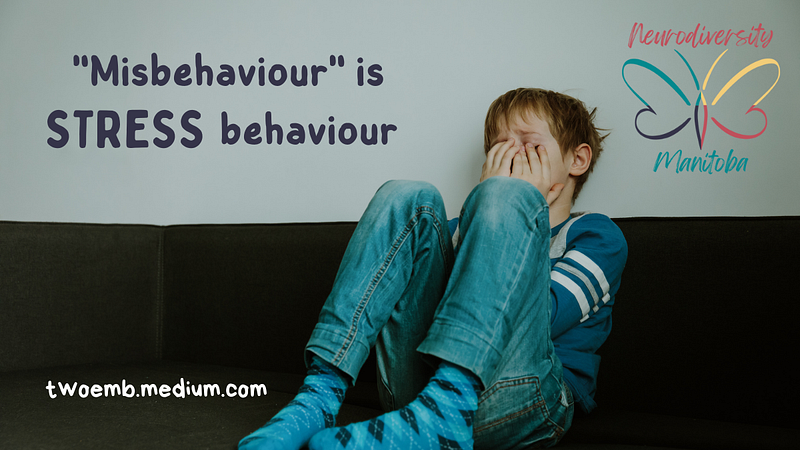
This is a two-part blog series focusing on preventing and supporting children whose behaviour can become quite challenging when they are dysregulated.

Actually, it’s part three of a four-part blog series, and then part one of a two-part blog series… because one topic led me into another, and they’re all related… Also, because ADHD, guys. Obviously.

The most recent related post was Punishments Don’t Teach Skills and I’ll list all the related posts at the end of this one.

Misbehaviour is Stress Behaviour

“The concept of misbehaviour is fundamentally tied to those of volition, choice, and awareness.”

— Siegel & Bryson

This assumes that the child willingly chose to act the way he did. The thing is, stress behaviour is physiologically based.

“The behaviour is just the signal… If caregivers are focused only on modifying behaviour, then all they’re modifying is the signal. But they’re not solving any of the problems that are causing the signal” — Dr. Ross Greene

When someone is emotionally dysregulated, they are not capable of deliberately choosing their actions or aware, in a rational way, of what they are doing.

Dysregulation refers to experiences like having BIG feelings and emotions, feeling out of control, feeling highly emotional, and experiencing an intense emotional response.

“A child who seems to be misbehaving is, in the process, adapting and surviving.”

— Dr. Mona Delahooke

Many neurodiverse people experience their emotions very intensely and can become dysregulated more easily than neurotypical people.

Parents and adults, please remember: As difficult and challenging (and exhausting) it can be for us to support and co-regulate with a child who experiences extreme dysregulation, it is even more distressing for the child, who doesn’t have the cognitive development to understand and regulate these experiences. It can be scary to lose control of oneself.

Image by Bill Watterson

Be Proactive

These strategies can help all children, not just neurodiverse children:

  • Define expectations before heading to an activity
  • Give children a “heads up” before transitions whenever possible
  • “We need to leave for school in 10 minutes, so please make sure you have everything ready that you need.”
  • “Five minutes ’til dinner, guys!”

Dysregulation Happens (to everyone)

Dysregulation can happen for many reasons:

  • Sensory overload: too hot, too cold, too loud, too bright, too everything
  • Anxiety / Fear
  • Frustration, sadness, hurt feelings
  • Not feeling well

When a Child is Upset / Dysregulated

Please do NOT:

  • Ignore or reject the child.

“When we are ignored as human beings, it decreases our emotional links to other people, who should be our life rafts when we are suffering.”

— Dr. Mona Delahooke

  • “Planned” ignoring is still ignoring.
  • Forcing them to isolate from the family as a form of punishment is rejection.
  • Sending a child to their room or to a “time out” can be (but is not always) a form of rejection*.
  • It may send the message that they are not wanted when they are experiencing big feelings, and that they will not be supported when they have these big feelings.

*That is not to say that we can’t or shouldn’t teach our children to take space when they need it.
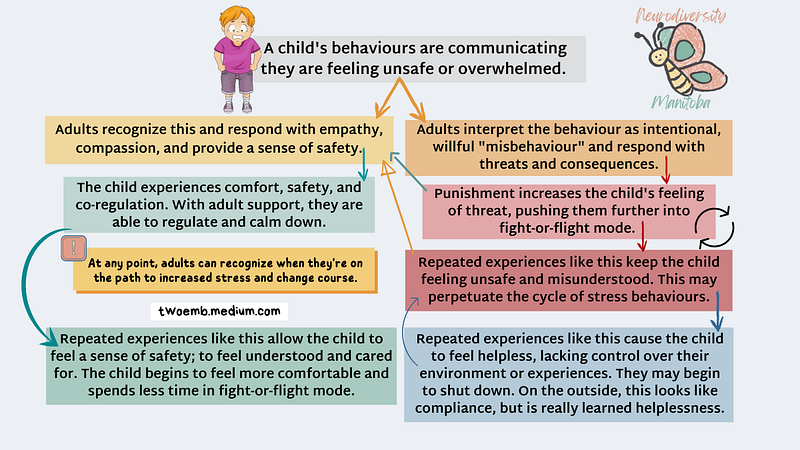
Created by author

When they need it.

The difference is that we’re teaching our child a skill and giving them tools for self-regulation, but in the mean time, we need to co-regulate with them.

Co-regulation happens when we help our children to regulate their emotions by soothing, comforting, and supporting them. Emotional co-regulation is attuning to and supporting another person through our presence.

Co-regulation is a relational dyadic exchange that exudes feelings of safety and belonging. Co-regulation requires the adult to maintain a calm brain during the conflict.

We also teach emotional regulation skills by practicing and role-modelling them for our children.

“Emotional co-regulation comes first, and this is how emotional self-regulation is developed.”

— Dr. Mona Delahooke

Supporting a child to take space and time to regulate, empathizing with their feelings, and staying with them if they want or need you to will help preserve the relationship, their dignity, and their self esteem.

It’s important to emphasize the message, “I didn’t like that behaviour, but I still love you.”

Please also do not dismiss their feelings or experience

  • “It’s not a big deal”
  • “Don’t worry about it!”
  • “That’s not what happened”
  • Tell them to “calm down”
  • Never in the history of calming down has anyone calmed down by being told to calm down.
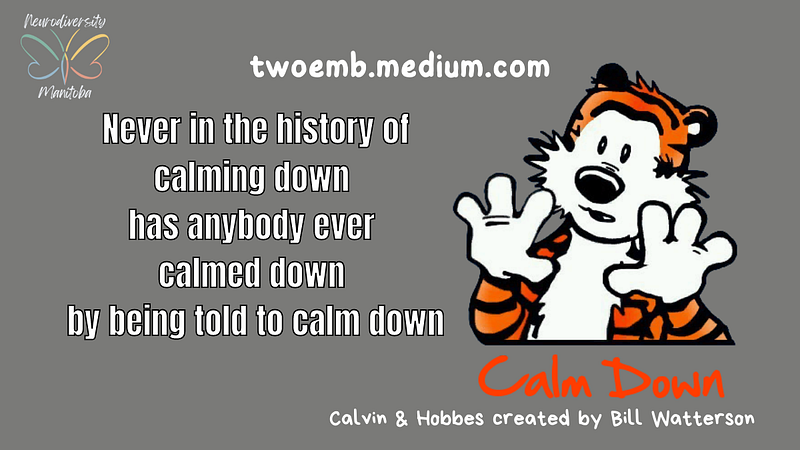
Created by author — (Calvin & Hobbes created by Bill Watterson)
  • Take care to not become dysregulated yourself (easier said than done, trust me, I know)

“Walk beside them through their pain, helping them see they are strong enough to handle a difficult situation and come out okay. “

— Siegel & Bryson

A dysregulated adult cannot co-regulate with, or help regulate (i.e. calm), a dysregulated child.
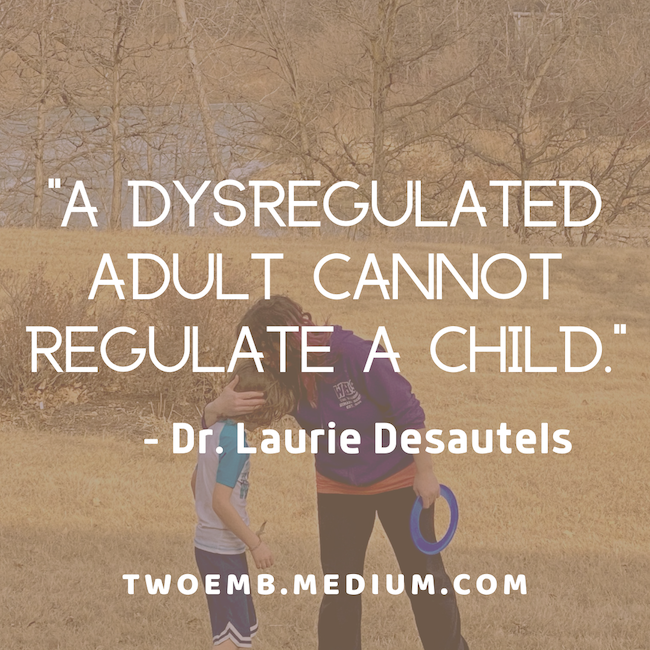
“It’s not easy to help a child feel safe, seen, soothed, and secure when we ourselves feel out of control emotionally.”

— Siegel & Bryson

Stay calm: Keep your body language and voice calm as much as possible. I f you are feeling frustrated, angry, or overwhelmed, ask for support from your co-parent, family member, or a friend if you can.

Role-model taking space yourself, or utilizing tools for self-regulation. It’s okay to say “ I’m feeling frustrated right now, I’m going to do [calming strategy], and I will come back to this conversation when I am feeling calm and ready.”

Start low and slow. If a child is in distress, it’s a good idea to speak very softly, quietly, gently, and to use as few words as possible.

When we contain or hold space, we make it safe for our children to express strong or difficult emotions or thoughts, without reacting ourselves.

Please do not make threats

  • “If you don’t _______, then _______!”
  • This only serves to escalate things and further pushes the child into a fight or flight mode

Points to Remember:

  • Dysregulation can be caused by many factors that are largely outside of the child’s control
  • Listen, empathize, validate, and co-regulate

Dysregulation is often caused by factors outside the child’s control.
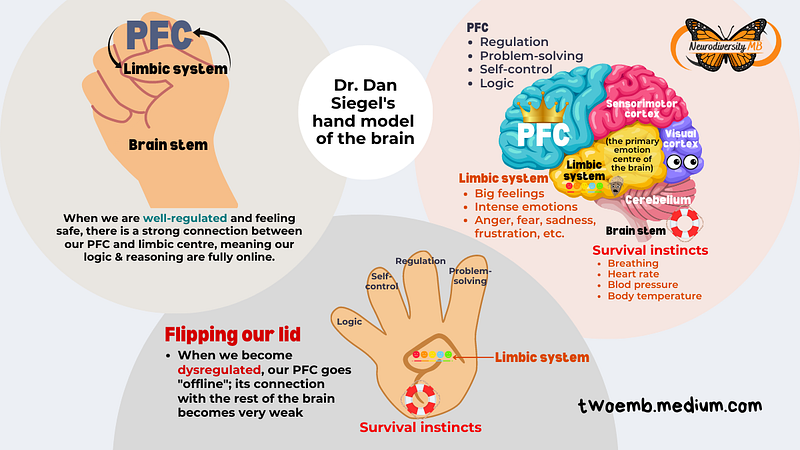
Image created by author, based on Dr. Dan Siegel’s hand model of the brain

“Misbehaviour” = STRESS Behaviour

When a child is out of control, or is overwhelmed by their emotions, environment, and/or senses, we call the resulting behaviours bottom-up behaviours. These are reflexible, automatic responses that do not involve conscious thought.

If a child is highly dysregulated (what we might call experiencing a “meltdown” or “flipping their lid”), they are exhibiting bottom-up behaviours.

When someone’s nervous system is in fight or flight mode, they are unable to access and utilize their rational brain. In this state, it is nearly impossible to connect in a caring way with another person.

That is NOT the time to:

Discuss their behaviour

  • This will further escalate them
  • Their brain is offline and not currently capable of processing that information

Problem solve

  • People cannot problem-solve when the logical and rational part of their brain (PFC) is offline
  • This will increase frustration

Use logic to try to talk them out of their feelings.

  • …but you love swimming!”
  • Cmon, you know he didn’t mean that
  • “You’re over-reacting
  • “You’re being silly/dramatic
  • This is invalidating and the child will not feel heard

Feelings are not rational, so don’t expect them to be. A child’s experience is valid and real, even if they seem to us to be over-reacting. Their perception of events may be inaccurate, but their feelings are 100% real.

The facts and logic can be dealt with once everyone is calm and safe, worry about that later. When a child is upset, logic often won’t work until we have first responded to their emotional needs (Siegel & Bryson, 2011).

Remember: A child’s feelings may not make sense to us, but they are 100% real.

Feelings are important and should definitely be recognized as such, but we also should recognize that they are flowing and changing throughout our lives, and throughout our day.

Stress = Fight or Flight Response

When people experience high levels of stress, their brains and bodies go into the fight or flight response.

The subconscious perception of safety and threat underlies these behaviours, which are adaptive and emerge from the instinctive drive toward self-protection.

The goal during this time is to help the child feel safe so that they can regulate (aka “calm down”) and get their PFC back online.

As Dr. Delahooke says, “safety is in the eye of the beholder.” What’s important is the child’s own perception and feeling of safety — not what the adults think should constitute relational or environmental safety.

Keep Calm and Regulate On

  • Take a slow, deep breath before responding
  • Speak calmly and softy, using as few words as possible
  • When the brain is in flight or flight, they won’t hear most of what you are saying.
  • The brain will focus in on certain words that either confirm or deny their sense of safety.
  • Get down to the child’s level (if safe to do so — keep a safe distance if needed)
  • Convey the message “I’m going to help keep you safe
  • Model the calm you want to see in the child

An essential part of tolerable stress is whether it has a beneficial or adverse effect depends largely on whether the person receives the support to handle it.

Points to Remember:

  • Feelings are not rational.
  • A child’s experience is valid even if they seem to us to be over-reacting.
  • Their feelings are 100% real.
  • The facts and logic can be dealt with once everyone is calm.
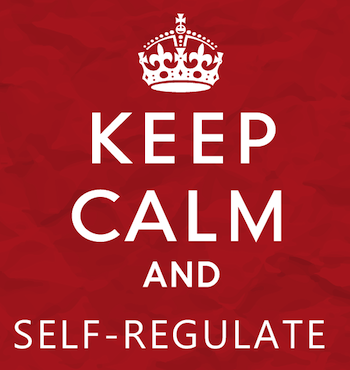
When the Dust Finally Settles…

  • Try your best not to take the child’s behaviour personally
  • Even if they were trying to hit you or calling you names
  • You can absolutely express that their behaviour hurt your feelings or made you feel unsafe
  • It’s important to remember that the child’s brain is completely offline during a meltdown and they are not in full control of their behaviour

Mona Delahooke and Looking Beyond Behaviours

When considering prevention:

Think in terms of problem-solving and reconciliation, rather than punishment

Part two (or is it part four?) of our blog series on preventing and supporting children whose behaviour can become quite challenging when they are dysregulated is available here.

© Jillian Enright, Neurodiversity MB

Related Articles

When you join medium, as a member you’ll have access to unlimited reads for only $5 per month. If you use my referral link, I’ll earn a small commission, and you’ll earn my undying gratitude.
If you’d prefer give a one-time tip, you can support my writing on Ko-Fi — also, it’s free to follow me on Facebook and LinkedIn!

Learn more

References

Delahooke, M. (2019). Beyond Behaviors: using brain science and compassion to understand and solve children’s behavioral challenges. PESI Publishing.

Desautels, L. (2020). Connections Over Compliance: Rewiring our perceptions of discipline. Wyatt-MacKenzie Publishing.

Dixon, M. L., Thiruchselvam, R., Todd, R., & Christoff, K. (2017). Emotion and the prefrontal cortex: An integrative review. Psychological Bulletin, 143(10), 1033–1081. https://doi.org/10.1037/bul0000096.

Greene, Ross, W. (2021). Lost & Found: Unlocking collaboration and compassion to help our most vulnerable, misunderstood students, and all the rest. (2nd ed.). Jossey-Bass.

Shanker, S., & Barker, T. (2016). Self-reg: how to help your child (and you) break the stress cycle and successfully engage with life. Penguin Press.

Siegel, D. J., & Bryson, T. P. (2020). The power of showing up: How parental presence shapes who our kids become and how their brains get wired. Ballantine Books.

Siegel, Daniel, J., & Bryson, T. P. (2011). The Whole Brain Child. Random House.

Neurodiversity
Adhd
Mental Health
Parenting
Psychology
Recommended from ReadMedium