
Positive Parenting
Punishments Don’t Teach Skills
Okay, maybe one: They teach people how to be better at avoiding punishment.
This is the second in a three-part series on problems with using punishment, and non-punitive ways to help children with challenging behaviours. If you haven’t read our first part, “Punishment Does Not Work”, click here.
We All Need Skills, Not Shame
If a child is not responding adaptively to a situation, or an expectation, then they must be lacking the skills to respond adaptively. The behaviour is just the signal that something is not working for them (Greene, 2021).
I run my own business and have a handful of part-time staff. If I ask them to perform a task for which I have not prepared nor trained them, and for which they do not have adequate education or experience, and they make a mistake, whose fault is it?
Mine.
Okay, they’re adults, so if I ever ask something of my staff that unfair or unrealistic, I would hope they would speak up and ask for further training or information. However, it is my responsibility to ensure my staff are properly trained to perform any duties that fall under their job description.
If they do make a mistake in that circumstance, should I reprimand them? Would that help them do better next time, if I do nothing further to prepare them?
I, along with my colleagues, had experiences like that when we were new employees, inexperienced youth workers fresh out of college. You know what happened there? Most of us burnt out and many of us quit.
How is it fair to punish our children for mistakes, if we haven’t provided them the skills to do better? What does that do for our relationships with them, for their perceptions of themselves, and for their ability to grow as individuals?
I’m glad you asked.
What Punishment Actually Accomplishes
Punishment may teach people to fear punishment — or worse, the punisher. When the person doling out punishment is an adult on whom child is reliant, that can be pretty scary.
An adult losing their cool and punishing a child may teach that child to do the same when things don’t go their way.
I’m not only talking about corporal or physical punishment, I’m talking about any adult-imposed punishment intended to stop or suppress a behaviour.
Punishments do not teach skills. They use threat, intimidation, and manipulation to coerce children into doing what we want.
“Traditional discipline can inadvertently escalate negative behaviours because survival brains cannot process rewards, consequences, or reason.”
— Dr. Lori Desautels
As I explained in my previous article, punishment usually doesn’t do what we want it to do, which is change someone’s behaviour.
As experts like Dr. Ross Greene, Alfie Kohn, L.R. Knost, and many others have been trying to teach us for decades: misbehaviour comes from missing skills. Misbehaviour does not need to be punished. Children need to be taught, guided, supported, and given options for what they can do instead.
Chase the Why
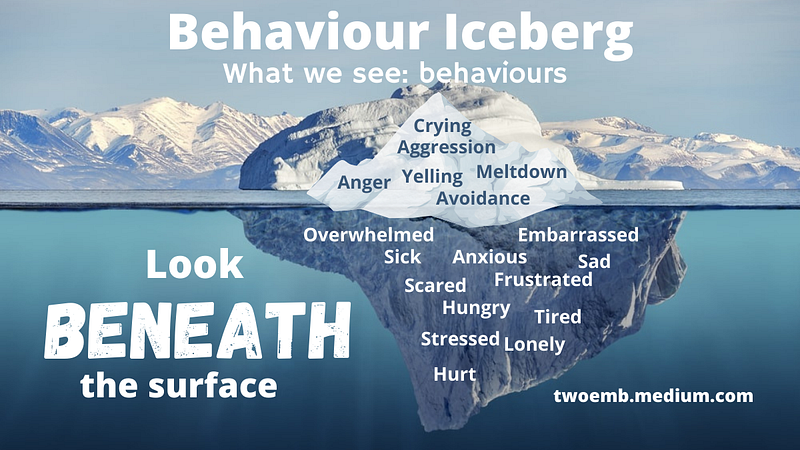
If a child is doing something you don’t like, or behaviour another adult doesn’t like, first ask why?
- Is the adult frustrated because they aren’t getting their way?
- Is the adult annoyed because the child is not immediately complying with their demand(s)
- Are you, or your co-parent, embarrassed by the behaviour?
- Does the behaviour actually need to change, or can the environment change to fit the needs of the child?
- Are the expectations even realistic for the child’s developmental age and stage?
- Is the child trying to communicate a need?
- What skill(s) is the child missing to be able to follow through with what is expected?
Punishing a child for any of the above reasons (which are usually the primary reasons) is unfair and, again, ineffective.
It never fails.
A parent posts a question in an online forum, for example, asking for advice. Their child isn’t following the rules around screen time, what should they do? The answers, inevitably, go something like this:
- Take away screens forever! Lock them up for good!
- Hide the remotes! Hide the controllers!
- Hide the power cord!
- Put passwords and padlocks on all of the things!
Okay… and then what? An adult will have to monitor and gate-keep all electronic devices and their use for the foreseeable future, until they get tired of it and the child goes back to the same behaviours with no new skills learned? Alternatively, the child learns how to work around these systems and learns to sneak their screens, instead of ask for them?
Both are distinct possibilities.
Let me be clear, I am absolutely not advocating for unlimited screen time (nor am I advocating for a permissive, let them do whatever they want style of parenting). I am a strong proponent of very limited screen time, especially in young children, and we have quite stringent boundaries around screens in our household. However, we didn’t come to these limits by locking everything up. We sat down as a family, discussed our concerns, our goals, and discussed the risks and benefits of screen use.
Do we have perfect harmony, even when we enforce these boundaries? Absolutely not (I wish!). We’re a family of humans, two of whom are 2e, there are definitely still challenges with pretty much any boundary.
That said, our son is (mostly) much more accepting of limits when he’s been included in the conversation: The reasons behind the limits have been discussed and explained, his perspective has been heard, and his feelings respected and validated.
Note that respecting and validating feelings are not the same as giving in because a child is upset. We all need to learn boundaries, but sometimes we need a little help working through feelings of disappointment.
Let’s Try Another Example
My child is disrespectful when I tell him “ no”, what do I do?
- Take away his privileges!
- Force him to write a letter of apology!
- Don’t let him think he rules the roost, put him in his place!
Let’s look at some possible reasons children may speak to adults in a disrespectful manner:
Possibility #1: Big Feelings
They’re angry, upset, disappointed, or their feelings are hurt.
They may not yet know how to express this in a calmer, kinder manner, or their self-regulation may not be developed enough to use these skills when they are experiencing intense emotions. And many neurodivergent children tend to feel their emotions very intensely.
They may also be feeling scared, stressed, or overwhelmed.
“Too often, caregivers, teachers, providers, and parents assume that a child is acting deliberately, when in fact a behavior is actually a stress response.”
—Dr. Mona Delahooke
A child who is misbehaving is, in the process, adapting and surviving (Delahooke, 2019).
In particular, children with ADHD can have significant struggles with emotional regulation. This is due to that delayed Prefrontal Cortex (PFC) development mentioned in our other blog post, and certainly not something over which children have any control.
Jessica McCabe created a great video about ADHD and Emotional Dysregulation on her How to ADHD YouTube channel:
Possibility #2: Impulsivity
Remember: Divergent brains develop differently from neurotypical brains, that’s why we’re called neurodivergent.
Impulsivity is a key feature of ADHD and is caused by differences in the brain’s wiring: A significant difference between an ADHD brain and a non-ADHD brain is the weakened or disrupted signal between the Thalamus (responsible for response inhibition) and the Frontal Cortex (responsible for decision-making). Another biological factor over which we have no control.
A child who responds by kicking over his chair, yelling obscenities, and stomping out of the room is clearly lacking some strategies for dealing with disappointment and managing their intense feelings.
They also likely reacted impulsively, meaning without stopping to think first. This may be because their brain’s communication between their thalamus and frontal cortex is not as developed as that of a neurotypical child, which again, would be something over which they have no control.
That’s all well and good, but…
If we’re not suggesting punishment or adult-imposed “ consequences” for knocking over a chair and calling you a name, then what do we suggest?
First, if your child has stomped to their room or to some other safe space, awesome! Why is it awesome that they slammed their door and told you to “go away?” in less-than flowery language? Because they’ve taken space to cool off, and if they’re in their room writing bad things about you in their journal or listening to angry music then cool, because those are some ways that people self-regulate.
Even better if they have a calming kit or “chill zone: a safe space they have chosen for themselves (or worked with you to set up), possibly with a soft blanket or pillow, sensory items, books they like to read, or whatever works to help them calm down when they feel overwhelmed.
Below is an example of one of the calm down menus we have created with our son when he was younger. These options were developed with him, in conversations while he was calm, and that have been adapted and adjusted as he gets older and develops different preferences, needs, and skills.

The best way for children to learn how to self-regulate is for the adult to help them do so by providing acknowledgement and validation of their feelings, support and comfort, and then role-modelling healthy ways of dealing with our emotions.
(I have some fantastic book and podcast recommendations on another blog post, many of the books listed include strategies for supporting children with emotional regulation and for dealing with challenging behaviours).
Decide what needs to happen
- Do the adults need to adjust their expectations to be more in line with the child’s developmental age and their current skills?
- Are there adjustments that can be made to the environment to set the child up for success?
- What need is the child trying to communicate with their behaviour, and how can we meet that need?
- What stressors are in the child’s life that are contributing to the behaviour?
- What skills need to be taught to allow the child to meet realistic and fair expectations?
Collaborate with your Child
Once cooler heads prevail, it’s time to dig into what is contributing to the behaviour.
Dr. Ross Greene has an amazing approach called Collaborative and Proactive Solutions (CPS), in which the child and adult(s) come together to identify and communicate their concerns, then work as a team to come up with reasonable and mutually-agreeable solutions (Greene, 2021).
It’s certainly not a panacea: There often need to be multiple conversations, multiple potential options for solutions, and the plan often needs to be re-worked. This approach teaches children communication, problem-solving, and teamwork skills. It also allows them to work through their feelings, but not stew in them, as they then focus on possible solutions alongside trusted adults in their lives.
Dr. Greene’s Lives in the Balance website has extensive CPS resources for parents, educators, and other professionals.
Learn Everything You Can
Seriously, the old adage that knowledge is power is an old adage for good reason.
Understanding the “ why” behind your child’s behaviour not only helps you problem-solve and support them more effectively, it also helps you show them more compassion and empathy. Instead of viewing behaviours purely as difficulties we need to get rid of, it’s helpful to see them as forming an instruction manual for how to support each child (Delahooke, 2019).
Become an expert on your child. If they have ADHD, read all of the things on ADHD (preferably all of the evidence-based, well-researched, well-written things).
The more you understand the biology, psychology, neurology, every-ology about your child, the better you will be able to regulate how you respond to them. Instead of “ why on earth did you do that?!” you’ll be able to say to yourself: “ I know why they did that. I still don’t like it, but at least I know they didn’t do it just to be a jerk” (or something along those lines).
Lose your temper, yell, fail, fall down, dust yourself off, and try again
Seriously. It’s going to happen, so expect it and be kind to yourself. This parenting thing is hard, and it can be even harder with neurodivergent children. Build yourself a community — however big or small you prefer — of like-minded parents, caring friends, family, and supportive people to lean on when you need someone.
Apologize to your child when you do lose your cool. This is not showing weakness: Apologizing is showing strength, it is role-modelling taking responsibility and making amends when we mess up, because we all do.
“It is powerful when we can model an observation of our own mistake and then model how we take responsibility for it.”
— Linda K. Murphy
Even the most patient and nurturing of parents have bad days and imperfect families. We can do everything right and our child might still have a meltdown.
Apologize to your child when you lose your cool. Apologizing shows strength, taking responsibility, and making amends when we mess up. Because we all do.
Go easy on yourself and on your child because the world will be hard enough on us all.
© Jillian Enright, Neurodiversity MB
When you join medium, as a member you’ll have access to unlimited reads for only $5 per month. If you use my referral link, I’ll earn a small commission, and you’ll earn my undying gratitude.
If you’d prefer give a one-time tip, you can support my writing on Ko-Fi — also, it’s free to follow me on Facebook and LinkedIn!

Related Articles
Misbehaviour is STRESS Behaviour
Help with Challenging Behaviours in Children
Punishing Unwanted Behaviour Makes it Worse
Setting Up Chill Zones and Calming Corners

References
Delahooke, M. (2019). Beyond Behaviors: using brain science and compassion to understand and solve children’s behavioral challenges. PESI Publishing.
Desautels, L. (2020). Connections Over Compliance: Rewiring our perceptions of discipline. Wyatt-MacKenzie Publishing.
Greene, Ross, W. (2021). Lost & Found: Unlocking collaboration and compassion to help our most vulnerable, misunderstood students, and all the rest. (2nd ed.). Jossey-Bass.
Murphy, L. K. (2020). Declarative Language Handbook: Using a thoughtful language style to help kids with social learning challenges feel competent, connected, and understood.

Further Resources
I have compiled an extensive list of resources, both local here in Manitoba, and online.
We also have a large recommended reading list on another article that I add to regularly.


