
ADHD, Autism, And Emotions
Why neurodivergent folks often struggle with dysregulation

Emotional Dysregulation
Why do Autistics and people with ADHD seem to get worked up so easily?
Why do we seem to be more “sensitive” than others, more emotional, or hot-tempered?
Well, it’s actually pretty complicated…
Never enough
I mean, we’re constantly told we’re “too” this, “not enough” that, or somehow doing things wrong.
We also frequently find ourselves in environments where others don’t “get” us.
Like, at all.
They don’t understand our needs or communication.
They don’t understand executive dysfunction and why it makes things so difficult.
People are always telling us we just need to “try harder”.
And that’s just the beginning…
Neurological differences
In addition to those social and environmental challenges, we also have neurological differences which impact our ability to regulate our emotions.
People with Autism and ADHD (and other divergent neurotypes) have less effective communication between our Prefrontal Cortex (PFC — the control centre of the brain) and our limbic centre, which is primarily responsible for emotions.
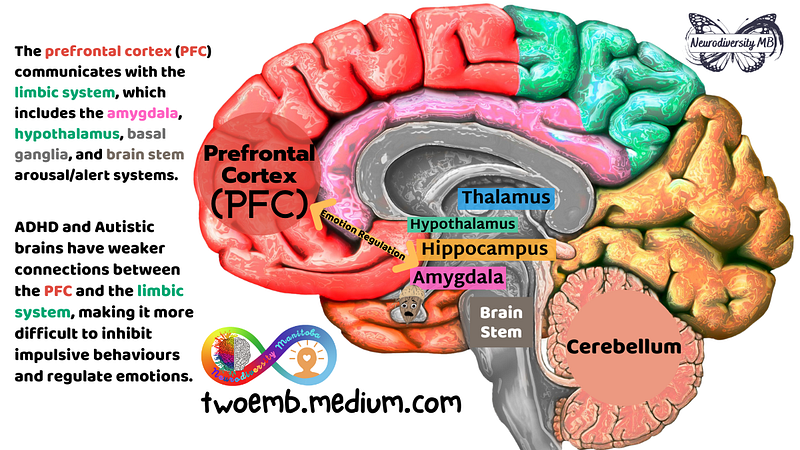
The PFC is the part of the brain which helps us slow down and think things through before acting, while the limbic system is primarily responsible for our emotional responses.
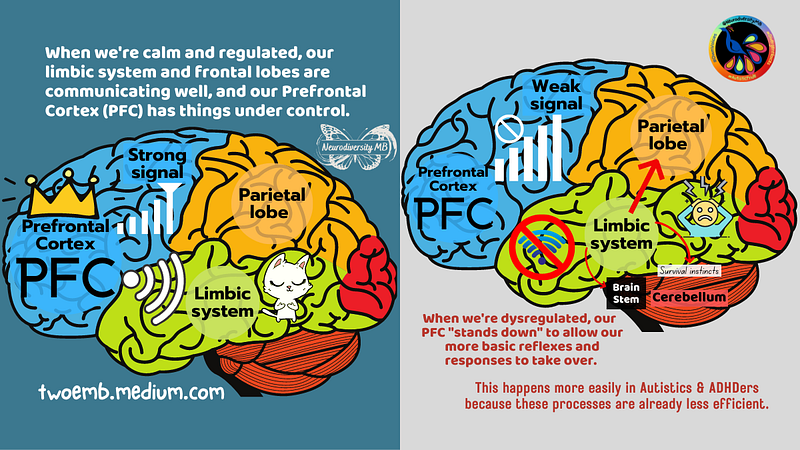
When we’re calm and regulated, our limbic system and frontal lobes are communicating well, and our Prefrontal Cortex (PFC) has things under control. This means we don’t get overwhelmed by our emotions because we can use logic and reason to process and work through whatever comes our way.
When we’re stressed, scared, angry, or dysregulated, our PFC “stands down” to allow our more basic reflexes and responses to take over.
This happens more easily in Autistics and ADHDers because these processes are already less efficient, and because we often encounter increased daily stressors due to the incompatibility between our needs and our environments.
This is all before we even talk about conditions which commonly co-occur with Autism and ADHD, such as anxiety, depression, OCD, and sleep disorders — among many others.
Here’s The Good News
The good news is we can develop strategies to better manage our emotions, to take care of ourselves, and reduce our stress levels so we are better able to handle situations that arise.
Things that help:
- Having supportive and understanding people in our lives.
- Access to good healthcare (both mental health support and physical health care).
- Access to affirming information about our neurotype, and practical help for managing associated challenges.
- Self-care strategies (and the time and resources to actually engage in self-care).
In the heat of the moment
- Engage in a grounding exercise: intense sensory input — like splashing cold water on your face or drinking very cold water — can help bring you back to your senses.
- Take a gulp of fresh air. You don’t have to go for a walk if you’re not up for it, just stick your head outside and breathe, feel the sun on your face or the breeze blowing.
- Play that funky music. If you enjoy music and it tends to affect you quite a bit, you may find that blasting some “feel good” music helps bring you out of your raging brain (hell, if blasting heavy metal works, go for it — whatever helps you).
- Shake it off. If, like me, you’re not a fan of T-swift, that’s okay (in fact, I fully support your decision). I mean this in the literal sense. Shake out your hands, wave them, jump up and down, stretch, touch your toes, then reach your hands up to the ceiling. Move however your body wants to move.
(Yes, these are types of stimming, and polyvagal theory demonstrates why stimming is regulating—and this is partly why it’s an important regulation tool for Autistics!)
It’s not all bad
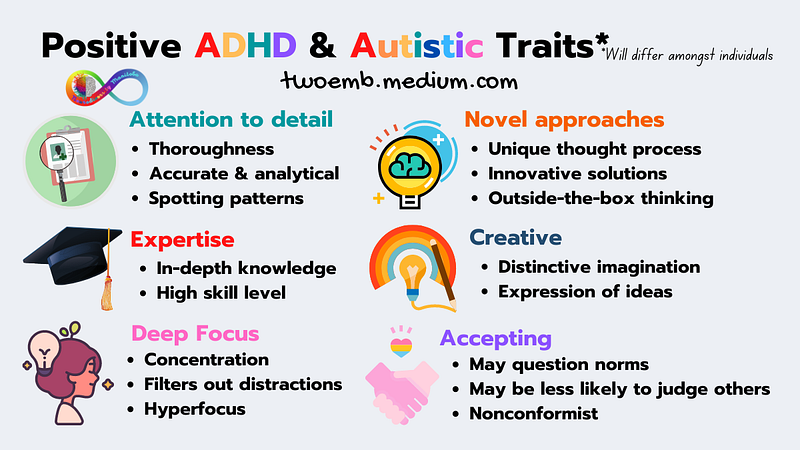
Let’s not forget there are also many strengths and assets that come with divergent brains. Like any difference, there are both pros and cons — challenges and advantages to thinking, processing, and experiencing things in a unique way.
© Jillian Enright, Neurodiversity MB
Related Articles
When you join medium, as a member you’ll have access to unlimited reads for only $5 per month. If you use my referral link, I’ll earn a small commission, and you’ll earn my undying gratitude.
If you’d prefer give a one-time tip, you can support my writing on Ko-Fi — also, it’s free to follow me on Facebook and LinkedIn!
Learn more
References
Porges, S. W. (2017). The Pocket Guide To Polyvagal Theory: The transformative power of feeling safe. W. W. Norton & Company.
Porges, S. W. (2011). The Polyvagal Theory: Neurophysiological foundations of emotions, attachment, communication, self-regulation. W. W. Norton & Co.


