avatarJillian Enright

Free AI web copilot to create summaries, insights and extended knowledge, download it at here

3986

Abstract

parent, I wasn’t making it a priority for a very long time, and it remains a challenge for me to do so consistently.</p><p id="ca19">Instead, if I do get frustrated or lose my temper, I often blame myself as though it were a character flaw. I expect myself to simply <i>be more patient</i> through sheer willpower, rather than seeing low tolerance for what it really is: depleted emotional resources.</p><p id="8185">Everyone has a finite amount of emotional resources, such as patience and tolerance. Some people have a longer fuse than others, admittedly mine is often very short, but there are ways we can increase the length of our fuses, and self-care is key.</p><figure id="82cb"><img src="https://cdn-images-1.readmedium.com/v2/resize:fit:800/1*wcFzxs-4Q3e5DL3zLm9hIw.png"><figcaption>Created by author</figcaption></figure><p id="76f5">I have learned — the hard way,<i> of course </i>— that I am a kinder, gentler person when I have taken time to replenish and recharge. Some of my self-care strategies are:</p><ul><li>Playing sports</li><li>Regular exercise</li><li>Camping</li><li>Canoeing/kayaking</li><li>Spending time outdoors</li><li>Hiking</li><li>Music</li><li>Reading a good book</li><li>Coffee or wine with my best friend</li><li>My dogs</li><li>Eating well (<i>ugh</i>)</li></ul><p id="a26d">I take stimulant medication for my ADHD which tends to suppress appetite. Ironically, I also suffer from hypoglycemia, and my blood sugar drops too low quickly and easily.</p><p id="2ba6">If I don’t eat I get <i>hangry</i>, and then if I still don’t eat, I get weak and shaky. I tend to drink a lot of coffee, get hyperfocused on something (like this blog, for example), and forget to eat altogether.</p><p id="cf70"><i>Actually, that reminds me… </i>(BRB).</p><h2 id="40f3">Follow the dopamine… and the research</h2><p id="3ecf">Something I keep saying I <i>should</i> do is try mindfulness. I’ve learned a lot about it academically and I’ve tried the odd mindfulness podcast, but I haven’t really delved into it in a meaningful way.</p><p id="acee">Many recent studies have demonstrated various benefits of practicing mindfulness, in particular for people with ADHD, and for those with mental health issues.</p><p id="39e1">One <a href="https://doi.org/10.1177/1087054719896865">study showed</a> that mindfulness facilitated an increase of self-compassion, leading to improved mental health in adults with ADHD, and another <a href="https://www.frontiersin.org/article/10.3389/fpsyg.2021.660845">study concluded</a> that mindfulness meditation increased performance in executive functioning tasks in children and youth.</p><p id="34df">Still another <a href="https://doi.org/10.1007/s12671-020-01512-5">study demonstrated</a> that mindfulness helped to reduce symptoms of anxiety, depression, and stress in adults.</p><p id="85bf">As we all likely recognize, knowing something is very different from actually putting it into practice. This writing is my public declaration in order to be held accountable: For the remainder of this summer, I will set aside at least 5 minutes each day to engage in and practice mindfulness.</p><h1 id="d371">Your Turn</h1><p id="6aab">What fills you up? What is your <a href="https://readmedium.com/self-care-makes-us-better-parents-partners-871de9f92fae">self-care</a> promise to yourself? Feel free to share in the comments if you want an accountability partner!</p><figure id="3fb4"><img src="https://cdn-images-1.readmedium.com/v2/resize:fit:800/1*7on7Ym0Ne4sVNDFq4ZjWgQ.png"><figcaption>Created by author</figcaption></figure><p id="24a1" type="7">What is your self-care promise to yourself?</p><p id="07ca">© Jillian Enright, Neurodiversity MB</p><figure id="a6e3"><img src="https://cdn-images-1.readmedium.com/v2/resize:fit:800/1*leyEPpi7hFxrQwZPx6loyA.png"><figcaption></figcaption></figure><p id="7281"><i>When you join medium, as a member you’ll have access to unlimited reads for only $5 per month. If you use <a href="https://t

Options

woemb.medium.com/membership">my referral link</a>, I’ll earn a small commission, and you’ll earn my undying gratitude.</i></p><p id="c63f"><i>If you’d prefer give a one-time tip, you can <a href="https://ko-fi.com/neurodiversitymb">support my writing on Ko-Fi</a> — also, it’s free to <a href="https://facebook.com/NeurodiversityMB">follow me on Facebook</a>!</i></p><h1 id="ef88">Related Articles</h1><div id="b051" class="link-block"> <a href="https://readmedium.com/self-care-makes-us-better-parents-partners-871de9f92fae"> <div> <div> <h2>Self Care Makes Us Better Parents, Partners, And Professionals</h2> <div><h3>It’s not a tired old cliché — okay, it is, but it’s still true</h3></div> <div><p>medium.com</p></div> </div> <div> <div style="background-image: url(https://miro.readmedium.com/v2/resize:fit:320/1*zfuveK3c74qUADk6mQ7lXg.png)"></div> </div> </div> </a> </div><div id="833a" class="link-block"> <a href="https://readmedium.com/avoiding-summer-holiday-burnout-e4b0cd9418a9"> <div> <div> <h2>Avoiding Holiday Burnout</h2> <div><h3>Advice for fellow Autistic-ADHD-anxious-introverts</h3></div> <div><p>medium.com</p></div> </div> <div> <div style="background-image: url(https://miro.readmedium.com/v2/resize:fit:320/1*eX574Osbm_2JobU7gz5CDw.png)"></div> </div> </div> </a> </div><div id="79af" class="link-block"> <a href="https://readmedium.com/how-to-keep-your-cool-ababce4e29d2"> <div> <div> <h2>Keeping Our Cool With Our Loved Ones</h2> <div><h3>Strategies for remaining calm when our children are experiencing intense emotions</h3></div> <div><p>medium.com</p></div> </div> <div> <div style="background-image: url(https://miro.readmedium.com/v2/resize:fit:320/1*W-QcDUw0b9aMfyEI0S6QCA.jpeg)"></div> </div> </div> </a> </div><div id="c7fd" class="link-block"> <a href="https://readmedium.com/exploring-emotional-co-regulation-ec56d43dbebe"> <div> <div> <h2>Exploring Emotional Co-Regulation</h2> <div><h3>Co-regulation is essential for any relationship</h3></div> <div><p>medium.com</p></div> </div> <div> <div style="background-image: url(https://miro.readmedium.com/v2/resize:fit:320/1*Wy0-gvXWeLonIMMHXG7B_g.jpeg)"></div> </div> </div> </a> </div><h2 id="a77b">References</h2><p id="6ffb">Bigelow, H., Gottlieb, M., Ogrodnik, M., Graham, J., Fenesi, B. (2021). The Differential Impact of Acute Exercise and Mindfulness Meditation on Executive Functioning and Psycho-Emotional Well-Being in Children and Youth With ADHD. <i>Frontiers in Psychology, 12</i>, 2157. [DOI: <a href="https://doi.org/10.3389/fpsyg.2021.660845].">https://doi.org/10.3389/fpsyg.2021.660845</a>].</p><p id="8803">Geurts, D. E. M., Schellekens, M. P. J., Janssen, L., & Speckens, A. E. M. (2021). Mechanisms of Change in Mindfulness-Based Cognitive Therapy in Adults With ADHD. <i>Journal of Attention Disorders, 25</i>(9), 1331–1342. [<a href="https://doi.org/10.1177/1087054719896865">https://doi.org/10.1177/1087054719896865</a>].</p><p id="9768">Strohmaier, S., Jones, F.W. & Cane, J.E. (2021). Effects of Length of Mindfulness Practice on Mindfulness, Depression, Anxiety, and Stress: a Randomized Controlled Experiment. <i>Mindfulness</i> <i>12</i><b>, </b>198–214. [<a href="https://doi.org/10.1007/s12671-020-01512-5">https://doi.org/10.1007/s12671-020-01512-5</a>].</p></article></body>

Parenting | Mental Health

Caring for ourselves enables us to better care for our children

Me and My Mini-Me

Photo credit: Peggy Venter

The importance of self-care is something we caregivers tend to understand intellectually, but which many of us have trouble putting into practice.

Myself (very much) included.

Self-care is necessary, not selfish

Those of us who work with children and families — and most of us who are parents — know that when our children are struggling, or have challenges in their lives, the first place to start looking for solutions is with us, the adults.

In order for us to be ready and able to support our children, we also need to take care of ourselves. This is important for everyone, but is especially true for caregivers with their own mental health issues, disabilities, or neurodifferences.

My 8 year old son is a mini-me. He is spirited (a.k.a. stubborn and strong-willed), curious, intelligent, cynical, and energetic. He is adventurous and impulsive. He is certainly not afraid to “speak truth to power”, as they say — in fact, I think he quite enjoys it. My son is 2e, he is gifted with ADHD and anxiety, just like me.

On the upside, this really helps me understand him on a deeper level. My husband is neurotypical, and a lot of times I understand what is going on in my son’s head better than my husband can, because I’ve been there to some degree.

The downside is that the struggles my son faces are often the same difficulties that I myself am trying to work on.
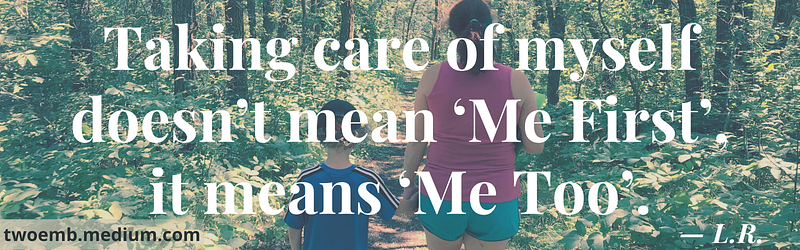
Photo by author’s husband

We are both learning to pick our battles in life (and with each other, really). We both struggle with rejection sensitivity, anxiety, impulsivity, impatience, and emotional regulation… to name but a few.

I believe we both get better at all of these every day, and I have learned a lot over the past couple of decades. I have grown thanks to academics, reading, experience, and most of all, through parenting my son.

And yet…

I am human, and a neurocomplex human at that, so I am always going to have my own issues to deal with, in addition to supporting my son. Taking care of my mental health as a parent while parenting a mini-me is difficult at the best of times, and it can feel damn near impossible when I’m really struggling, which of course is when I need it most.

When I am at my best, I can be much more patient and compassionate. If my son is struggling with emotional dysregulation, I can take a deep breath, then offer comfort and co-regulate with him. I can stay calm(ish) rather than getting frustrated and escalating right along with him, which is counter-productive, but oh-so-hard to avoid sometimes.
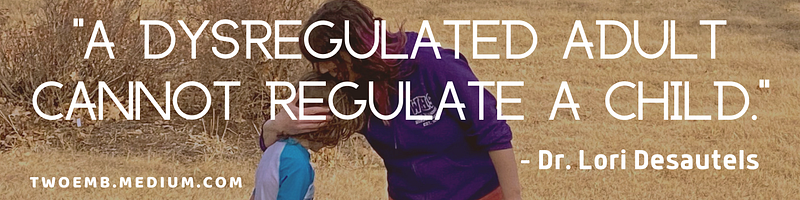
Photo by author’s husband

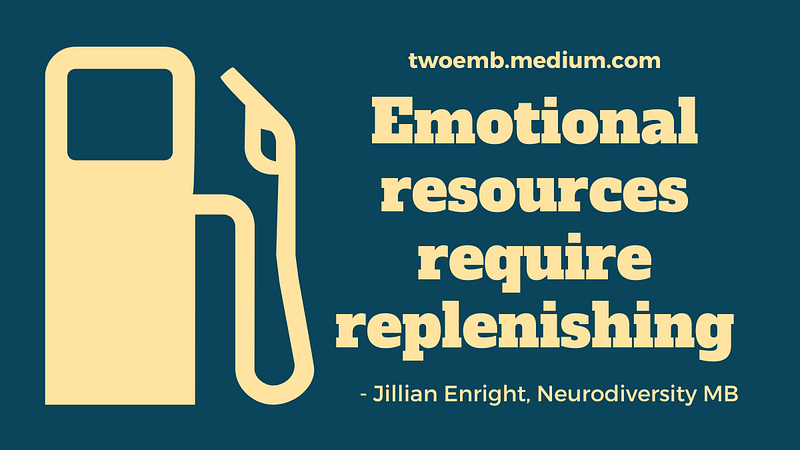
Emotional resources require replenishing

Despite knowing intellectually that self-care helps me to be a better parent, I wasn’t making it a priority for a very long time, and it remains a challenge for me to do so consistently.

Instead, if I do get frustrated or lose my temper, I often blame myself as though it were a character flaw. I expect myself to simply be more patient through sheer willpower, rather than seeing low tolerance for what it really is: depleted emotional resources.

Everyone has a finite amount of emotional resources, such as patience and tolerance. Some people have a longer fuse than others, admittedly mine is often very short, but there are ways we can increase the length of our fuses, and self-care is key.
Created by author

I have learned — the hard way, of course — that I am a kinder, gentler person when I have taken time to replenish and recharge. Some of my self-care strategies are:

  • Playing sports
  • Regular exercise
  • Camping
  • Canoeing/kayaking
  • Spending time outdoors
  • Hiking
  • Music
  • Reading a good book
  • Coffee or wine with my best friend
  • My dogs
  • Eating well (ugh)

I take stimulant medication for my ADHD which tends to suppress appetite. Ironically, I also suffer from hypoglycemia, and my blood sugar drops too low quickly and easily.

If I don’t eat I get hangry, and then if I still don’t eat, I get weak and shaky. I tend to drink a lot of coffee, get hyperfocused on something (like this blog, for example), and forget to eat altogether.

Actually, that reminds me… (BRB).

Follow the dopamine… and the research

Something I keep saying I should do is try mindfulness. I’ve learned a lot about it academically and I’ve tried the odd mindfulness podcast, but I haven’t really delved into it in a meaningful way.

Many recent studies have demonstrated various benefits of practicing mindfulness, in particular for people with ADHD, and for those with mental health issues.

One study showed that mindfulness facilitated an increase of self-compassion, leading to improved mental health in adults with ADHD, and another study concluded that mindfulness meditation increased performance in executive functioning tasks in children and youth.

Still another study demonstrated that mindfulness helped to reduce symptoms of anxiety, depression, and stress in adults.

As we all likely recognize, knowing something is very different from actually putting it into practice. This writing is my public declaration in order to be held accountable: For the remainder of this summer, I will set aside at least 5 minutes each day to engage in and practice mindfulness.

Your Turn

What fills you up? What is your self-care promise to yourself? Feel free to share in the comments if you want an accountability partner!

Created by author

What is your self-care promise to yourself?

© Jillian Enright, Neurodiversity MB

When you join medium, as a member you’ll have access to unlimited reads for only $5 per month. If you use my referral link, I’ll earn a small commission, and you’ll earn my undying gratitude.

If you’d prefer give a one-time tip, you can support my writing on Ko-Fi — also, it’s free to follow me on Facebook!

Related Articles

References

Bigelow, H., Gottlieb, M., Ogrodnik, M., Graham, J., Fenesi, B. (2021). The Differential Impact of Acute Exercise and Mindfulness Meditation on Executive Functioning and Psycho-Emotional Well-Being in Children and Youth With ADHD. Frontiers in Psychology, 12, 2157. [DOI: https://doi.org/10.3389/fpsyg.2021.660845].

Geurts, D. E. M., Schellekens, M. P. J., Janssen, L., & Speckens, A. E. M. (2021). Mechanisms of Change in Mindfulness-Based Cognitive Therapy in Adults With ADHD. Journal of Attention Disorders, 25(9), 1331–1342. [https://doi.org/10.1177/1087054719896865].

Strohmaier, S., Jones, F.W. & Cane, J.E. (2021). Effects of Length of Mindfulness Practice on Mindfulness, Depression, Anxiety, and Stress: a Randomized Controlled Experiment. Mindfulness 12, 198–214. [https://doi.org/10.1007/s12671-020-01512-5].

Parenting
Mental Health
Family
Psychology
Life Lessons
Recommended from ReadMedium