
Supporting Loved Ones Through Meltdowns
When big feelings overwhelm us and those we love

Dear parents,
You’re doing everything right. You’ve read all the books on parenting and emotional co-regulation. You’ve created a “chill zone” for your child, providing a safe space where they can calm down when they are feeling overwhelmed.
You’ve learned how to remain calm when your child is saying hurtful things, throwing or breaking objects, even when they become physically aggressive.
You’re doing everything right and still things are not getting any better.
Breathe.
Most importantly, please understand this: You can do everything perfectly and still your child can have a meltdown. Children’s brains are not fully mature yet, they struggle to manage big feelings — some will struggle with this more than others.
It will get better. It won’t get perfect, but it will get better.
You will learn what works and what doesn’t. Your parenting skills will continue to improve (as we are all learning and growing every moment). Your child’s brain will mature, they will develop new skills and learn new self-management strategies.
What do you do in the mean time, to keep yourself and your children safe, and to maintain your sanity?
If you haven’t yet done all of the things mentioned above, do those first.
If you have done all of these things, but need something more, I will break things down for you a little further, and fill in the gaps left by these strategies.
This information isn’t just for parents or caregivers, it’s for everyone. We all experience intense emotions and need support when we feel overwhelmed.
Weather the storm
Firstly, remember that our brains are incapable of accessing logic and reason when we’re highly dysregulated. This means there’s no point in trying to talk things out when people are upset, it will only lead to frustration.
This is the case for all humans, not just the small ones.
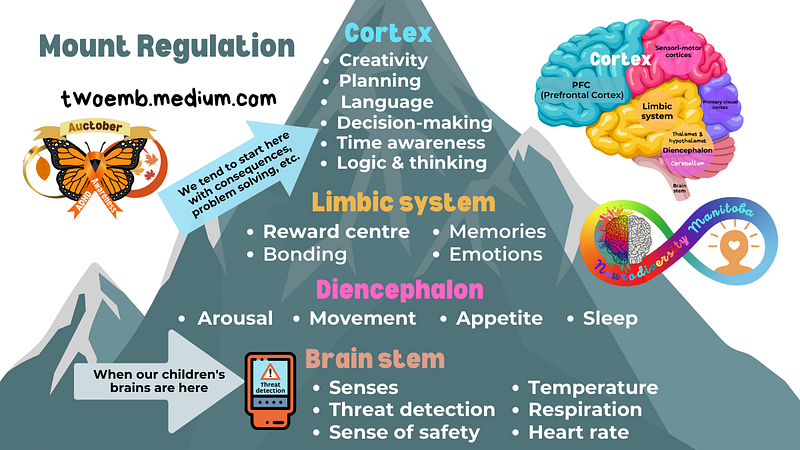
The key is not whether a person is literally safe in the moment, it’s whether their brain is telling them they are safe.
Many children have hyper-sensitive sensory systems and an adult who is much bigger than them and clearly unhappy, possibly raising their voice, can be enough to trigger alarms. People with any sort of trauma history will likely be hyper-vigilant and have an over-responsive threat-detector.
Neurodivergent people may also have over-responsive threat-detection systems as a result of our neurological wiring.
When people are in fight-or-flight mode, the most helpful response is to provide a calm and safe environment, offering reassurance in our actions and words (or lack thereof) they are safe. That’s it.
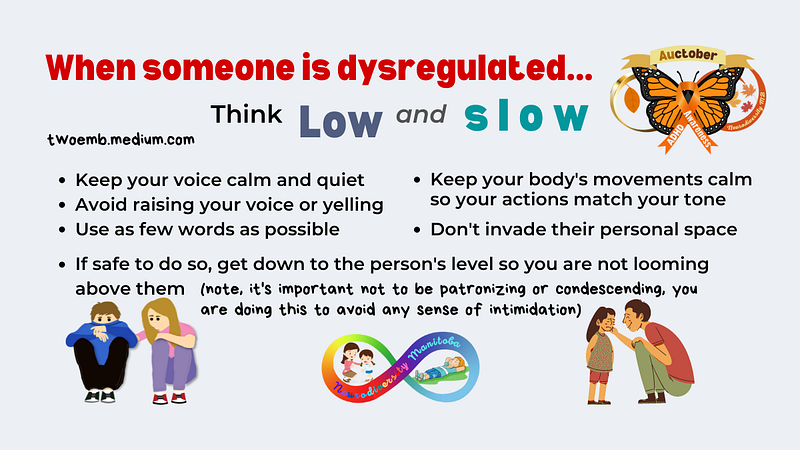
Think low and slow
When someone is dysregulated…
- Keep your voice calm and quiet
- Avoid raising your voice or yelling
- Use as few words as possible
- Keep your body’s movements calm so your actions match your tone
- Don’t invade their personal space
- If safe to do so, get down to the person’s level so you are not looming above them — (note, it’s important to not be patronizing or condescending, you are doing this to avoid any sense of intimidation)
How to avoid escalation
- Be mindful of your tone, volume, and body language — do your best to keep both your verbal and non-verbal communication as reassuring, non-threatening, and calming as possible.
- Don’t threaten consequences — there will be plenty of time to talk things through once everyone is regulated and calm.
- Avoid power-struggles or engaging in debates — the details can be sorted out later.
Choose your words and tone carefully
When a person is in a dysregulated state and their brain is in fight-or-flight mode, the way they hear and interpret their environment changes.
As an evolutionary necessity for self-preservation, if our brain is signalling potential danger, our senses are heightened, and we process them differently.
For example, when we feel scared or anxious, our muscles don’t just tighten on the outside. When we clench our jaw and physically prepare to defend ourselves, this also changes the muscles inside our ears.
The human voice is heard at a higher frequency than environmental noises. Our ears and brains have adapted to be able to filter out those lower-frequency sounds and focus on speech.
When we sense trouble, however, our focus becomes lower-frequency sounds: Sounds that alert us to danger, such as banging, growling, or a person speaking in an angry tone.
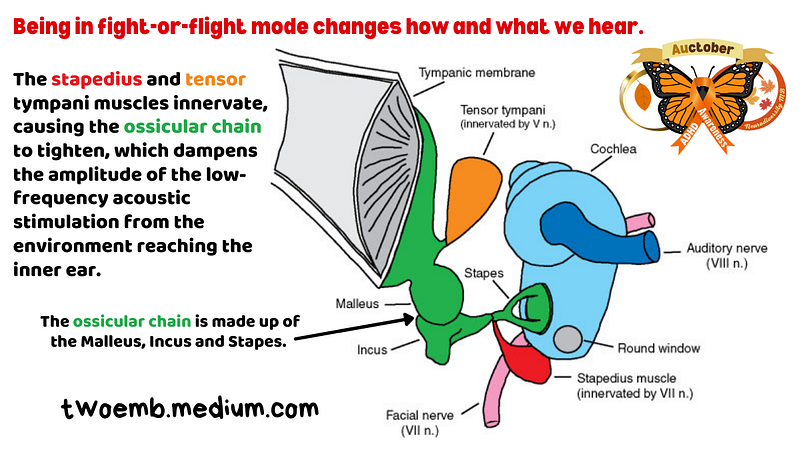
This is why fewer words are better. Choosing words carefully while speaking in a gentle and calm voice will help the person’s brain interpret this as non-threatening communication, helping them feel safer.
Parenting through meltdowns
Something I help families and school staff with is setting up regulation spaces in their household or classroom. I also teach conflict-resolution and problem-solving based on Dr. Ross Greene’s important work, Collaborative and Proactive Solutions (CPS).
This means adults sit down with kids when everyone is feeling calm and engaged. We talk about what difficulties we’ve noticed and solicit the child’s input, genuinely seeking to understand their perspective and asking for their feedback.
As a team, we work together to come up with possible solutions or strategies we can try when these problems arise in the future. One such solution is usually for a dysregulated person to seek out a safe, quiet space equipped with items that help them feel better.
Here’s how that often plays out:
Child: “I hate you! This is so unfair!”
Adult: “I notice you’re looking really tense and sounding angry. I think this might be a good time to try out your zen zone.”
Child: “No, I’m not going anywhere! You can’t make me!”
Sound familiar?
Troubleshooting
When the plan doesn’t seem to be working, remember to focus on the intent of the plan, rather than the specifics. The intent of the calming corner is for the child to have somewhere safe they can go to regulate when they need it.
They don’t want to go there because they’re dysregulated, their brain signalling danger, making them resistant to any form of suggestion or direction. They also may feel unfairly targeted by being asked to leave the space, as though this is putting them blame on them.
Regardless of whether they truly are responsible— or whether their behaviour is what is causing the problem at that moment — feeling blamed will elicit defensiveness and isn’t conducive to co-regulating.
The goal isn’t to work out who did what, the only objectives right now are creating a sense of felt safety and facilitating emotional regulation.
Instead:
- Offer alternatives: “Okay, can I bring you something from your zen zone that might help right now?” or “is there somewhere else you’d rather go where we can give you space?”
- Be clear with boundaries, but flexible with options. “I understand you don’t want to leave the room, but when you are hitting or throwing things, it’s making this an unsafe space. If you don’t want to go to the chill zone, where can we try instead?”
- Validate and acknowledge. “I know you’re really upset about that, and I promise you I will hear everything you want to say after we’ve all had a chance to cool off.”
- Be proactive. Whenever possible, don’t wait until someone is already dysregulated before offering support. Notice the early, more subtle signs they are becoming slightly agitated, and redirect or offer comfort and compassion.
- Refuel their resources. Also, don’t wait until someone is clearly struggling to carve out quality time to reconnect. We’re all more tolerant and patient when we feel refreshed and relaxed, like after a wonderful vacation. We can give our loved ones little top-ups every day by spending time together and connecting in meaningful ways.
We all want to know we are seen, cared for, and will be heard. Even — especially — in our most difficult moments.
Please remember, a meltdown is not a tantrum. A person who is feeling overwhelmed by intense emotions is not choosing to feel or behave this way. Some brains and bodies are more sensitive than others, and our neurology is not a choice.
We all want to know we are seen, cared for, and will be heard. Especially in our most difficult moments.
I have further tips and strategies to expand on, so there will be a follow-up coming soon— stay tuned!
© Jillian Enright, Neurodiversity MB
Related Articles
When you join medium, as a member you’ll have access to unlimited reads for only $5 per month. If you use my referral link, I’ll earn a small commission, and you’ll earn my undying gratitude.
If you’d prefer give a one-time tip, you can support my writing on Ko-Fi — also, it’s free to follow me on Facebook!

References
Delahooke, M. (2022). Brain-Body Parenting: How to stop managing behaviour and start raising joyful, resilient kids. Harper Collins.
Desautels, L. (2020). Connections Over Compliance: Rewiring our perceptions of discipline. Wyatt-MacKenzie Publishing.
Paulus, F. W., Ohmann, S., Möhler, E., Plener, P., & Popow, C. (2021). Emotional Dysregulation in Children and Adolescents With Psychiatric Disorders. A Narrative Review. Frontiers in psychiatry, 12, 628252. https://doi.org/10.3389/fpsyt.2021.628252
Porges, S. W. (2017). The Pocket Guide To Polyvagal Theory: The transformative power of feeling safe. W. W. Norton & Company.
Porges, S. W. (2011). The Polyvagal Theory: Neurophysiological foundations of emotions, attachment, communication, self-regulation. W. W. Norton & Co.


