
Repairing The Disconnect
Four ways you can improve your relationship and connect with your child

Relationship dynamics
Relationships are always changing and evolving, especially the parent-child relationship, because our children grow and change so much in such a short period of time.
All relationships go through periods where they are strengthened and periods where they are weakened. It’s part of life and is unavoidable. However, when we notice our relationship with our child isn’t as close as we’d like it to be, there are steps we can take to bridge the gap.
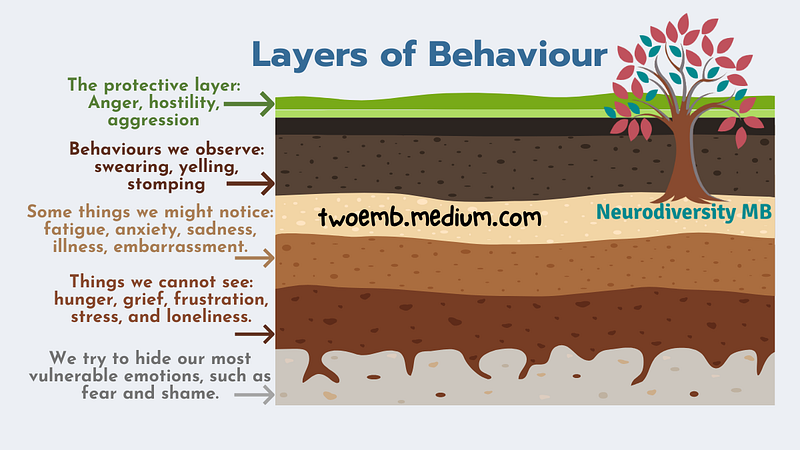
One of the ways we’ll recognize our child is lacking the security they need in their relationship with us is through their behaviour. Disconnect causes stress, and stress leads to what we call misbehaviour.
Rather than focusing on managing behaviour before we even know what it means, we must prioritize (re)establishing a trusting connection with our child, and from emerging reciprocal engagement, they are able to make sense of the concerning behaviours.
I will describe four ways in which we can strengthen our relationships with our children, based on work by Dr. Daniel Hughes.
P.A.C.E.
Pace is an acronym developed by Dr. Daniel Hughes to help us remember the keys to connecting and reconnecting with children, especially children who have experienced trauma.
We can use these strategies to repair the disconnect between ourselves and our children, regardless of whether they have experienced trauma.
Disconnect between child and their parent (or any important adult in their life) can be thought of as a minor psychological wound, and P.A.C.E. as the first-aid treatment to ensure these minor wounds do not develop into emotional or psychological trauma.
Playfulness
Joint laughter and enjoyment convey a sense of acceptance and ease. Playfulness shows our children we experience joy simply from being in their presence.
Playing and laughing together help to reduce tension, blow off steam, and release oxytocin. Increased oxytocin reduces activity in the amygdala (the area of the brain most implicated in fear and stress) and increases activity in the regions of the brain responsible for emotional regulation.
Every child needs and deserves at least one adult in their life who lights up every time they enter the room. Or as Urie Bronfenbrenner said:
“Every child needs at least one adult who is irrationally crazy about him or her.” — Dr. Bronfenbrenner
Acceptance
Acceptance of our child and their experience means acceptance without evaluation, judgement, or criticism.
When we invalidate, dismiss, or disagree with our child’s description of their experiences or feelings, we are not accepting their inner world, which means we are not fully accepting them.
Conversely, when we are fully open to exploring and understanding their perspective, we build trust — their trust in our relationship, and their trust in themselves.
“When the parent accepts the inner life of the child, and the child is accepted, even if their behaviour is not, this strengthens the child’s secure attachment.” — Dr. Daniel Hughes
If our children feel we do not accept them, or their emotions and experiences, they will be focused on convincing us (and themselves) they are worthy of acceptance. Children do this by defending their actions, diverting blame onto others to avoid your disapproval, or arguing to convince you they are right.
When we show our children that we love them unconditionally, we accept and validate their feelings and experiences, they no longer have to expend their emotional energy convincing us of their worth.
“Our children need our loving acceptance, complete with all their tangled-up feelings… our acceptance and understanding of what our child is feeling helps them recognize and accept their own emotions.” — Dr. Laura Markham
Once children feel secure in their relationship with us, and in their own value as people, they will be more able to reflect on how their behaviour may have impacted both themselves and others.
“The child is accepted, even if the behaviour is not.” — Dr. Daniel Hughes
Curiosity
When we express curiosity without judgement, this allows our children to be more open and to become curious about their own behaviour.
“So often, children do not reflect on their own behaviours, and this is especially true when they experience discomfort about what they do.” — Dr. Daniel Hughes
The most important part is we convey our curiosity without evaluation, judgements, or accusations. Instead of “why on earth would you do that?!” we might wonder out loud, “you must have been feeling very angry to do something like that. I wonder what happened?”
When we remain curious and don’t jump to conclusions, we give children time and opportunity to process their behaviour for themselves, and space to explain it to us in their own words.
If we are assigning blame and intent, without allowing children the chance to self-reflect, then they won’t develop this extremely important skill. We also may jump to the wrong conclusions, and miss the proverbial boat entirely.
Empathy
“Regulation, control, empathy, and kindness are a few of the skills that need to be taught and modelled, just like math, reading, or any other academic subject.” — Dr. Lori Desautels
Knowing that you “get it” while still accepting your child often calms your child and helps them to stay regulated. Emotions like sadness and anger are a signal communicating to ourselves and to others that something is wrong.
When a child is acting out intense emotions, their body and brain are trying to signal to us that something isn’t right. Once we acknowledge and show empathy for those emotions, they’ve done their job, and (with a little help via co-regulation) they can begin to recede.
“Empathy says to the child, ‘I am with you in your distress, we will handle it together, and you will be safe.’” — Dr. Daniel Hughes
It’s important to understand that honouring our children’s emotions and experiences is not the same as taking them on ourselves. We convey caring and concern while remaining internally regulated, so that we can offer our calming, comforting presence.
“Empathy is accepting and being with what someone is expressing.” — Dr. Laura Markham
It’s more than okay to express sadness or frustration on our child’s behalf, “that sounds really hard, buddy” or, “I’m sorry that happened, that sounds really unfair”, but we’re not getting swept up in their emotions or rushing in to try to fix things for them.
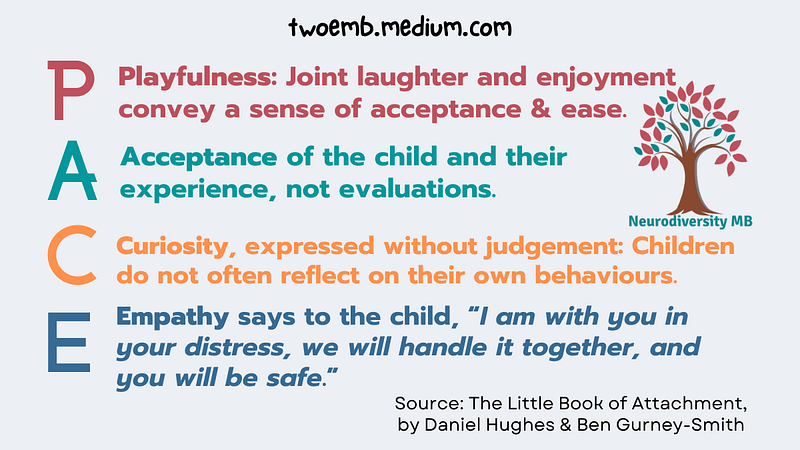
Playfulness, acceptance, curiosity, and empathy are all extremely important to build and strengthen our relationships. In my opinion, acceptance is the first and most important step to bridging the gap when one begins to develop.
I tried to come up with my own acronym beginning with A for acceptance, but the best I could come up with was A for acceptance, C for caring & compassion, I for interest & curiosity, and D for delight & joy.
Pace sounds a lot nicer than acid, so I think I’ll leave well enough alone.
© Jillian Enright, Neurodiversity MB
Related Stories
When you join medium, as a member you’ll have access to unlimited reads for only $5 per month. If you use my referral link, I’ll earn a small commission, and you’ll earn my undying gratitude.

References
Brendtro, Larry. (2006). The Vision of Urie Bronfenbrenner: Adults Who Are Crazy about Kids. Reclaiming Children and Youth: The Journal of Strength-based Interventions, 15. Available online.
Carrington, J. (2020). Kids These Days: A game plan for (re)connecting with those we teach, lead, and love. IMpress Books.
Desautels, L. (2020). Connections Over Compliance: Rewiring our perceptions of discipline. Wyatt-MacKenzie Publishing.
Hoffman, K., Cooper, G., Powell, B., Benton, C. M. (2017). Raising a secure child. Guilford Publications.
Hughes, D., & Gurney-Smith, B. (2020). The Little Book of Attachment: Theory to practice in child mental health with dyadic developmental psychotherapy. W.W. North & Company.
Markham, L. (2012). Peaceful Parenting, Happy Kids: How to stop yelling and start connecting. Penguin Books Ltd.
Răban-Motounu, N. (2021). Laughter and Empathy. Current Trends in Natural Sciences, 10(20), 192–202. https://doi.org/10.47068/ctns.2021.v10i20.026