
Education & Parenting
Gaining a Better Understanding of Behaviour
You’ll have to be both a deep-sea diver and a time-traveller

Human behaviour is complex. It can be even more so in people who face greater daily challenges, such as individuals with disabilities.
This includes people with ADHD.
Children with ADHD are at a higher risk for adverse childhood experiences (ACEs).
ADHD is characterized by delayed prefrontal cortex development, which can lead to challenges with emotional regulation. As a result, children with ADHD may experience greater life stressors, and may also be ill-equipped to handle those stressors due to their neurodevelopmental disorder.
That seems a little unfair, doesn’t it? Yet children with ADHD and other disabilities are constantly being held accountable for behaviour that may well and truly be outside of their control.
“I don’t understand. Sammy had a total meltdown, just because he was asked to write a few sentences!”
Did he, though?
On the surface, sure, that’s what happened when the proverbial straw broke the camel’s back. To better understand why, we’ll have to mix together at least three different metaphors. So let’s rewind a bit further, dig a bit deeper, and unpack this hypothetical scenario.
First, we’ll back up the tape
Or the blu-ray DVD or streaming video, to be more culturally relevant.

Some historical factors that may have contributed to Sammy’s outburst:
Maybe Sammy didn’t get much sleep last night, or maybe he didn’t eat a nutritious breakfast that morning. Perhaps he had a fight with his sister when they were getting ready for school, or was chastised by his parents for something, and his feelings were hurt.
Could be that a friend is upset with him, or he is being bullied by an older student in the school. When Sammy walked into the classroom this morning, two students were whispering and pointed at him as he walked by. He forgot his homework that he stayed up late finishing, so now he’ll lose marks for handing it in late.
Maybe a bird pooped on his head as he walked to school, who knows. The point is that our lives are not compartmentalized into isolated, unrelated moments of our days. How we respond in any situation depends on our history: the history of our life, our month, our hour.
Now for some deep diving
You’ve likely heard the metaphor about icebergs: what we see above the water’s surface is only about 1/10th of the iceberg. Such is behaviour. The behaviours we observe are a minute fraction of a person’s history, inner workings, biology, and individual experience.
“Too often, caregivers, teachers, providers, and parents assume that a child is acting deliberately, when in fact a behaviour is actually a stress response.”
— Dr. Mona Delahooke
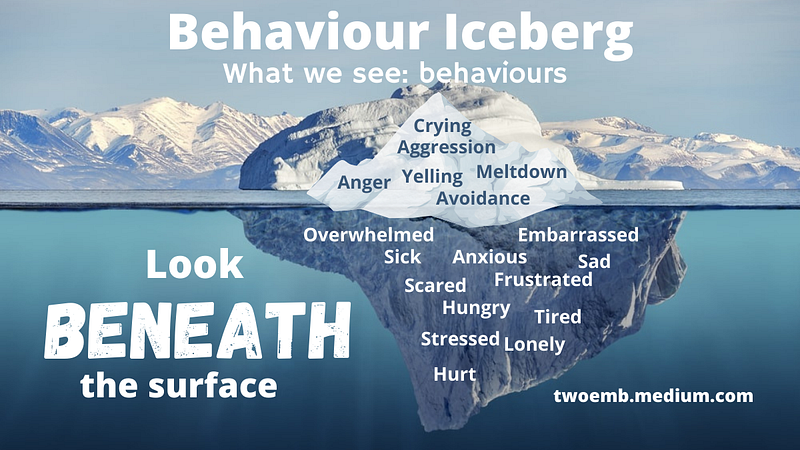
Taking Sammy as our example, perhaps he wasn’t feeling well that day. It’s possible he’s feeling sad, overwhelmed, hurt, anxious, or lonely.
Maybe Sammy has an undiagnosed learning disability or fine motor issues, making writing particularly difficult and stressful for him.
A similar scenario actually happened to my son when he was only in grade one. The class of 6 and 7 year olds had been asked to write a paragraph. The next day, they were to go through their writing and make corrections, then write up a good copy. In grade one.
My son is twice exceptional: he is gifted and has ADHD. Intellectually, he has no problem with this exercise, but there are two problems.
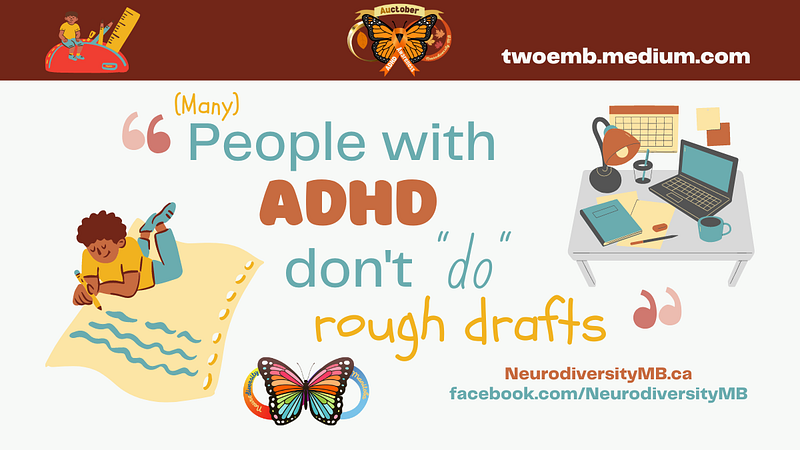
One: people with ADHD don’t “do” rough drafts.
Okay, that’s an overgeneralization, but many fellow ADHD-ers will relate to this. Once we feel we are finished with a task, we find it extremely difficult to go back and make corrections, especially if it’s not something we find very interesting.
Secondly, as it turns out, my son does have fine motor issues. While his IQ is in the 99th percentile, his visual-motor integration capabilities are in the 10th percentile. A disparity that significant is referred to as asynchrony, which is common in gifted and twice exceptional children. This asynchrony is particularly pronounced in 2e children— those who are gifted and also have a disability.
While not everyone with ADHD has fine motor issues, research has found that difficulties in fine motor skills are prevalent in children with ADHD, which may lead to poor handwriting, including a specific learning disability involving writing called dysgraphia.
In my son’s real-life example, the teacher kept pushing while he was resisting and my son ended up tearing up his paper and hiding under his desk (remember, he was only 6). Children do not usually hide under their desk to be defiant. If a child is hiding, and they’re not playing a game of hide-and-seek, then it’s highly likely they are feeling overwhelmed.
If the teacher were not trying to dive deeper and just looked at the surface behaviour, they might say my son was misbehaving and refusing to do his work. That would be taking a very narrow, oversimplified view of behaviour… which is pretty much what happened.
I received an email from the teacher saying “his behaviour seemed to come out of the blue.” Now, I say this with all due respect for the teacher. She had a class of more than 30 grade two children, so it would be completely unfair to expect her to see everything that led up to my son’s behaviour that day.
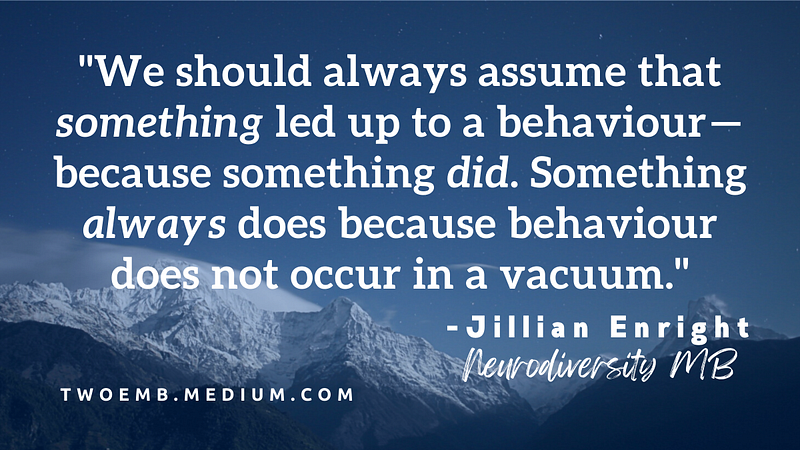
That said, even if we have no idea what led up to the behaviour, we should always assume that something did — because something did. Something always does because behaviour does not occur in a vacuum. We should never take behaviour at face value.
Empathy and Validation
When a child is dysregulated (i.e. upset, angry, has big feelings), our first response should be to provide support through showing empathy, engaging in co-regulation, and offering validation.
“Emotional co-regulation is attuning to and supporting another person through our presence.”
— Dr. Mona Delahooke
Note: I wrote more about these strategies in additional blog posts, which I will link to at the bottom of the page, under further resources.
In this example, if the teacher had a good relationship with my son, she could have gotten down to his level (literally, like crouching, sitting, or kneeling down to look at him under the desk) and demonstrated empathy.
This might sound like, “hey buddy, it looks like you’re having a hard time right now. When I feel like I want to hide, that usually means I’m feeling overwhelmed.”
If she knew that he had a hard time with writing exercises — which, she did, by the way, because I told her — she could say something like, “I know writing is not your favourite, and that’s okay, we all have things that we don’t like. How about we take a break for a few minutes, and we can talk when you’re ready?”
Ideally, especially in a class with such young children, the classroom would have a sensory area or a quiet corner — some place where students are allowed to go for a few minutes when they need a break. This area could have sensory items, fidget toys, comfort items such as soft blankets or stuffed animals, books, building blocks like Lego or Duplo, etc.
That way, in this case, my son could have retreated to that space until he was ready to return. Unfortunately, this class did not have any such space, and students were not allowed to play with the toys when it was not a designated “free play” time.
Sigh. The things we do when we don’t understand, or lose sight of, providing developmentally-appropriate classrooms and spaces… but I digress… (for now).
I say for now because my next story explains why that quiet sensory area needs to be in the classroom, or in a room adjoining the classroom, and not in a room across the school — among other things related to inclusive education:
© Jillian Enright, Neurodiversity MB
Related Articles
The Perils of Punishment
Because I like alliteration… and science. I really like science.
medium.com
When you join medium, as a member you’ll have access to unlimited reads for only $5 per month. If you use my referral link, I’ll earn a small commission, and you’ll earn my undying gratitude. If you’d prefer give a one-time tip, you can support my writing on Ko-Fi — also, it’s free to follow me on Facebook!

References
Delahooke, M. (2019). Beyond Behaviors: using brain science and compassion to understand and solve children’s behavioral challenges. PESI Publishing.
Lugo-Candelas, C., Corbeil, T., Wall, M., Posner, J., Bird, H., Canino, G., Fisher, P. W., Suglia, S. F., Duarte, C. S. (2020). ADHD and risk for subsequent adverse childhood experiences: understanding the cycle of adversity. The journal of child psychology and psychiatry. https://doi.org/10.1111/jcpp.13352
Mokobane, M., Pillay, B. J., & Meyer, A. (2019). Fine motor deficits and attention deficit hyperactivity disorder in primary school children. The South African journal of psychiatry : SAJP : the journal of the Society of Psychiatrists of South Africa, 25, 1232. https://doi.org/10.4102/sajpsychiatry.v25i0.1232
Ottone-Cross, K. L., Gelbar, N. W., Dulong-Langley, S., Root, M., Avitia, M. J., Bray, M. A., Courville, T. & Pan, X. (2019). Gifted and learning-disabled: A study of strengths and weaknesses in higher-order processing, International Journal of School & Educational Psychology,7(1), 173–181, DOI: 10.1080/21683603.2018.1509034
Roshannia, S., Maleki-Karamolah, S., Akhlaghi, Z., Kordestani-Moghadam, P. (2021). Review of Cognitive Disorders in Attention Deficit Hyperactivity Disorder with Emphasis on Executive Functions and Brain Structures. International Clinical Neuroscience Journal, 8(2):60–66. https://journals.sbmu.ac.ir/neuroscience/article/view/33963


