
Stimminy Cricket: Everybody Stims
Stimming, or “self-stimulatory” behaviours are human behaviours

What is stimming?
Stimming is self-stimulatory behaviour and is often a way that Autistics regulate our emotions. It can be calming, it can be enjoyable, and sometimes it can signal to others that something is wrong.
Stimming can be extremely important for many Autistics and should not be prevented unless it is harmful or dangerous, in which case a safer alternative should be found.
“Stimming is most commonly understood as serving essential functions of self- regulation and integration.” — Dr. Nick Walker
Everybody stims
Yes, everybody stims — Some more obviously than others, and for many stimming is a very important part of our daily lives.
Some behaviours which can be forms of stimming are:
- Pacing, walking back and forth
- Biting your nails
- Picking at your skin
- Biting your lip
- Cracking your knuckles
- Tapping your pen
- Tapping yourself on your body (for example, some people tap their finger to their lips or chin when they’re trying to remember something)
- Rocking
- Jumping up and down
- Hand flapping or wiggling fingers
- Humming, singing, or vocalizing
- Wiggling your feet or rubbing them together*
This is where I came up with the phrase “stimminy cricket!” One of my stims is rubbing my feet together. Someone referred to this as “cricket feet”, which then evolved (or devolved, depending on your perspective) into Stimminy Cricket.
A + B does not equal C
Occasionally performing those behaviours mentioned above is not the same as stimming, and stimming does not automatically mean someone is Autistic. Stimming is a normal part of human behaviour.
The difference is most Autistics tend to stim much more often, and in more obvious ways, and generally have a greater need for stimming as a self-regulation tool.
Other neurodivergent people stim as well, for example a lot of people with ADHD and OCD use stims to self-regulate.
Stimming has purpose
Stimming has many important functions and its uses will be different for everybody.
When I’m anxious I’ll often tap, usually by tapping my fingers together or tapping my shoulder. I also might rock a bit.
Lots of people stim when anxious! People pace back and forth while awaiting important news, drum their fingers on their desk while considering a challenging question on an exam, or twirl their hair when nervous. Others may bite their nails or hum.
When I’m excited I might flap my hands or do a little tippy-tappy with my feet. Lots of people stim when excited! Observe a sports fan when their favourite team wins in overtime, or someone receiving very good news. They may jump up and down, squeal with delight, or pump their fists in the air.
We use physical movement to express our feelings, blow off steam, and to regulate our emotions. This is the same reason people slam doors, yell, and stomp their feet when angry — those aren’t stims, but they’re physical ways of venting our mental and emotional energy through physical action.
Stims can serve the same purpose.
Stimming can also be relaxing. I do my “cricket feet” — rubbing my feet together — when I’m relaxing on the couch. It’s something I‘m hardly aware of doing, but when I make a point of paying attention to it, I recognize it as a self-soothing behaviour. I rub my feet together more often after a long day at work and when I’m tired.
Stimming can improve focus and concentration. I often tap or rub my fingers together when I’m thinking, and play with my hair when I’m trying hard to focus on what someone is saying to me.
Stimming can also help with sensory processing. A lot of Autistics experience sensory overload or sensory overwhelm. When we’re unable to quickly leave an overwhelming environment, or otherwise block out the stimuli we’re experiencing as painful or too much for our nervous system to handle, stimming can help.
The exact mechanisms are not well understood, but some preliminary evidence has led researchers to propose some theories. The neuroscience is complex, but one hypothesis is that stimming (or repetitive behaviours) are consistent and predictable, making them comforting.
When an environment is producing a lot of sudden, intense, or unpredictable stimuli, this causes anxiety and can overwhelm the brain’s ability to process and manage the incoming information. Stimming allows the brain to focus on the familiar, comforting, and predictable physical experiences.
The irony
Despite the fact that everybody stims, many Autistics have been mistreated in an effort to “teach” them to not stim, or to stim in ways that neurotypicals have arbitrarily decided are acceptable.
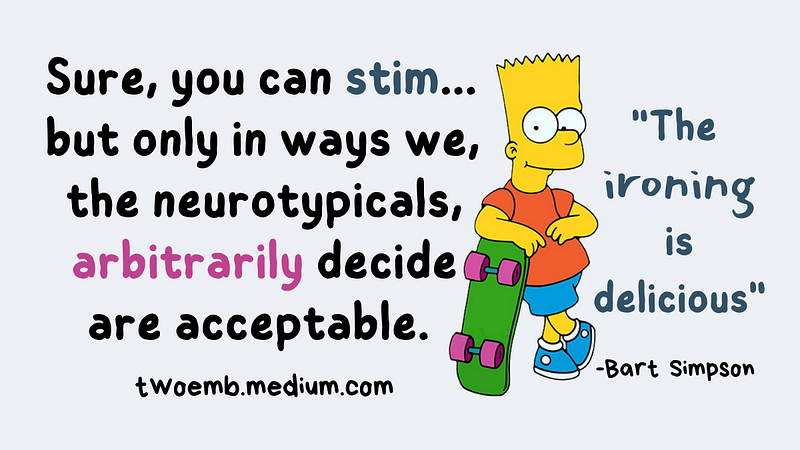
For example, quietly jiggling your leg under the desk is generally accepted as an “appropriate” fidget or stim. Flapping one’s hands, tapping one’s body, or rocking back and forth — none of which hurts anyone — are often behaviours considered “inappropriate”.
Many of us have been told “quiet hands” when we flap. As Amy Laurent exclaimed in her Ted Talk, while jumping and flapping her hands, “this doesn’t make any sound!”
It’s not about sound, and it’s not about safety; It’s about not appearing “weird” to others. As Remi Yergeau explained, behaviour therapies
“…are concerned less with the child and more about the repercussions for larger social bodies.” — R. M. Yergeau
Many Autistics have expressed the importance of stimming and other behaviours deemed “autistic behaviours”, and have expressed the harms of therapies which aim to suppress said autistic behaviours.
That message has been made crystal clear for anyone who bothers to ask the question, yet autistic children continue to be subjected to these therapies, these harmful therapies often prescribed by trusted doctors and other professionals. If not for the child’s benefit, then what are their purpose?
Conformity, fitting in, and going along to get along. I understand parents don’t want their children bullied or picked on for being different. I have news for you though: We will always be different, regardless of how many hours of therapy we are subjected to.
Our differences can be pretty damn awesome if we’re given the love, support, and acceptance we need to allow our strengths to shine through.
If your child is being bullied or teased for being different, what message do you want them to receive at home? That home is a safe place where they are loved and accepted for exactly who they are? That it’s wrong for others to pick on them, and you will stand up for them no matter what?
Or will they get the impression that you, too, find their differences off-putting and wish they were less like themselves and more like everybody else?
© Jillian Enright, Neurodiversity MB
Relates Stories
When you join medium, as a member you’ll have access to unlimited reads for only $5 per month. If you use my referral link, I’ll earn a small commission, and you’ll earn my undying gratitude.
References
Charlton, R. A., Entecott, T., Belova, E., Nwaordu, G. (2021). “It feels like holding back something you need to say”: Autistic and Non-Autistic Adults accounts of sensory experiences and stimming. Research in Autism Spectrum Disorders, 89, 101864. https://doi.org/10.1016/j.rasd.2021.101864
Kapp, S. K., Steward, R., Crane, L., Elliott, D., Elphick, C., Pellicano, E., & Russell, G. (2019). ‘People should be allowed to do what they like’: Autistic adults’ views and experiences of stimming. Autism, 23(7), 1782–1792. https://doi.org/10.1177/1362361319829628
McCarty, M. J., & Brumback, A. C. (2021). Rethinking Stereotypies in Autism. Seminars in Pediatric Neurology, 38, 100897. https://doi.org/10.1016/j.spen.2021.100897
Walker, N. (2021). Neuroqueer Heresies: Notes on the neurodiversity paradigm, Autistic empowerment, and postnormal possibilities. Autonomous Press.
Yergeau, M. R. (2018). Authoring Autism: On rhetoric and neurological queerness. Duke University Press.


