
Executive Functions for Parents And Kids
Executive functions explained in a relatable way

Knowledge is compassion
As parents of neurodiverse children, it’s our responsibility to understand what reasonable expectations might be for our children. Children with asynchronous development may need a little extra patience and guidance.
When we have a deeper understanding of the challenges they face on a moment-to-moment basis, this helps us show our kids more compassion and empathy, rather than becoming frustrated when we feel they aren’t “listening” to us.
Something I found difficult to wrap my head around when I began learning about ADHD and autism was executive functioning — I honestly wondered to myself, what on earth is that?
In all my years of College and University, never once had I encountered this terminology, and my degrees are in psychology! I’ve since written extensively about executive functions from a more academic standpoint.
One of the best ways we can empower our children to advocate for themselves is to teach them about their own neurology (at a developmentally-appropriate level), and help them identify and understand their own strengths and weaknesses.
I’ve broken down the executive functions into five key categories, and explained them in a relatable way, so that parents can help their children understand their own neurology a bit better.
Perhaps more importantly, I write from the child’s perspective, to help parents better understand and empathize with their children’s experiences.
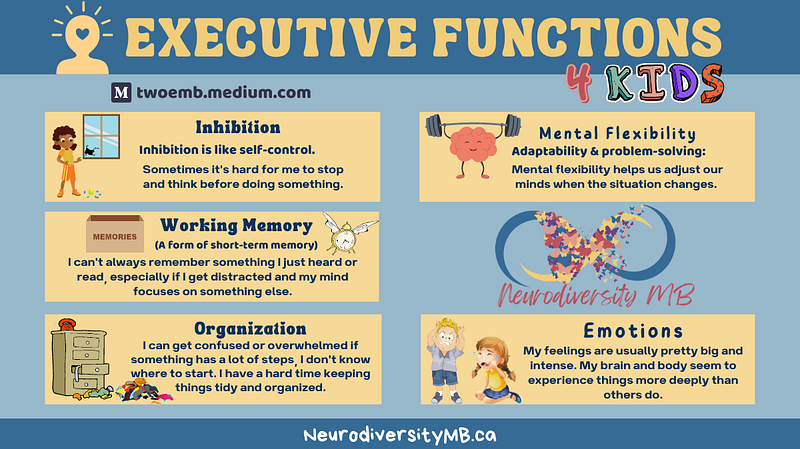
Executive functions:
Inhibition
Inhibition is like self-control.
Sometimes I do or say things without really thinking, especially if I’m excited or mad. It can get me in trouble too, but I don’t mean to make anyone mad or upset.
When an adults ask me why I did something, I can’t explain because I really don’t know the answer. It makes me feel bad when I can’t give them an answer, and I figure it must be because there’s something wrong with me.
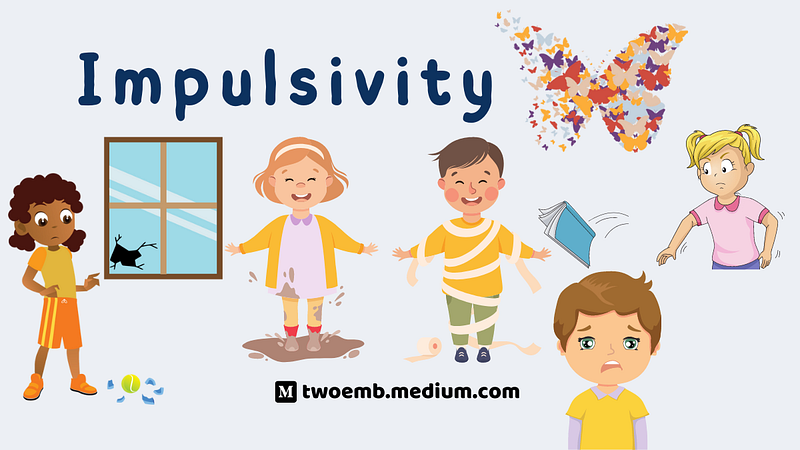
Impulsivity can make it hard for me to stop and think before doing something. Some things I do by accident are:
- Talking out in class, forgetting to raise my hand and wait my turn.
- Breaking something or hitting someone when I’m really mad.
- When I’m really excited, sometimes I can’t hold back and I do something before I’m supposed to, or before it’s my turn.
- Lying when I’m afraid I might get into trouble.
- Hurting someone’s feelings or body by accident when doing something I thought would be funny, but ends up not being so funny after all. Then I feel bad.
Mental flexibility
Mental flexibility helps us adjust our thinking when the situation or environment around us changes.
This can be hard for neurodivergent kids!
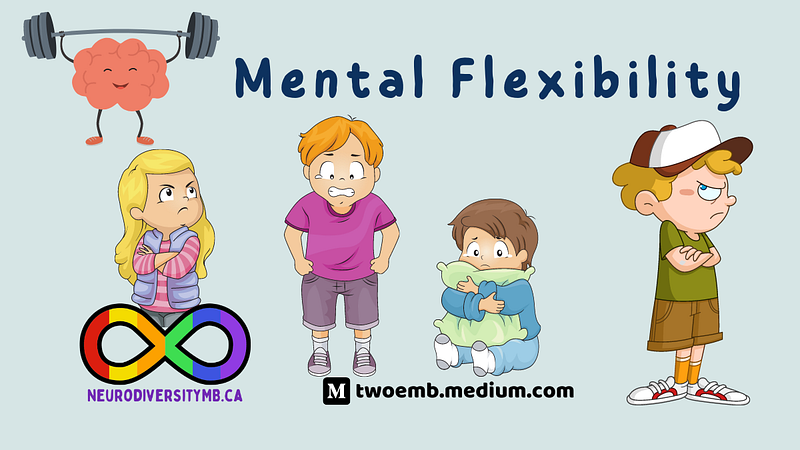
When I’m doing something fun, it’s so hard to stop, especially when I have to do something boring or something I don’t like instead.
I get anxious or upset when plans change suddenly, especially when something I was looking forward to gets cancelled or postponed.
Even when I’m doing something that’s not super fun, it’s hard for my brain to switch over to something different — it’s like a car getting stuck in high gear, when you need to switch to a low gear!
I can get really focused on rules, sometimes my thinking can be very black-and-white. It’s hard for me to understand or accept when things don’t seem fair, and it makes me feel anxious when I don’t know what to expect.
Short-term memory
An important executive function is working memory, a specific type of short-term memory. Working memory helps me store things in my brain while I’m using that information to do something.
I can remember things from a long time ago pretty well, but when I’m doing school work I sometimes forget things I just read. It’s not because I don’t understand it either, it’s just that my brain can be slippery sometimes and memories can be so tricky to hold on to.
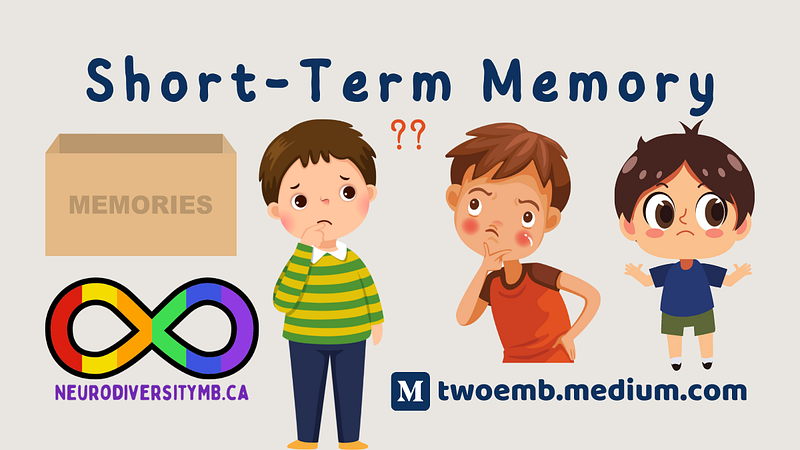
If I get instructions with a lot of steps, I can get distracted along the way and forget what I was supposed to do next. I can get so overwhelmed trying to remember all the steps that I completely lose track of what I’m doing, or sometimes I end up feeling like I can’t do anything at all.
Organization
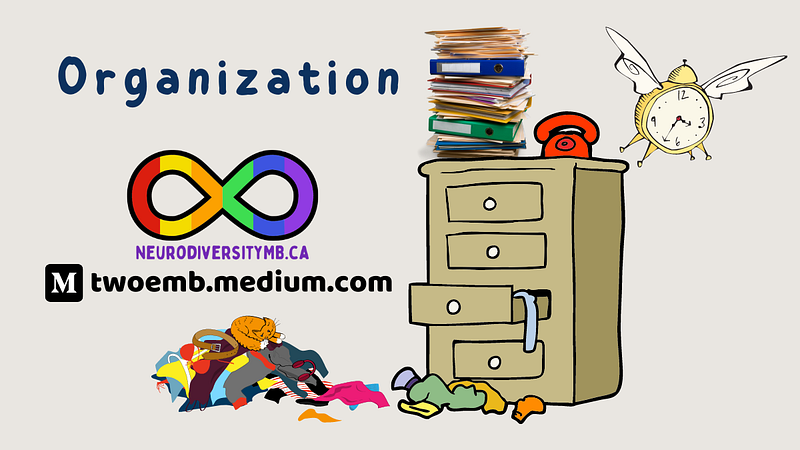
- I have a hard time keeping my room clean.
- My binder is usually pretty messy with pages sticking out and in the wrong spots.
- My desk is pretty messy too, I usually stuff things in when I’m in a hurry to get outside for recess (and don’t even ask about my locker!).
- Sometimes I use something and leave it there without even realizing, I usually need reminders to go back and clean up.
- Later, when I am looking for that same item, I usually won’t remember where I left it, and I get frustrated when I can’t find what I’m looking for.
Planning
- I lose track of time easily and have trouble guessing how much time it will take me to do something.
- Sometimes I think something will be a lot harder than it really is, and I avoid it for as long as possible. Then when I finally do it, I realize it wasn’t so tough after all!
- Other times I think I can get something done quickly, but then it turns out it takes a lot longer than I expected, and I end up being late or making people wait for me when I didn’t mean to.
- I have trouble planning things out, especially if it’s a big task with a lot of steps. I may need help breaking them down into manageable parts.
- Sometimes I have trouble figuring out which task is most important to tackle first.
- I find prioritizing difficult, and prefer to do the fun stuff first.
Emotions!
Emotion regulation is a very important executive dysfunction. Many neurodiverse people struggle with emotional dysregulation and intense feelings.
- My feelings are usually pretty big, sometimes they’re huge.
- My brain and body seem to experience things more deeply than others do.
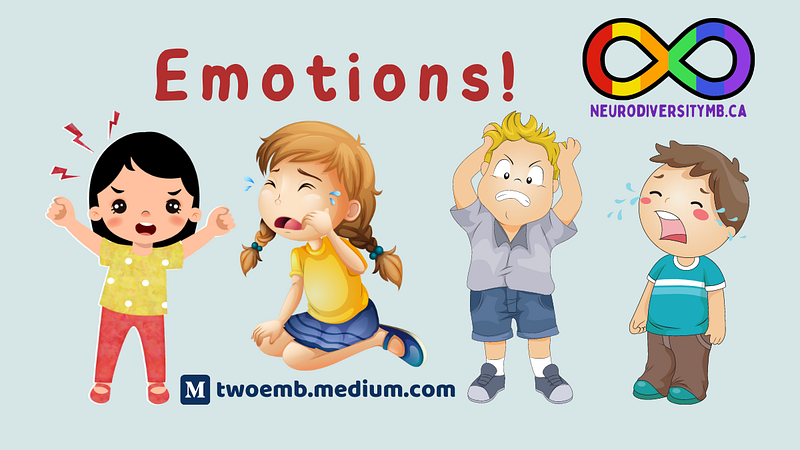
- Sometimes I get overwhelmed and my emotions feel totally out of control, and it can be really hard for me to calm down.
- I need help learning how to identify when I’m starting to get upset, because I don’t always notice until I’m already really, really upset.
- Then I need help finding ways to calm myself down. Sometimes I need an adult to help me work through my big feelings.
Personal responsibility versus neurodevelopment
When our children struggle with executive functioning due to neurodivergence, it’s important we educate ourselves on their unique neurotypes so we can better understand their experiences.
If a child has executive functioning difficulties (and if they’re neurodivergent, then they do — in one form or another), their neurological maturity will be behind their peers.
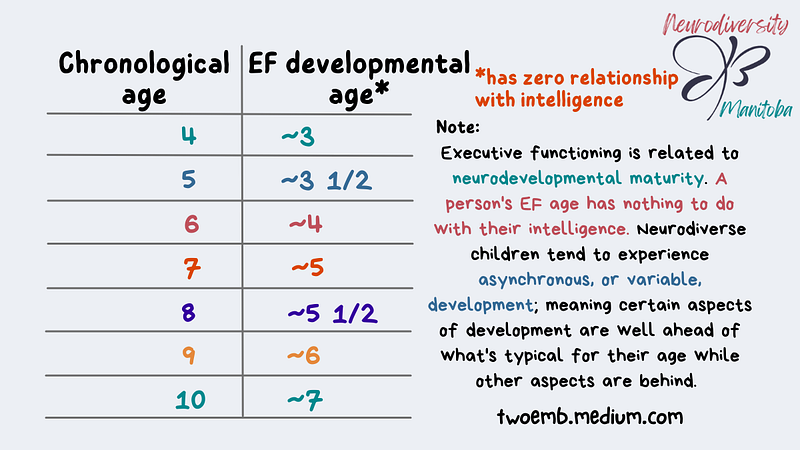
This chart above is simply an estimate and will not be representative of all neurodiverse children, nor of individual children in different skillsets. These numbers are based on research that estimates children with ADHD are approximately 30% behind their peers in the maturation of their prefrontal cortex (PFC).
The PFC plays a very important role in all of the executive functions, such as impulse control, planning, organization, working memory, and emotion regulation.
Asynchronous development
As noted in the developmental ages chart above, executive functioning and neurodevelopmental age have absolutely nothing to do with a person’s intelligence. In fact, twice exceptionality — a term to describe a person who is cognitively gifted and also disabled or neurodiverse — is characterized by asynchronous and variable development.
Asynchronous development describes how certain skillsets lag behind what is typical for the child’s age, while other areas of their development are significantly advanced for what is expected at their age.
Executive functioning and neurodevelopmental age have absolutely nothing to do with a person’s intelligence.
The reason for sharing the chart above is to give adults an understanding of what reasonable expectations might be for their child.
A lot of children receive consequences, or are considered to be disobedient, when they aren’t meeting expectations. However, it may be that they are developmentally unable to meet those expectations at that moment in time.
This doesn’t mean neurodiverse people don’t have personal responsibility, far from it, however it does mean that children with asynchronous development may need a little extra patience and guidance.
Spiky cognitive profile
Another way of describing asynchrony is through a spiky cognitive profile. I love this term because it’s extremely accurate and descriptive.
For example, here is a partial section from my son’s psychoeducational assessment from 3 years ago:
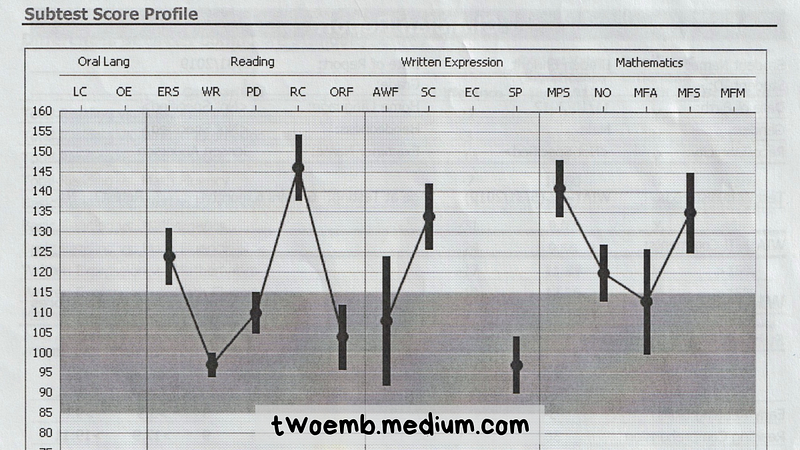
Keeping in mind that this is just one very small part of an extensive assessment — look how spiky it is!
The darker grey areas represent the average for his age group (he was six years old at the time). You can see how, even within a particular skillset, he has significant variation. For example, his reading comprehension (RC) is way up in the 99.9th percentile, yet his individual word reading (WR) was down in the 42nd percentile.
What this means is my son puts sentences together using pattern recognition and is a big-picture thinker. When he reads individual words, they make less sense to him without context, so it takes him longer to process.
Having average word reading skills may seem just fine — and it is — except that when a child’s cognitive profile is so asynchronous, this causes incredible frustration.
Another example is his sentence composition (SC) which was also in the 99th percentile. Something not pictured here is an assessment of his visual-motor integration, which was in the 10th percentile. Poor visual-motor integration is very common in people with dysgraphia, a disorder related to writing.
While he was able to put sentences together as well as a child 3 years older than he was, his ability to physically write out those sentences was well below the average for his age. You can imagine the frustration this would cause.
Individual differences
A person doesn’t have to be cognitively gifted to have variable development either. Some neurodiverse kids may do really well with some executive functions and poorly with others, just as any human being has both strengths and weaknesses.
The message I want to share with adults is this: If you feel yourself becoming frustrated with your child, ask yourself if the demands or expectations you’re placing upon them are developmentally appropriate. Not for “kids their age”, but for your child, for who they are in that moment.
Not only do we all have strengths and weaknesses, but we all have good days and bad. Good hours and bad. Good moments and bad. (You get the idea). Just as we should be allowed to have an “off” day, so should our children. They’re human too, after all.
© Jillian Enright, Neurodiversity MB
Small self-promotion
If you would like to I have a webinar available for purchase on my website which covers all the essential information about executive functions, especially as they relate to Autism and ADHD.
Related Stories
When you join medium, as a member you’ll have access to unlimited reads for only $5 per month. If you use my referral link, I’ll earn a small commission, and you’ll earn my undying gratitude.
References
Shaw, P., Eckstrand, K., Sharp, W., Blumenthal, J., Lerch, J. P., Greenstein, D., Clasen, L., Evans, A., Giedd, J., & Rapoport, J. L. (2007). Attention-deficit/hyperactivity disorder is characterized by a delay in cortical maturation. Proceedings of the National Academy of Sciences of the United States of America, 104(49), 19649–19654. https://doi.org/10.1073/pnas.0707741104


