avatarJillian Enright

Free AI web copilot to create summaries, insights and extended knowledge, download it at here

5513

Abstract

ence. To <a href="https://medical-dictionary.thefreedictionary.com/pathologize">pathologize</a> neurodivergence is to diagnose a normal variation as disordered, based on the assumption that it ‘should’ cause disease.</p><p id="9ff5">Autistic and other neurodivergent self-advocates characterize <a href="https://www.goodreads.com/book/show/51150367-neurodiversity-studies">neurodiversity</a> as a <a href="https://neurodiversity2.blogspot.com/2021/02/neurodiversity-its-political-not.html">political</a> term, an analytical lens for examining social issues such as inequity and discrimination, and a civil rights movement for the neurological minorities.</p><blockquote id="9887"><p><i></i>Neurodiversity is a political and civil rights movement for the neurological minorities<i>.”— Judy Singer</i></p></blockquote><p id="0cb8">Rather than focusing only on the ecological and evolutionary advantages of bio- and neurodiversity, this perspective encourages us to delve deep into the social constructs that have led to the <i>othering</i> of differences.</p><p id="b99f">The <a href="https://neurodiversity2.blogspot.com/p/what.html">neurodiversity movement</a> seeks to call out and challenge social institutions which perpetuate the oppression of people whose neurocomplexities are outside of the majority.</p><p id="c984">Interesting. Or rather, sad. Someone who railed against institutional oppression is now perpetuating it.</p><h2 id="d03d">A celebration of differences</h2><p id="3eee">According to <a href="https://neurodiversity2.blogspot.com/p/what.html">Singer herself</a>, there are four common goals in the Neurodiversity movement. They are to:</p><ol><li>Shift mainstream perceptions of marginalized neuro-minorities.</li><li>Replace negative, deficit-based stereotypes of neuro-minorities with a more balanced valuation of their gifts and needs.</li><li>Find valued roles for neurologically marginalized people.</li><li>Show that all society benefits from the incorporation, inclusion, and celebration of neuro-minorities.</li></ol><p id="c0d9">What the neurodiversity paradigm <i>does</i> say is that the current medical model is overly negative, deficit-focused, and puts the individual at the centre of the problem.</p><p id="380b">The current characterization of neurodivergent individuals is that we suffer because our brains operate outside of the norm, because our brains are different and therefore “disordered” or less-than, and we must learn to adapt to suit the needs of the majority.</p><h2 id="7a0e">Neurodiversity is affirming and inclusive</h2><p id="6002">The neurodiversity paradigm does not dismiss or minimize the fact that people often suffer as a result of their differences, nor does it seek to police who can or cannot identify as neurodivergent.</p><p id="4e5c" type="7">“Neurodivergent refers to all neurologically divergent from typical.” — Kassiane Asasumasu</p><p id="d3f6">This is a <a href="https://readmedium.com/the-social-model-of-disability-c7af919892e0">social</a> movement in which we — those of us who are neurodivergent — are working to educate others on the fact that what disables us comes more often from a lack of understanding, knowledge, acceptance, and accommodation by the general public, than from our divergent neurotypes themselves.</p><blockquote id="a606"><p>“Within in the social model of disability, when we say that a person is disabled, we mean that society isn’t properly set up to enable their participation, and instead is often set up in a way that creates barriers to their participation.” <i>— Dr. Nick Walker</i></p></blockquote><p id="e51f">We’re saying stop calling us disordered and deficient as individuals, and look at how the <a href="https://readmedium.com/the-social-model-of-disability-c7af919892e0">larger systems and institutions</a> are themselves disordered and deficient, and how those systems and institutions are disabling everyone.</p><p id="b602">Putting the responsibility on, and pointing the finger at, people with disabilities removes all accountability from the <a href="https://readmedium.com/the-social-model-of-disability-c7af919892e0">larger systems</a> that actually have the power and resources to improve quality of life for <i>everyone</i>.</p><p id="6718">The impact is often greater on people who already have vulnerabilities and differences, but that does not mean there isn’t a negative impact on the general public at large.</p><p id="cb5a">We’re the canary in the coal mine, guys.</p><figure id="271b"><img src="https://cdn-images-1.readmedium.com/v2/resize:fit:800/1*nATIMf-qorBvTZwWvtNbHw.png"><figcaption>Quote & image by author</figcaption></figure><h1 id="8e09">My Understanding</h1><p id="4fa4">The neurodiversity paradigm does not reject accepting accommodation or supports. In fact, this paradigm accepts that nature is not perfect and some adaptations or changes result in problems for those individuals.</p><p id="c0b5">What it this paradigm <i>does</i> reject is the old assumption that different automatically means <i>worse</i> or less-than. The neurodiversity movement demands that <i>all</i> individuals be seen as valuable, and the gifts that come along with our differences be celebrated.</p><p id="6b61">Variation and difference are neither inherently good nor bad. What sets us apart can make us great while also making our lives more difficult, which brings to mind one of my favourite quotes:</p><p id="0df6" type="7">“Treat distress, not difference” — Joel Salinas.</p><p i

Options

d="ce37">Distress is defined by the individual, not their parents, co-workers, employer, teacher, or anyone else.</p><p id="a706">© Jillian Enright, Neurodiversity MB</p><figure id="c4ee"><img src="https://cdn-images-1.readmedium.com/v2/resize:fit:800/1*tsFDdL4D8l2uYS_me-aTIg.png"><figcaption></figcaption></figure><p id="a6e7"><i>When you join medium, as a member you’ll have access to unlimited reads for only $5 per month. If you use <a href="https://twoemb.medium.com/membership">my referral link</a>, I’ll earn a small commission.</i></p><p id="69b9"><i>If you’d prefer give a one-time tip, you can <a href="https://ko-fi.com/neurodiversitymb">support my writing on Ko-Fi</a> — also, it’s free to <a href="https://facebook.com/NeurodiversityMB">follow me on Facebook</a> and <a href="https://linkedin.com/in/adhd2emb">LinkedIn</a>!</i></p><h1 id="2884">Learn More</h1><div id="5f81" class="link-block"> <a href="https://readmedium.com/a-sports-analogy-for-neurodiversity-a9b88ad62506"> <div> <div> <h2>A Sports Analogy for Neurodiversity</h2> <div><h3>Where differences are not just tolerated, they’re sought after</h3></div> <div><p>medium.com</p></div> </div> <div> <div style="background-image: url(https://miro.readmedium.com/v2/resize:fit:320/1*LdTokYYTiJ-6gaLiX0-ZCA.png)"></div> </div> </div> </a> </div><div id="a9b4" class="link-block"> <a href="https://readmedium.com/neurodiversity-is-not-a-group-of-people-f105b3edca65"> <div> <div> <h2>Neurodiversity Is Not A Group of People</h2> <div><h3>Neurodiversity is a political movement, a philosophy, and a personal framework.</h3></div> <div><p>medium.com</p></div> </div> <div> <div style="background-image: url(https://miro.readmedium.com/v2/resize:fit:320/1*jrwdOIAqBam1dMFsPu2ISA.png)"></div> </div> </div> </a> </div><div id="28b9" class="link-block"> <a href="https://readmedium.com/neurodiversity-and-the-politics-of-self-control-e0dd1f680fc"> <div> <div> <h2>Neurodiversity and the Politics of Self-Control</h2> <div><h3>ADHD, Neurodiversity, and the Benefits of Intensity</h3></div> <div><p>medium.com</p></div> </div> <div> <div style="background-image: url(https://miro.readmedium.com/v2/resize:fit:320/1*[email protected])"></div> </div> </div> </a> </div><div id="7e14" class="link-block"> <a href="https://readmedium.com/diagnosis-and-treatment-series-f2596ed7117b"> <div> <div> <h2>Diagnosis and Treatment Series</h2> <div><h3>A series of stories on the journey toward diagnosis and treatment</h3></div> <div><p>medium.com</p></div> </div> <div> <div style="background-image: url(https://miro.readmedium.com/v2/resize:fit:320/1*ZHncc4xA7bgcpheU9tSrKQ.png)"></div> </div> </div> </a> </div><h2 id="42a5">References</h2><p id="4baa">Asasumasu, Kassiane. (2020). <i>Neurodiversity: Basic Terms & Definitions</i>. (Nick Walker). <a href="https://neuroqueer.com/neurodiversity-terms-and-definitions/">Neuroqueer.com</a></p><p id="4daa">Blume H. (1998). Neurodiversity.<i> The Atlantic. <a href="https://www.theatlantic.com/magazine/archive/1998/09/neurodiversity/305909/"></a></i><a href="https://www.theatlantic.com/magazine/archive/1998/09/neurodiversity/305909/">http://www.theatlantic.com/magazine/archive/1998/09/neurodiversity/305909</a></p><p id="793e">Chapman, R. (2021). Neurodiversity and the Social Ecology of Mental Functions. <i>Perspectives on Psychological Science</i>. <a href="https://doi.org/10.1177/1745691620959833">https://doi.org/10.1177/1745691620959833</a></p><p id="ac0c">Mcgee, M. (2012). Neurodiversity. <i>Contexts</i>, <i>11</i>(3), 12–13. <a href="https://doi.org/10.1177/1536504212456175">https://doi.org/10.1177/1536504212456175</a></p><p id="a90d">pathologize. (n.d.) <i>McGraw-Hill Concise Dictionary of Modern Medicine</i>. (2002). Retrieved August 23 2021 from <a href="https://medical-dictionary.thefreedictionary.com/pathologize">https://medical-dictionary.thefreedictionary.com/pathologize</a></p><p id="d310">Rosqvist H.B., Chown N., Stenning A. (eds.). (2020). <i>Neurodiversity Studies: A New Critical Paradigm</i> [Internet]. Routledge. Available from: <a href="https://www.ncbi.nlm.nih.gov/books/NBK568483/doi:">https://www.ncbi.nlm.nih.gov/books/NBK568483</a></p><p id="8c74">Singer, J. (1998).<i> Odd People In: The Birth of Community Amongst People on the “Autistic Spectrum”: a personal exploration of a New Social Movement based on Neurological Diversity</i>. [Honours thesis]. University of Technology.</p><p id="03dd">Singer, J. (2020). <i>What is Neurodiversity</i>?. [Blog post]. <a href="https://neurodiversity2.blogspot.com/p/what.html">https://neurodiversity2.blogspot.com/p/what.html</a></p><p id="cdc3">Walker, N. (2021). <i>Neuroqueer Heresies: Notes on the neurodiversity paradigm, Autistic empowerment, and postnormal possibilities</i>. Autonomous Press.</p></article></body>

The Meaning of Neurodiversity

Exploring the significance of the neurodiversity movement
Created by author

What is Neurodiversity?

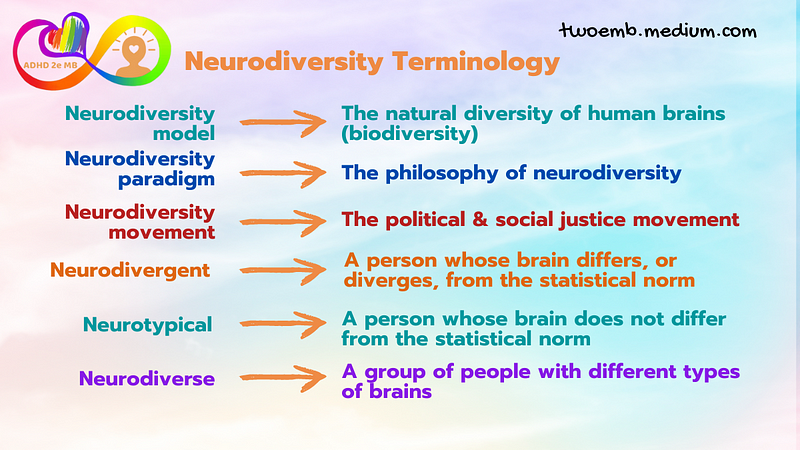
The concept of neurodiversity usually refers to perceived variations seen in cognitive, affectual, and sensory functioning differing from the majority of the general population or ‘predominant neurotype’, more usually known as the ‘neurotypical’ population” (Rosqvist et al., 2020).

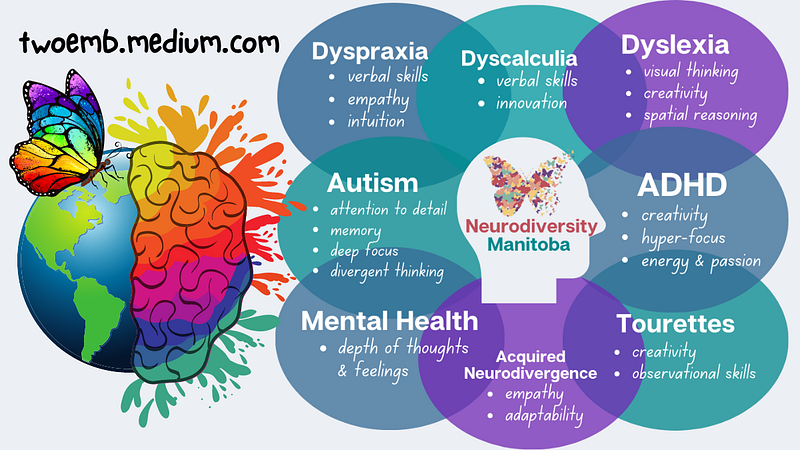
There are two primary models of neurodiversity, but they really complement each other rather than exist as separate entities.

The meaning will differ slightly for each individual who identifies as being neurodivergent, based on how they perceive themselves and what framework works best for them.
Created by author

The Ecological Model

The ecological model, previously described by Harvey Blume (1998), reframes neurocognitive diversity as a normal and healthy manifestation of biodiversity.

Just as biodiversity is critical to the health of ecosystems, neurodiversity asserts that neurological variation is not only natural, but is central to the success of the human species.

As Dr. Nick Walker stated in her new book, Neuroqueer Heresies:

“Neurodiversity is a natural, healthy, and important form of human biodiversity — a fundamental and vital characteristic of the human species, a crucial source of evolutionary and creative potential.”

— Dr. Nick Walker

The greater the biodiversity within an ecosystem, the more stable, adaptable and sustainable that system is. It follows that the more neurodiversity is respected and facilitated within a culture, the more stable, adaptable and sustainable that culture is.

Simply put, the ecological model of neurodiversity is the idea that we need changes and differences in our neurotypes for the health of humankind (à la biodiversity and evolution).
Created by author

The Socio-political model

While Singer embraces the ecological model, and states that neurodiversity is a subset of biodiversity, she posits the term biodiversity was coined in the 1980s as a political term to argue for the conservation of species.

Judy Singer coined the term neurodiversity in 1998,

“…a political term to argue for the importance of including all neurotypes for a thriving human society.”

A 2023 update

Diversity and inclusion are the antithesis of gate-keeping.

Neurodivergent refers to all neurologically divergent from typical.” — Kassiane Asasumasu
Screen shot provided by author

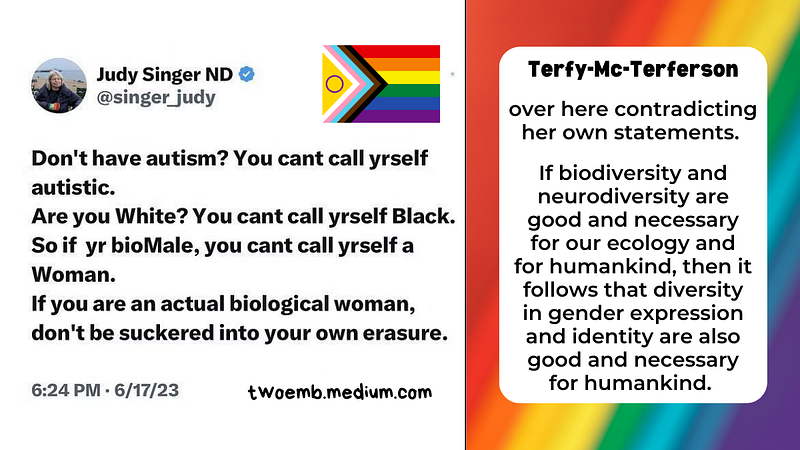
Terfy-Mc-Terferson was over on the twitter contradicting her own statements.

If biodiversity and neurodiversity are good and necessary for our ecology and for humankind, then it follows that diversity in gender expression, sexuality, and gender identity are also good and necessary for humankind.

Thankfully, Terfy doesn’t actually own the term neurodiversity. She may have coined it, but it belongs to the entire neurodivergent community, the majority of which is in support of inclusion, not exclusion.

Honouring and celebrating diversity of gender expression is not participating in the so-called “erasure” of “actual biological” women.

Just as welcoming anyone with a divergent neurotype into the neurodivergent community is good for the ND community, welcoming all women (and yes, that includes trans women) into womanhood is good for the gender (such as it is — being a social construct and all).

Terfy can suck an egg… or eat her words. Or both, I’m flexible.

Singer’s own paradigm supports inclusion

The neurodiversity paradigm focuses on depathologizing, and instead politicizing neurodivergence. To pathologize neurodivergence is to diagnose a normal variation as disordered, based on the assumption that it ‘should’ cause disease.

Autistic and other neurodivergent self-advocates characterize neurodiversity as a political term, an analytical lens for examining social issues such as inequity and discrimination, and a civil rights movement for the neurological minorities.

Neurodiversity is a political and civil rights movement for the neurological minorities.”— Judy Singer

Rather than focusing only on the ecological and evolutionary advantages of bio- and neurodiversity, this perspective encourages us to delve deep into the social constructs that have led to the othering of differences.

The neurodiversity movement seeks to call out and challenge social institutions which perpetuate the oppression of people whose neurocomplexities are outside of the majority.

Interesting. Or rather, sad. Someone who railed against institutional oppression is now perpetuating it.

A celebration of differences

According to Singer herself, there are four common goals in the Neurodiversity movement. They are to:

  1. Shift mainstream perceptions of marginalized neuro-minorities.
  2. Replace negative, deficit-based stereotypes of neuro-minorities with a more balanced valuation of their gifts and needs.
  3. Find valued roles for neurologically marginalized people.
  4. Show that all society benefits from the incorporation, inclusion, and celebration of neuro-minorities.

What the neurodiversity paradigm does say is that the current medical model is overly negative, deficit-focused, and puts the individual at the centre of the problem.

The current characterization of neurodivergent individuals is that we suffer because our brains operate outside of the norm, because our brains are different and therefore “disordered” or less-than, and we must learn to adapt to suit the needs of the majority.

Neurodiversity is affirming and inclusive

The neurodiversity paradigm does not dismiss or minimize the fact that people often suffer as a result of their differences, nor does it seek to police who can or cannot identify as neurodivergent.

“Neurodivergent refers to all neurologically divergent from typical.” — Kassiane Asasumasu

This is a social movement in which we — those of us who are neurodivergent — are working to educate others on the fact that what disables us comes more often from a lack of understanding, knowledge, acceptance, and accommodation by the general public, than from our divergent neurotypes themselves.

“Within in the social model of disability, when we say that a person is disabled, we mean that society isn’t properly set up to enable their participation, and instead is often set up in a way that creates barriers to their participation.” — Dr. Nick Walker

We’re saying stop calling us disordered and deficient as individuals, and look at how the larger systems and institutions are themselves disordered and deficient, and how those systems and institutions are disabling everyone.

Putting the responsibility on, and pointing the finger at, people with disabilities removes all accountability from the larger systems that actually have the power and resources to improve quality of life for everyone.

The impact is often greater on people who already have vulnerabilities and differences, but that does not mean there isn’t a negative impact on the general public at large.

We’re the canary in the coal mine, guys.
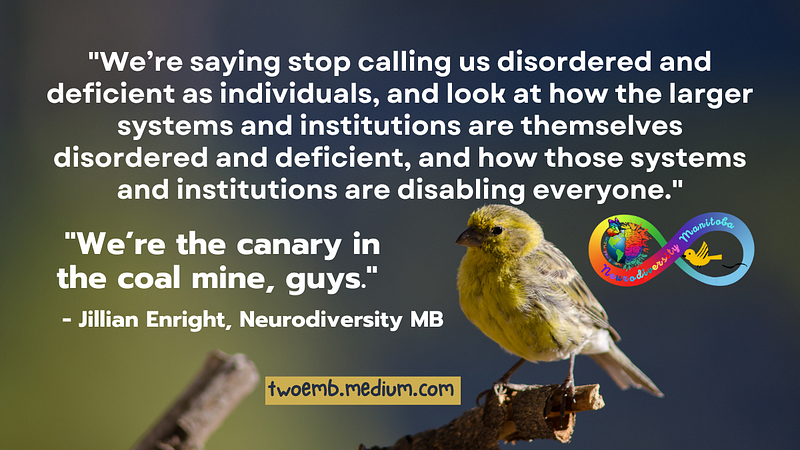
Quote & image by author

My Understanding

The neurodiversity paradigm does not reject accepting accommodation or supports. In fact, this paradigm accepts that nature is not perfect and some adaptations or changes result in problems for those individuals.

What it this paradigm does reject is the old assumption that different automatically means worse or less-than. The neurodiversity movement demands that all individuals be seen as valuable, and the gifts that come along with our differences be celebrated.

Variation and difference are neither inherently good nor bad. What sets us apart can make us great while also making our lives more difficult, which brings to mind one of my favourite quotes:

“Treat distress, not difference” — Joel Salinas.

Distress is defined by the individual, not their parents, co-workers, employer, teacher, or anyone else.

© Jillian Enright, Neurodiversity MB

When you join medium, as a member you’ll have access to unlimited reads for only $5 per month. If you use my referral link, I’ll earn a small commission.

If you’d prefer give a one-time tip, you can support my writing on Ko-Fi — also, it’s free to follow me on Facebook and LinkedIn!

Learn More

References

Asasumasu, Kassiane. (2020). Neurodiversity: Basic Terms & Definitions. (Nick Walker). Neuroqueer.com

Blume H. (1998). Neurodiversity. The Atlantic. http://www.theatlantic.com/magazine/archive/1998/09/neurodiversity/305909

Chapman, R. (2021). Neurodiversity and the Social Ecology of Mental Functions. Perspectives on Psychological Science. https://doi.org/10.1177/1745691620959833

Mcgee, M. (2012). Neurodiversity. Contexts, 11(3), 12–13. https://doi.org/10.1177/1536504212456175

pathologize. (n.d.) McGraw-Hill Concise Dictionary of Modern Medicine. (2002). Retrieved August 23 2021 from https://medical-dictionary.thefreedictionary.com/pathologize

Rosqvist H.B., Chown N., Stenning A. (eds.). (2020). Neurodiversity Studies: A New Critical Paradigm [Internet]. Routledge. Available from: https://www.ncbi.nlm.nih.gov/books/NBK568483

Singer, J. (1998). Odd People In: The Birth of Community Amongst People on the “Autistic Spectrum”: a personal exploration of a New Social Movement based on Neurological Diversity. [Honours thesis]. University of Technology.

Singer, J. (2020). What is Neurodiversity?. [Blog post]. https://neurodiversity2.blogspot.com/p/what.html

Walker, N. (2021). Neuroqueer Heresies: Notes on the neurodiversity paradigm, Autistic empowerment, and postnormal possibilities. Autonomous Press.

Neurodiversity
Adhd
Autism
Autistic
Advocacy
Recommended from ReadMedium