
Neurodiversity Stories
The social and political movement and its implications for Neurodivergent people
N is for… Neurodiversity!
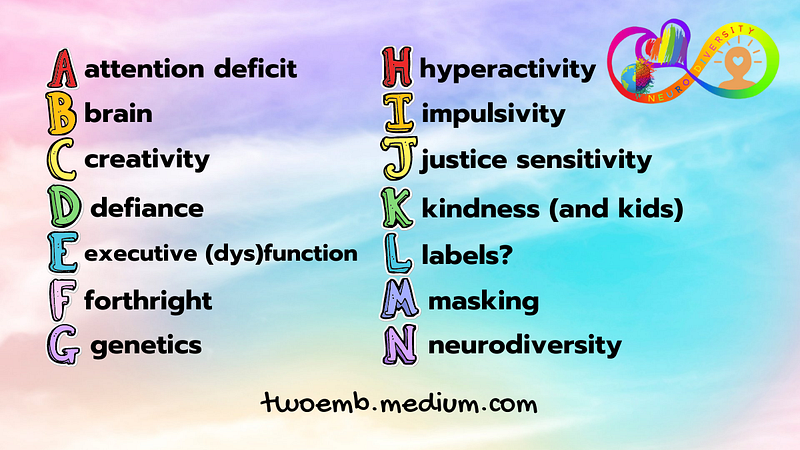
Instead of the usual “advent” calendar, I’ve been doing an A-B-C countdown to when santa comes. I started with A is for Attention Deficit and have been working my way through the alphabet, making a series of videos with some basic information.
Today I got to ’N’ for Neurodiversity, so I’m halfway there.
First and foremost, what is Neurodiversity?
The concept of neurodiversity usually refers to perceived variations seen in cognitive, affectual, and sensory functioning differing from the majority of the general population or ‘predominant neurotype’, more usually known as the ‘neurotypical’ population.” — (Rosqvist et al., 2020)
It is also:
“…a political term to argue for the importance of including all neurotypes for a thriving human society.”
— Judy Singer
The neurodiversity paradigm is empowering
The neurodiversity movement also gives us a framework for pushing back against social norms and the societal institutions that have oppressed us for being different.
“Neurodiversity is a political and civil rights movement for the neurological minorities.”
— Judy Singer
The neurodiversity movement seeks to call out and challenge social institutions which perpetuate the oppression of people whose neurocomplexities are outside of the majority.
“It simply names an indisputable fact about our planet, that no two human minds are exactly alike, and uses it to name a paradigm for social change.”
— Judy Singer
“The Neurodiversity Movement is a social justice movement that seeks civil rights, equality, respect, and full societal inclusion for the neurodivergent.”
— Dr. Nick Walker
The neurodiversity paradigm is a reframe
The neurodiversity paradigm has taken the pathology paradigm, which treats neurodivergent people as though they are defective, and turned it on its head.
As Dr. Nick Walker explains in her new book, Neuroqueer Heresies, the neurodiversity paradigm is a complete shift away from the old pathologizing model.
The Pathology Paradigm
- There is one “right,” “normal,” or “healthy” way for human brains and human minds to be configured and to function.
- If your neurological configuration and functioning diverge substantially from the dominant standard of “normal,” then there is Something Wrong With You.
The Neurodiversity Paradigm
- Neurodiversity — the diversity among minds — is a natural, healthy, and valuable form of human diversity.
- There is no “normal” or “right” style of human mind.
“Neurodiversity is a natural, healthy, and valuable form of human diversity.”
— Dr. Nick Walker
What neurodiversity is and is not
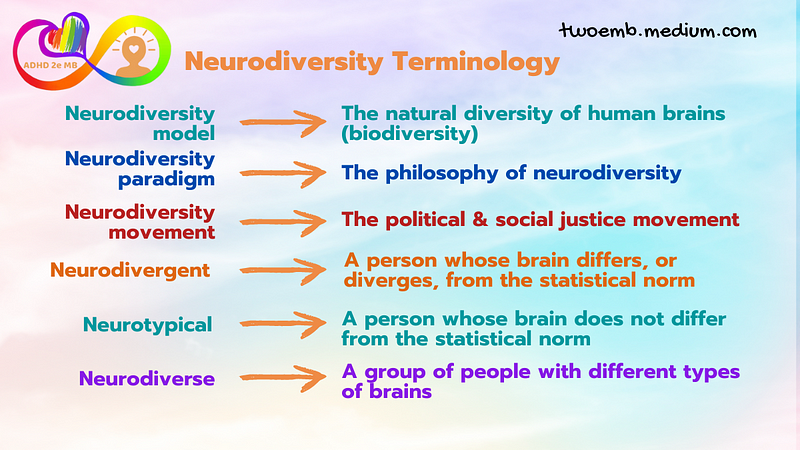
As Jesse Meadows explained, neurodiversity is not a euphemism for disorder, nor a synonym for Autistic or ADHD.
Neurodiversity reframes neurocognitive diversity as a normal and healthy manifestation of biodiversity.
Just as biodiversity is critical to the health of ecosystems, neurodiversity asserts that neurological variation is not only natural, but is central to the success of the human species.
Put another way, this means that when people have a diversity of brains and neurotypes, this is beneficial to humankind.
Neurodiversity is that variety, but the word does not refer to a person, nor to a group of people. It refers to the various neurotypes across individuals, or to the social and political movement.
Finding neurodiversity-affirming support and resources
When you join medium, as a member you’ll have access to unlimited reads for only $5 per month. If you use my referral link, I’ll earn a small commission.
References
Blume H. (1998). Neurodiversity. The Atlantic. http://www.theatlantic.com/magazine/archive/1998/09/neurodiversity/305909
Chapman, R. (2021). Neurodiversity and the Social Ecology of Mental Functions. Perspectives on Psychological Science, 16(6), 1360–1372. https://doi.org/10.1177/1745691620959833
Mcgee, M. (2012). Neurodiversity. Contexts, 11(3), 12–13. https://doi.org/10.1177/1536504212456175
Rosqvist H.B., Chown N., Stenning A. (eds.). (2020). Neurodiversity Studies: A New Critical Paradigm [Internet]. Routledge. Available from: https://www.ncbi.nlm.nih.gov/books/NBK568483
Singer, J. (1998). Odd People In: The Birth of Community Amongst People on the “Autistic Spectrum”: a personal exploration of a New Social Movement based on Neurological Diversity. [Honours thesis]. University of Technology.
Singer, J. (2020). What is Neurodiversity?. [Blog post]. https://neurodiversity2.blogspot.com/p/what.html
Walker, N. (2021). Neuroqueer Heresies: Notes on the neurodiversity paradigm, Autistic empowerment, and postnormal possibilities. Autonomous Press.


