
Finding Neurodiversity-Affirming Support
Understanding the difference between pathologizing and affirming approaches

If you or a family member are Neurodivergent and seeking support, how do you know what to look for?
For me, one of the most important qualities in a good coach, counsellor, tutor, or therapist is they are neurodiversity-affirming.
What does that mean?
Pathologizing is a focus on deficits, treating divergent brains as though they are sick and disordered. Professionals who pathologize focus on a person’s weaknesses, viewing differences as abnormalities.
Many focus on helping a person “fit in”, conform, and behave as neurotypical as possible. These approaches have been shown to be harmful.
Teaching an Autistic person to camouflage or mask their Autistic traits causes psychological distress and is even a risk factor for suicidality.
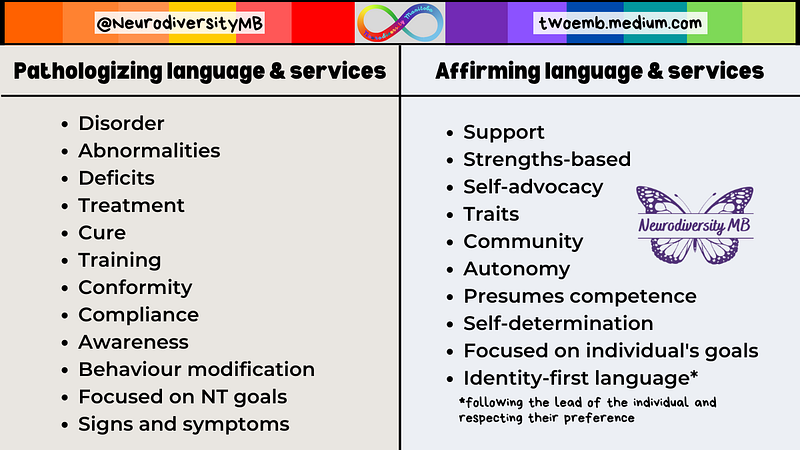
In contrast, an affirming approach is one that views neurodiversity as a positive part of human ecology. Different brains and neurotypes bring new perspectives, different ways of thinking and being, which is integral to a thriving society.
An affirming professional should help a person identify their strengths and areas of struggle, and help them utilize those strengths to manage the areas of difficulty. The challenges are identified by the client, not the professional, and the focus is on the client’s goals, not the goals of neurotypical people in their life.
Qualifications
There are many different ways a person can become an excellent coach, counsellor, therapist, or tutor.
One important factor is experience, both professional and personal. Personal means having lived experience as a neurodivergent person themselves, or as the family member of a neurodivergent person.
Another is training and education.
A person doesn’t need a formal education to be an excellent counsellor, but they do need to be knowledgeable. Experience is important, but on its own is not enough because each person’s lived experience will be different.
Some of the ways people can become knowledgeable consultants are:
- Personal lived experience
- Related professional experience
- Academic training
- Learning from others in the neurodivergent community
- Reading books and articles from scholars and others with lived experience
A prospective consultant or counsellor should be willing and able to:
- Show proof of their professional and academic credentials
- Talk about their personal and professional experience and how it guides their work
- Discuss specifically how they would support you or your family member if you were to hire them
- Describe their personal and professional philosophies when supporting neurodivergent people
Inquiry
If you set up a chat to discuss how they can help, the consultant or counsellor should be interested in:
- What your goals are and what you hope to get out of their time and support
- What has worked well for you in the past and what has been unhelpful
They should also ask about accommodations you might need to get the most out of your time together, and your preferred format for receiving support.
They should be open to, and interested in, receiving feedback from you regularly on what is working and if any changes are needed along the way.
Goals
The focus should be on your (or your family member’s) goals, not the consultant’s.
They should be helping you work toward those goals in a way that is respectful and primarily directed by you, with their expertise as a guide.
The long-term goals should be toward self-advocacy and autonomy, so you need less and less support the longer you work with that professional.
Respect
Most importantly, you should feel the consultant respects you and your family.
If the professional is pushing therapies you are not comfortable with, this is not respectful.
If you’re sitting in a meeting with a professional and they’re talking about your family member as though they’re not in the room, this is not respectful.
An effective counsellor should be working to build rapport with you and your family, seeking the most effective ways to connect and communicate. They should offer multiple communication methods and ways of engaging.
They should be willing to admit when they are not knowledgeable about something and seek to educate themselves. They should not talk over you, or other neurodivergent people, as though they know better because they are the professional.
A supportive consultant should be actively seeking to learn from the lived experiences of neurodivergent people, even if they are themselves neurodivergent. We should all continue to learn from one another, because each of us has valuable perspective and knowledge to contribute.
© Jillian Enright, Neurodiversity MB
Related Articles
Support my work
When you join medium, as a member you’ll have access to unlimited reads for only $5 per month. If you use my referral link, I’ll earn a small commission, and you’ll earn my undying gratitude.
If you’d prefer give a one-time tip, you can support my writing on Ko-Fi — also, it’s free to follow me on Facebook!
References
Cassidy, S., Bradley, L., Shaw, R., & Baron-Cohen, S. (2018). Risk markers for suicidality in autistic adults. Molecular autism, 9, 42. https://doi.org/10.1186/s13229-018-0226-4
Wilkenfeld, D.A., & McCarthy, A.M. (2020). Ethical Concerns with Applied Behavior Analysis for Autism Spectrum “Disorder”. Kennedy Institute of Ethics Journal 30(1), 31–69. https://doi.org/10.1353/ken.2020.0000


