
The Real Reasons We All Struggle with Emotions
Alexithymia, interoception, and emotional regulation
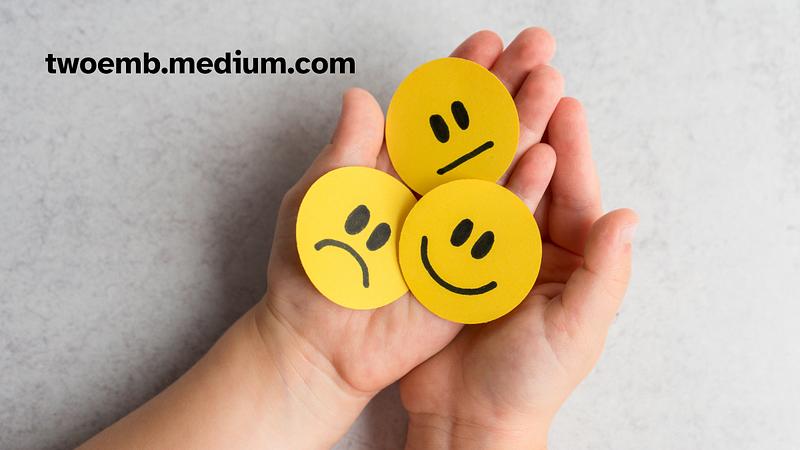
There are three primary reasons why we all struggle with emotional regulation, and with emotions in general. This isn’t about our inability to talk about our feelings, the problems begin before we even get to that point.
The first two reasons can be applied to just about anyone, and the last one is primarily applicable to Autistics and other neurodivergent folks.
We’re taught to ignore and mistrust our own bodies
Children are indirectly taught not to listen to what their bodies are telling them. This despite the fact that some of our more “modern” (yet still out-dated) social-emotional learning (SEL) programming teaches children to listen to their bodies.
“I’m hungry.” — “We just had lunch, you can’t possibly be hungry already!”
“I need to go to the bathroom.” — “We just had a bathroom break, you can wait until recess time.”
“I don’t like this food.” — “You’re expected to eat the dinner in front of you!”
“They hurt my feelings.” — “Sticks and stones, just ignore them.”
And so on and so forth.
When the messaging in our (brief, often infrequent) SEL lessons aren’t genuinely implemented, and the adults don’t role-model the concepts therein, this becomes very confusing for students. They inadvertently learn to disregard ideas which don’t line up with their real-world experiences.
SEL is useless if it is not embraced as a culture and communication style. If SEL is not integrated into every lesson and every interaction with the students, then they have no context for the lessons, and no opportunity to apply and practice what they are learning.
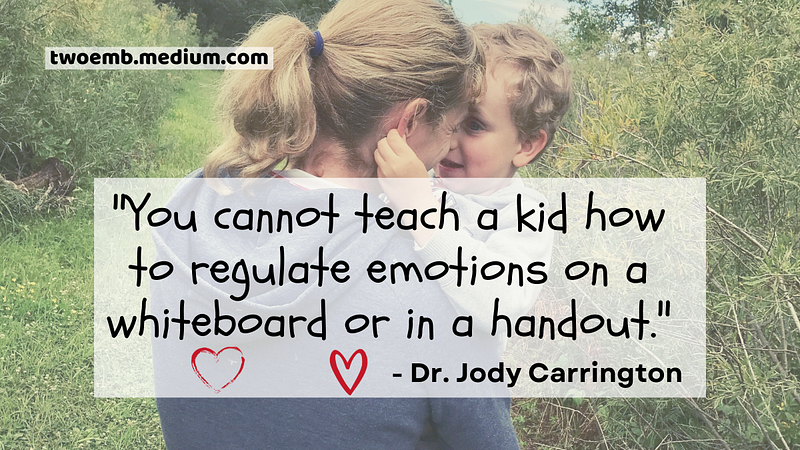
We need to teach children to trust their own bodies, to encourage and support them in paying attention to what their bodies are trying to tell them, even — perhaps especially — when it’s inconvenient for us.
This means believing them when they tell us something about their own bodies, respecting and understanding that their experiences will differ from ours.
Integrating interoception
Interoception refers to our ability to recognize and interpret the signals coming from within our own bodies. Generally we think of bodily needs such as hunger, thirst, or needing to go to the bathroom.
Our awareness and understanding of those messages are part of interoception, yes. What a lot of people don’t know (because we’re not taught!) is that interoception is a key starting point to recognizing, identifying, understanding, and responding to our emotions.
Think of the last time you felt an intense emotion.
When I’m sad, I feel the energy start to drain from my body. I feel my muscles almost sagging. I might feel a burning sensation or a sick feeling in my tummy. My breathing might become ragged, or I might breathe more deeply if I’m trying to stop myself from crying.
When I’m angry, however, my body responds very differently. My muscles become very tense, my face feels hot, and my breathing is fast. My heart starts pounding in my chest, my body feels the need to move and move hard. I might slam a door, stomp my feet, or raise my voice as a result.
While there are some commonalities, everybody’s internal experience of their emotions is different.
Unfortunately this is only starting to enter some aspects of SEL instruction, but many of these programs are sorely lacking. Instead they use colours or emojis to indicate certain emotion words.
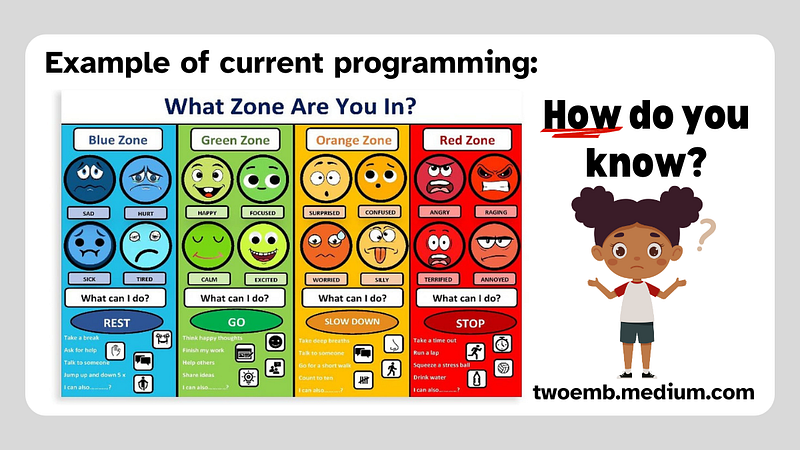
These programs offer a good starting point: giving children words for their feelings, helping them determine what level of energy (or what “zone”) is needed for which types of activities. That’s not necessarily a bad thing.
However, they simply give kids charts with these colours, pictures, and words and ask them to identify how they are feeling. What if they don’t know, how are they supposed to figure that out?
A lot of educators make the mistake of teaching this with the underlying message that the “green” zone is the ideal zone, and that regulated means calm. It is not, and it does not.
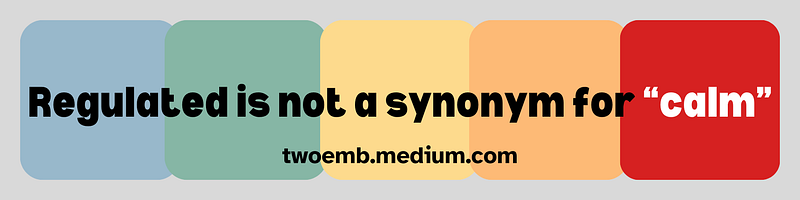
The ideal zone is the one which best fits the current situation. If you’re playing a hockey game, you’ll want to be in the yellow zone. You want to have a burst of energy, you want to be fired up, and you want to be motivated. The red zone will lead you to the penalty box, but the blue zone will keep you on the bench.
If someone is trying to hurt you, the red zone is necessary and self-protective. If you’re sick or haven’t had enough sleep, the blue zone is a way for your body to communicate that you need to get some rest.
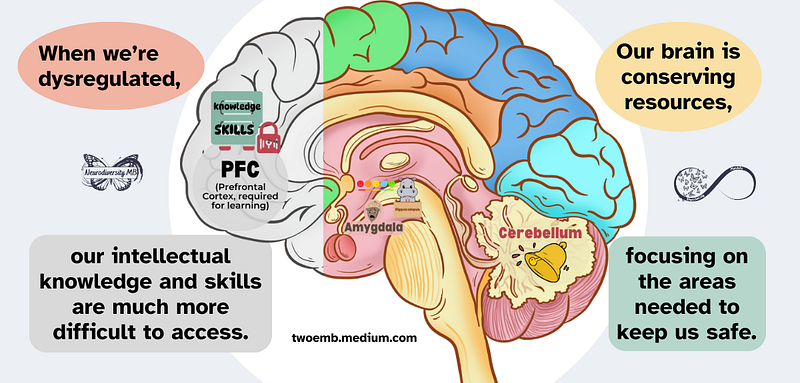
Neurodivergent folks in particular tend to struggle with interoception. We may not notice those signals our bodies are sending out until they are intense. When we’re teaching emotional regulation, these skills require access to our prefrontal cortex (PFC), the part of our brains responsible for reasoning, problem-solving, and logic.
Well, if we don’t notice we’re dysregulated until we’re already in survival mode, then any intellectual knowledge we have is inaccessible while our brain dedicates all available resources to keeping us safe.
Neuronormativity
Neuronormativity is the assumption that being neurotypical — meaning having a brain that is typically-developing and typically operating— is best.
Think of how, in North America, white is the standard default. While inclusion and diversity are improving, the majority of advertisements, movies, and other media we see feature white people.
Similarly, heteronormativity assumes that heterosexuality is the default, and anything else is abnormal. Most of the families and couples represented in popular media feature cis-gendered, heterosexual couples. This is also improving, but representation remains scarce.
When SEL programs are developed, neurotypical is considered the default. The lessons are created with neurotypical students — with neurotypical brains and bodies — in mind.
A significant part of being Autistic is experiencing the sensory world differently from the neurotypical majority, in addition to often struggling with interoception.
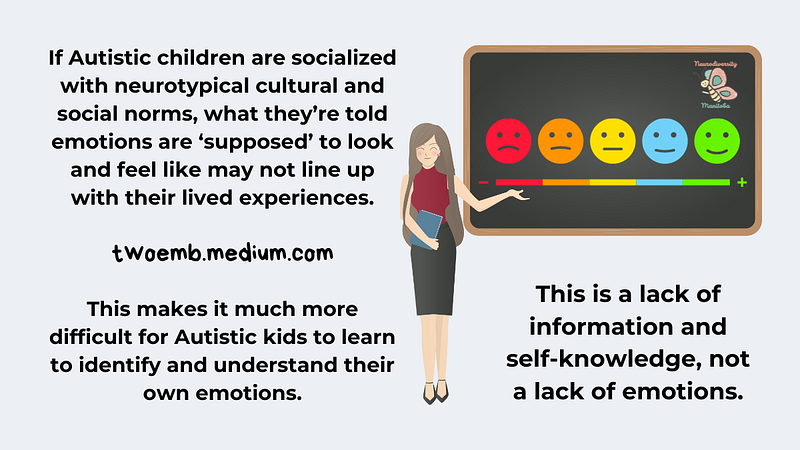
While neurotypical (NT) people might describe similar internal experiences or physical feelings associated with emotions, these may vary significantly from the experiences of Autistic people.
We’re being taught to suppress our feelings when our behavioural expressions of emotions are inconvenient to others. We’re taught about ways of processing, expressing, and managing our emotions which are common to NTs, but often don’t line up with our own experiences.
Put it all together…
and what do you get?
We’re taught one thing in our lessons while people’s actions communicate an entirely different message. We’re told to suppress our emotions when our behaviours are inconvenient.
We’re expected to be able to identify, label, describe, and manage our emotions which don’t even match up with those described on the worksheets handed out in class.
When we can’t make sense of this unfamiliar information we’re labelled as unfeeling, lacking in emotional awareness, and as having deficits in social and emotional communication.
Why is it every time the adults can’t figure out how to best teach a skill or support a child, the problem ends up being the child?
© Jillian Enright, Neurodiversity MB
Related Articles
Ways to support my work
You can leave a “tip” on Ko-Fi at https://Ko-Fi.com/NeurodiversityMB
Become a paid subscriber to my Substack publication
Check out my online store at https://NeurodiversityMB.ca/shop
Read and share my articles from twoemb.medium.com
Learn more
References
Carrington, J. (2020). Kids These Days: A game plan for (re)connecting with those we teach, lead, and love. IMpress Books.
Goodall, E., & Brownlow, C. (2022). Interoception and Regulation: Teaching skills of body awareness and supporting connection with others. Jessica Kingsley Publishers.
Mahler, K., Hample, K., Jones, C., Sensenig, J., Thomasco, P., Hilton, C. (2022). Impact of an Interoception-Based Program on Emotion Regulation in Autistic Children. Occupational Therapy International. https://doi.org/10.1155/2022/9328967
Milton, D. (2012). On the ontological status of autism: the ‘double empathy problem’. Disability & Society, 27(6), 883–887. https://doi.org/10.1080/09687599.2012.710008
Walker, N. (2021). Neuroqueer Heresies: Notes on the neurodiversity paradigm, Autistic empowerment, and postnormal possibilities. Autonomous Press.


