avatarJillian Enright

Free AI web copilot to create summaries, insights and extended knowledge, download it at here

3736

Abstract

ent? I primarily work from home and I drink a lot of coffee and water, so I get up a lot.</p><p id="2d73">Granted, I’m an extremely independently-minded (aka stubborn), self-employed adult with ADHD, so I really <i>can</i> do essentially whatever I want. Although I do need to pay my bills, so if my process didn’t work for me at all, then I’d be in a bit of trouble.</p><p id="da56">Many adults get up from their desk to refill their water bottles, grab a coffee, go to the washroom, to visit a colleague or perhaps the vending machine. For the most part, as long as we get our work done and we aren’t disrupting others, no one really cares how many times a day we pee (except maybe our doctors).</p><p id="f4c5">We do this because we can, but also because it helps us regulate our attention. When we’re staring at the screen puzzling over something we know we can figure out, sometimes walking away for a few minutes is all we need to come back and see the problem with fresh eyes.</p><p id="9d47">Apparently kids, whose attention spans are shorter and brains less developed than ours, aren’t allowed to exercise this need because some adults feel the need to control and micro-manage every aspect of their lives.</p><figure id="b67b"><img src="https://cdn-images-1.readmedium.com/v2/resize:fit:800/1*F-vqHP8z0WyhrzrNz9CFsA.png"><figcaption>Image created by author — (Seinfeld created by Larry David and Jerry Seinfeld)</figcaption></figure><h2 id="c405">Would chaos ensue?</h2><p id="75dc">If kids were allowed to get up and use the washroom or get a drink whenever they wanted, teachers didn’t keep track, and schools didn’t require students to have a hall pass, would it be chaos? Would children be milling about all day, constantly getting up and leaving class?</p><p id="5664">Actually, <i>no</i>.</p><p id="a45d">I worked in an alternative school setting where children were free to move about as they needed, as long as it was safe and not disruptive. Sure, students fidgeted and wiggled, <i>because they’re kids</i>. Yet somehow the children learned, and there was not complete pandemonium.</p><figure id="1cd2"><img src="https://cdn-images-1.readmedium.com/v2/resize:fit:800/1*UqcUyuTRz-uQAPzD1wSEKw.png"><figcaption>Created by author on Canva — (Lord of the Flies written by William Golding)</figcaption></figure><p id="84af">Kids <a href="https://readmedium.com/deny-recess-at-your-peril-9703764ed26c"><i>need</i> to move</a> their bodies, and plenty of adults need some form of movement to help them focus as well.</p><p id="727e">My spouse — who definitely does <i>not</i> have ADHD — still doodles during meetings. Plenty of people wiggle their feet, tap their pens, or twirl their hair. Nobody tells <i>them</i> to sit still — and truthfully, if someone tried to tell me to demonstrate “<a href="https://readmedium.com/behaviourism-is-not-inclusion-aecc591b2201#36f8">whole body listening</a>”, they’d get an earful from me.</p><h2 id="2647">This isn’t really about pee breaks</h2><p id="676f">This is about a lot more than whether teachers try to limit their student’s bathroom breaks. It’s about trusting children to know their own bodies better than we do, and supporting them to trust their own <a href="https://readmedium.com/interoception-and-emotion-regulation-fd6d5b877f2c">bodily signals</a>, something called <a href="https://readmedium.com/interoception-and-emotion-regulation-fd6d5b877f2c">interoception</a>.</p><p id="9767">Interoception is a key first step toward developing <a href="https://readmedium.com/interoception-and-emotion-regulation-fd6d5b877f2c">self-regulation</a> skills. Out of one side of our mouth we’re teaching children these so-called <a href="https://readmedium.com/education-sponsore

Options

d-gaslighting-f2baf482d1d6">social-emotional programs</a>, while from the other we’re telling children to sit down, stay in their seats, and stop wiggling.</p><p id="482d">It’s as though we’re saying, “<i>trust and listen to your body… unless it’s inconvenient for the adults</i>”.</p><p id="e845">It’s not the responsibility of children to make our lives easier, it’s <i>our</i> responsibility to make <i>their</i> lives easier.</p><p id="cded" type="7">Trust and listen to your body… unless it’s inconvenient for the adults.</p><p id="990b">© Jillian Enright, Neurodiversity MB</p><figure id="b94e"><img src="https://cdn-images-1.readmedium.com/v2/resize:fit:800/1*4cP-h7xc9_flt99pyikttw.png"><figcaption></figcaption></figure><p id="5564"><i>When you join medium, as a member you’ll have access to unlimited reads for only $5 per month. If you use <a href="https://twoemb.medium.com/membership">my referral link</a>, I’ll earn a small commission, and you’ll earn my undying gratitude.</i></p><p id="7de6"><i>If you’d prefer give a one-time tip, you can <a href="https://ko-fi.com/neurodiversitymb">support my writing on Ko-Fi</a> — also, it’s free to <a href="https://facebook.com/NeurodiversityMB">follow me on Facebook</a>!</i></p><h1 id="3d8d">Related Stories</h1><div id="a598" class="link-block"> <a href="https://readmedium.com/deny-recess-at-your-peril-9703764ed26c"> <div> <div> <h2>Let Kids Play And Be Heard</h2> <div><h3>Denying recess, planned ignoring, and behaviour contracts are counter-productive</h3></div> <div><p>medium.com</p></div> </div> <div> <div style="background-image: url(https://miro.readmedium.com/v2/resize:fit:320/1*9eGrl5L0IjWolZCJjb2xVw.png)"></div> </div> </div> </a> </div><div id="1003" class="link-block"> <a href="https://readmedium.com/children-are-entitled-to-autonomy-da05c2685d5d"> <div> <div> <h2>Children Are Entitled To Autonomy</h2> <div><h3>I choose joyful chaos over despondent deference</h3></div> <div><p>medium.com</p></div> </div> <div> <div style="background-image: url(https://miro.readmedium.com/v2/resize:fit:320/1*AiT9G3oglEK7Lm6MKoLOww.png)"></div> </div> </div> </a> </div><div id="f7eb" class="link-block"> <a href="https://readmedium.com/stop-micro-managing-students-and-employees-22699ad75761"> <div> <div> <h2>Stop Micro-Managing Students And Employees</h2> <div><h3>We need to stop trying to dictate how children, students, and employees regulate themselves</h3></div> <div><p>medium.com</p></div> </div> <div> <div style="background-image: url(https://miro.readmedium.com/v2/resize:fit:320/1*FpDOTcP7pqr6Jz8c4jUUPA.png)"></div> </div> </div> </a> </div><h2 id="05e5">References</h2><p id="a786">Jeyanthi, S., Arumugam, N. & Parasher, R.K. (2019). Effect of physical exercises on attention, motor skill and physical fitness in children with attention deficit hyperactivity disorder: a systematic review. <i>ADHD Attention Deficit Hyperactivity Disorders 11</i>, 125–137. <a href="https://doi.org/10.1007/s12402-018-0270-0">https://doi.org/10.1007/s12402-018-0270-0</a></p><p id="c7d9">Sahlberg, P., & Doyle, W. (2019). <i>Let the Children Play: how more play will save our schools and help children thrive</i>. Oxford Press.</p></article></body>

Excuses Versus Self-Regulation

We need to trust kids and encourage them to trust their own experiences

Created by author on Canva

Airing of grievances

It bothers me when adults say that children are “making excuses” or avoiding their work if they ask to go get a drink of water or use the washroom more often than the adults deem “necessary”.

I mean, first of all, how would you know? The child may genuinely need to use the washroom or may genuinely be thirsty.

If a child says they are thirsty and we say “you can’t be thirsty, you just went for a drink of water a few minutes ago,” not only are we invalidating their experience and saying we don’t trust them, we are also saying they shouldn’t listen to and trust their own body’s signals.

(Then we wonder why kids struggle with interoception).

Secondly, who cares whether they are truly thirsty or not? Does it really harm them or anyone else if they take a short break?

Perhaps instead of calling it avoidance, we call it self-regulation. We frequently complain that children have poor self control, but then we shut down their attempts at practicing regulation strategies.

A child who takes frequent, short breaks may actually focus better over the long-term because they are regulating their attention and listening to their body, getting up to move when they feel the need to do so.

Plenty of research demonstrates the positive impact of exercise on memory, focus, and attention. Long periods of unstructured play outdoors is ideal, but little breaks to stretch one’s legs are also beneficial.

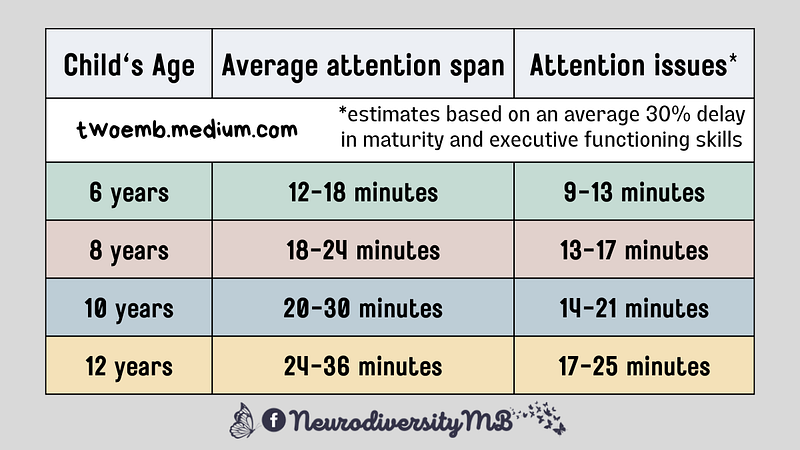
The average subject period in elementary school is approximately 40 minutes in length, depending on the school, the teacher, and age of the students. The attention spans of school age children (6–12 years old) range between 12–36 minutes, and those are estimates based on neurotypical averages.

Students with ADHD, Autism, learning disabilities, and other neurodevelopmental differences often have shorter attention spans than their peers.
Created by author

Double standards

There often seems to be a double standard between what we expect and allow from adults, and what we expect and allow from children.

Don’t we all do this, take “unnecessary” breaks, to some extent? I primarily work from home and I drink a lot of coffee and water, so I get up a lot.

Granted, I’m an extremely independently-minded (aka stubborn), self-employed adult with ADHD, so I really can do essentially whatever I want. Although I do need to pay my bills, so if my process didn’t work for me at all, then I’d be in a bit of trouble.

Many adults get up from their desk to refill their water bottles, grab a coffee, go to the washroom, to visit a colleague or perhaps the vending machine. For the most part, as long as we get our work done and we aren’t disrupting others, no one really cares how many times a day we pee (except maybe our doctors).

We do this because we can, but also because it helps us regulate our attention. When we’re staring at the screen puzzling over something we know we can figure out, sometimes walking away for a few minutes is all we need to come back and see the problem with fresh eyes.

Apparently kids, whose attention spans are shorter and brains less developed than ours, aren’t allowed to exercise this need because some adults feel the need to control and micro-manage every aspect of their lives.
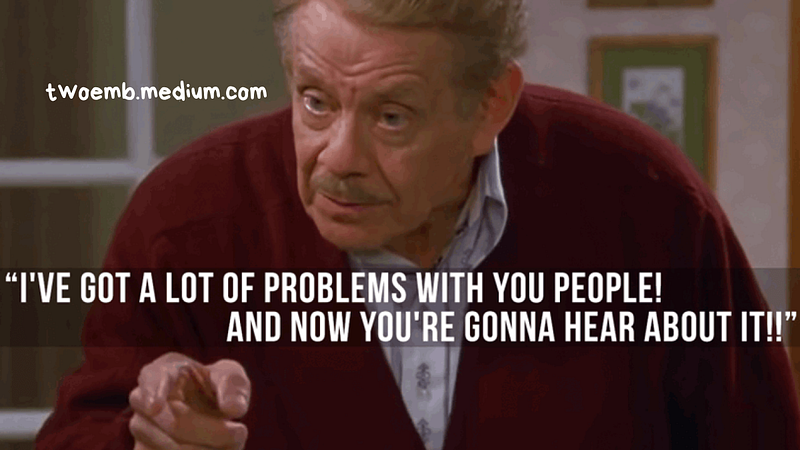
Image created by author — (Seinfeld created by Larry David and Jerry Seinfeld)

Would chaos ensue?

If kids were allowed to get up and use the washroom or get a drink whenever they wanted, teachers didn’t keep track, and schools didn’t require students to have a hall pass, would it be chaos? Would children be milling about all day, constantly getting up and leaving class?

Actually, no.

I worked in an alternative school setting where children were free to move about as they needed, as long as it was safe and not disruptive. Sure, students fidgeted and wiggled, because they’re kids. Yet somehow the children learned, and there was not complete pandemonium.

Created by author on Canva — (Lord of the Flies written by William Golding)

Kids need to move their bodies, and plenty of adults need some form of movement to help them focus as well.

My spouse — who definitely does not have ADHD — still doodles during meetings. Plenty of people wiggle their feet, tap their pens, or twirl their hair. Nobody tells them to sit still — and truthfully, if someone tried to tell me to demonstrate “whole body listening”, they’d get an earful from me.

This isn’t really about pee breaks

This is about a lot more than whether teachers try to limit their student’s bathroom breaks. It’s about trusting children to know their own bodies better than we do, and supporting them to trust their own bodily signals, something called interoception.

Interoception is a key first step toward developing self-regulation skills. Out of one side of our mouth we’re teaching children these so-called social-emotional programs, while from the other we’re telling children to sit down, stay in their seats, and stop wiggling.

It’s as though we’re saying, “trust and listen to your body… unless it’s inconvenient for the adults”.

It’s not the responsibility of children to make our lives easier, it’s our responsibility to make their lives easier.

Trust and listen to your body… unless it’s inconvenient for the adults.

© Jillian Enright, Neurodiversity MB

When you join medium, as a member you’ll have access to unlimited reads for only $5 per month. If you use my referral link, I’ll earn a small commission, and you’ll earn my undying gratitude.

If you’d prefer give a one-time tip, you can support my writing on Ko-Fi — also, it’s free to follow me on Facebook!

Related Stories

References

Jeyanthi, S., Arumugam, N. & Parasher, R.K. (2019). Effect of physical exercises on attention, motor skill and physical fitness in children with attention deficit hyperactivity disorder: a systematic review. ADHD Attention Deficit Hyperactivity Disorders 11, 125–137. https://doi.org/10.1007/s12402-018-0270-0

Sahlberg, P., & Doyle, W. (2019). Let the Children Play: how more play will save our schools and help children thrive. Oxford Press.

Education
Parenting
Schools
Adhd
Back To School
Recommended from ReadMedium