
Supporting Students Through Task Avoidance
Spoiler alert: doubling down on the pressure will backfire

Back to school
This past week was the first week back to school for students in our community. With a new school year come new friends, new achievements, and of course, new challenges.
Two difficulties I often hear discussed by parents and school staff are school refusal and task avoidance.
School refusal is when children try everything in their power to not go to school at all. They may be anxious or scared. When I was being bullied at school, I tried to fake sick as often as possible.
Eventually my doctor told my mother to take my temperature. If I didn’t have a fever, she was to send me to school.
The problem with this approach is it does nothing to address the underlying causes of school avoidance. It punishes the child (in this case, me) for trying to avoid something that is causing them distress.
Task avoidance is when children resist completing school work. Many adults interpret this as willful, intentional behaviour. They may say the child just doesn’t want to do it, that they’re “lazy” or defiant.
Get curious
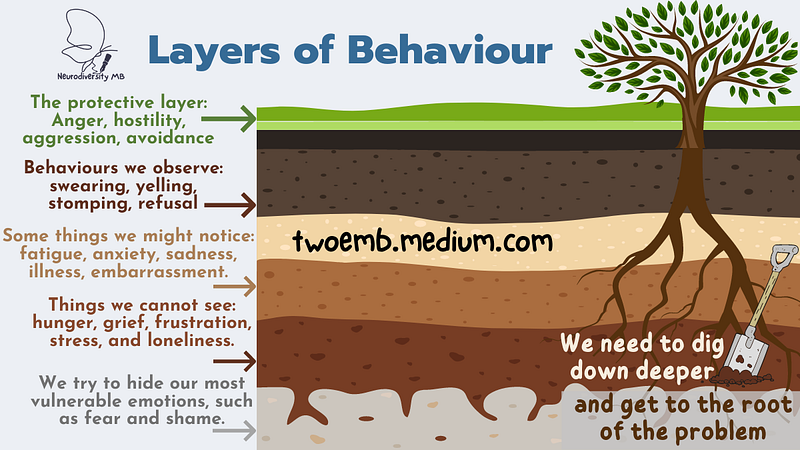
When this happens, we need to become curious, seeking to understand, rather than engaging in power struggles with students.
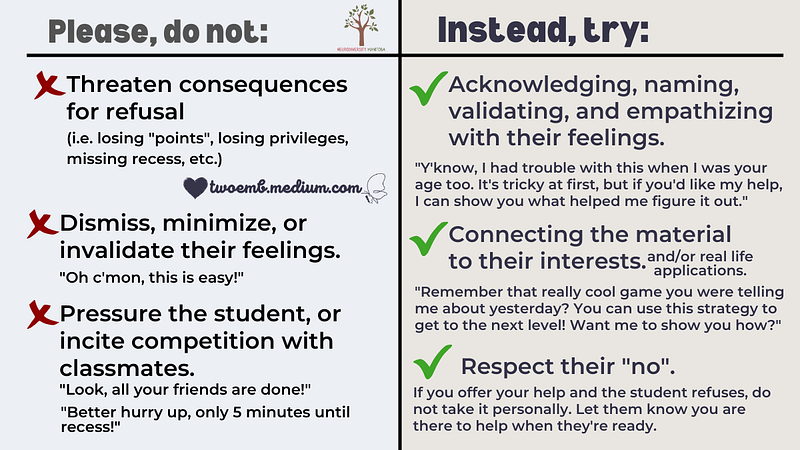
Please, do not
Threaten consequences for refusal:
- Losing points
- Having their “rating” or colour changed on a classroom chart
- Losing privileges
- Missing recess
- Being told they’ll have to leave class if they’re not listening (i.e. go to the principal’s office, see the guidance counsellor, or sit in the hall)
Dismiss, minimize, or invalidate their feelings:
- “Oh c’mon, this is easy!”
- “You have to do it whether you like it or not.”
Pressure the student, or incite competition with classmates.
- “Look, all your friends are done!”
- “Better hurry up, only 5 minutes until recess!”
- This can make the student feel ashamed, inadequate, or increase their anxiety.
- Students who are already struggling may shut down at this point.
Take the behaviour personally
- Assuming the child is being intentionally “defiant” or noncompliant.
Unpopular opinion
Threatening consequences, pressuring students, and forcing them to do tasks which they are not presently ready to try are forms of bullying.
Threats signal to the child that the adult doesn’t know how to deal with the situation and is resorting to punitive measures. It is not okay to leverage one’s position or power over a child in order to get them to do what we want.
Not only does this harm one’s relationship with that child, it also causes them to develop mistrust in adults, and often increases so-called “oppositional” behaviour.
It is not okay to leverage one’s position or power over a child in order to get them to do what we want.
Instead, try
Acknowledging, naming, validating, and empathizing with their feelings:
- “Y’know, I had trouble with this when I was your age too. It’s tricky at first, but if you’d like my help, I can show you what helped me figure it out.”
Connecting the material to their interests, and/or real life applications:
- “Remember that really cool game you were telling me about yesterday? You can use this strategy to get to the next level! Want me to show you how?”
Respect their “No”:
- If you offer your help and the student refuses, do not take it personally.
- Let them know you are there to help when they’re ready.
If the student requires accommodations, ensure you are following their education plan:
- “I’m sorry, I forgot to ask if you would like your wobble chair (fidget tool, ear protection, sensory item, etc.) today, might that help a bit?”
- “It’s pretty loud in here right now, do you want to stay in the classroom, or would you prefer to work in a quieter space?”
- “Does your body feel like you need a movement break before giving this a try?”
- “I know it looks like a lot of writing. What about just trying question #1, then taking a break, and we’ll see how you’re feeling then?”
Simply ask the student:
(Depending on the student’s capabilities, personality, preferences, needs, etc.)
- “Is there something you need right now?”
- “What do you think might help?”
- “Your body is looking pretty tense (like you’re upset, mad, frustrated, sad, etc.) right now, what’s up?”
Reconnect first, teach second
- If a student is feeling disconnected from their educator, or their classroom community, this first must be addressed before trying to teach them.
- The relationship must come first in order for a student to feel safe enough to take chances, make mistakes, ask for help, and challenge themselves.
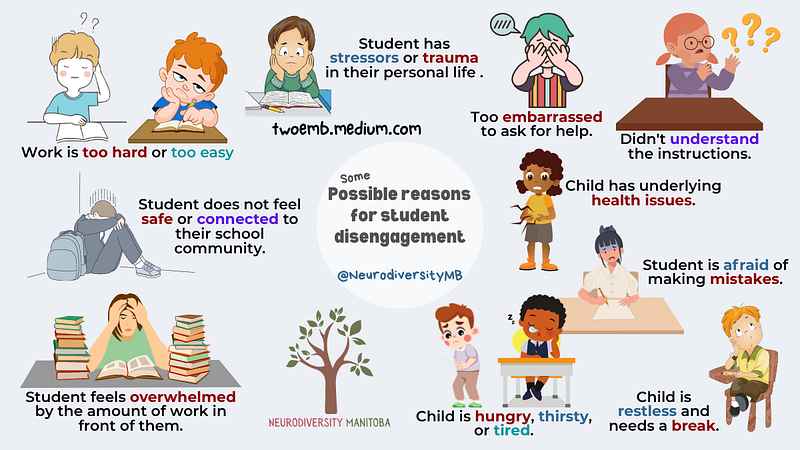
Possible reasons for student disengagement
Student has stressors or trauma in their personal life:
- Poverty
- Abuse
- Bullying
- Addictions (self or family members)
- Domestic violence
- Interpersonal conflict
- Child is hungry, thirsty, or tired
- Student does not feel safe or connected to their school community
Student didn’t understand the instructions:
- Too embarrassed to ask for help.
- Student is afraid of making mistakes.
- Student feels overwhelmed by the amount of work in front of them.
- Work is too hard or too easy
Child’s needs are not being met in the classroom:
- Child is restless and needs a break.
- School staff are not following the student’s education plan.
Child has underlying health issues:
- Mental health struggles
- Physical health challenges
- Unidentified learning disabilities
- Other disabilities
- Neurodivergence (ADHD, autism, OCD, anxiety, etc.)
Probably misses his old glasses
Task avoidance could be something as simple as a child needing glasses and no one has realized this yet.
During the pandemic we skipped our son’s annual eye exam due to office closures and Covid concerns, as he wasn’t yet eligible for his vaccination.
One day in class he told his teacher he couldn’t see what was on the white board. According to my son, his teacher stood beside his chair and sarcastically said, “well you must need glasses then, because I can see it just fine from here.”

Yes, that might be a concern to share with the child’s parents, don’t you think?
Instead, nothing was said. We heard about it from our son weeks later, when the subject came up over dinner. I booked an eye exam and, lo and behold, our son really did need glasses for reading from a distance.
I’m not sure what the teacher was thinking, or if perhaps she had intended to alert us and forgot — but it sounded, from our son’s perspective, as though she assumed he was making excuses and didn’t want to do the work.
This is what happens when adults assume children are being willful or disobedient without giving them the benefit of the doubt.
“Attribute to children the best possible motive consistent with the facts.” — Alfie Kohn
© Jillian Enright, Neurodiversity MB

When you join medium, as a member you’ll have access to unlimited reads for only $5 per month. If you use my referral link, I’ll earn a small commission, and you’ll earn my undying gratitude.


