
Stop Micro-Managing Students & Employees
We need to stop trying to dictate how children, students, and employees regulate themselves

Why do we care?
Classrooms, offices, job interviews, even online lectures — it seems everywhere you turn, someone is trying to tell you how to present yourself.
Truthfully, it’s getting a little ridiculous.
During the months and years of online learning, I heard complaints from plenty of parents about teachers insisting students have their cameras on during class, so they can be sure they are paying attention.
I appreciate that teachers want to support their students to learn the material, but with all due respect, some people need to pick their battles.
I’ve heard from some students who actually preferred online learning because they could turn off their camera. Some felt less pressure and self-consciousness, or less visual over-stimulation, and found they could focus better on the class.
Many felt free to fidget, stim, move, sit in awkward positions — do whatever their body needed to — without distracting others, or being told to “sit properly”.
Now most elementary-aged students are back to in-person learning, and the micro-managing of their bodies ramps up.
What’s with this obsession over sitting nicely or properly?
Some classrooms incorporate behaviour management programs which give students points for things like sitting “nicely” in class.
What exactly does “sitting nicely” mean anyway, and why do we care so much? I mean, I’m nearly 40 years old, have been a successful entrepreneur for 12 years, have two degrees, and I’ve never sat “properly” or “nicely” a day in my life.
I often work while sitting outside, at my kitchen table with my feet tucked under me, or with my legs stretched out on my couch. I sit with my legs crossed in our home office chair, rather than putting my feet on the floor.
My feet frequently go numb because I’ve been sitting on them, but sitting in the usual way does not work for me, I find it highly uncomfortable.
This brings me to my next concern: An ableist and controlling concept taught in many classrooms called “whole body listening”.
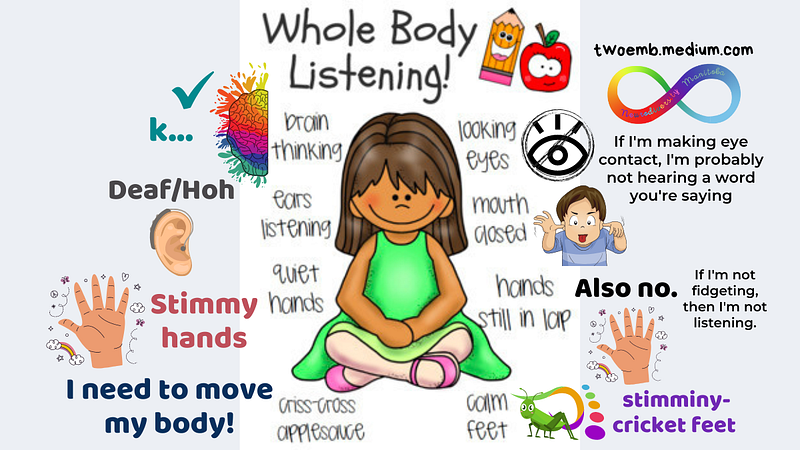
Whole body listening is something taught to educators and school staff as part of our Inclusive Education framework, and is most decidedly not inclusive.
It (unfortunately) looks like this:
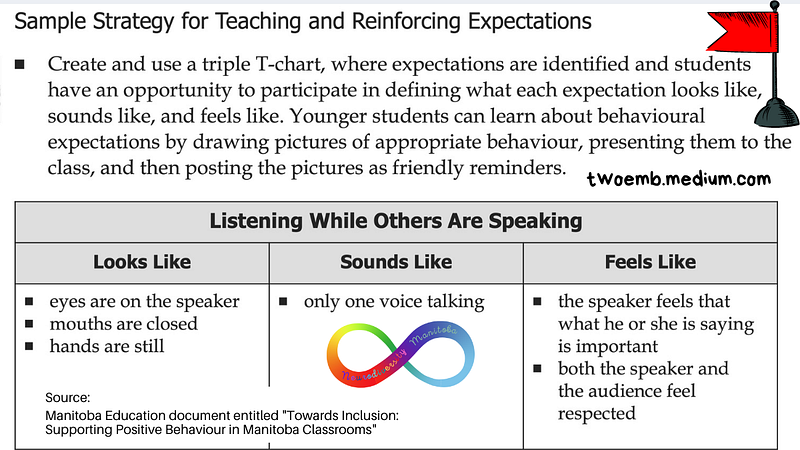
I’ll explain why these, and other similar classroom expectations, are ableist, controlling, and not inclusive.
Eyes are on the speaker
Not if you want those of us who are uncomfortable with prolonged eye-contact to actually hear and comprehend anything the speaker is saying.
Many neurodivergent people may look around while listening and can listen with their ears. Forcing eye contact is disrespectful and controlling.
Calm feet & hands in lap
Seriously, we need to micro-manage how someone has their hands and feet now too? I do stimminy-cricket feet, where I stim by rubbing my feet together.
It’s relaxing. I can still work, read, write, pay attention, and learn, even if my feet are wiggling, so mind your business.
Quiet hands/hands are still
If I had to focus on keeping my hands still, I wouldn’t hear a thing because it would use up all of my mental energy not to fidget.
Stimmy hands, fidgeting, doodling, etc. are all valid ways for a person to self-regulate and maintain their focus.
Like I said, as long as students are being safe and not disrupting others, mind your business.
Criss cross applesauce
I only sit criss-cross applesauce when it is entirely awkward for me to do so, like in our swivelling office chair. If I were sitting on the floor there is no way I could sit criss-cross applesauce.
We don’t have the right to control other people’s bodies and they can sit however they please, provided they aren’t harming anyone.
Listening ears
Not everyone’s ears can listen. Not surprisingly, they didn’t consider the needs of Deaf and Hard of Hearing students when they made those ableist “whole body listening” posters. That’s certainly not very inclusive.
Bodily autonomy
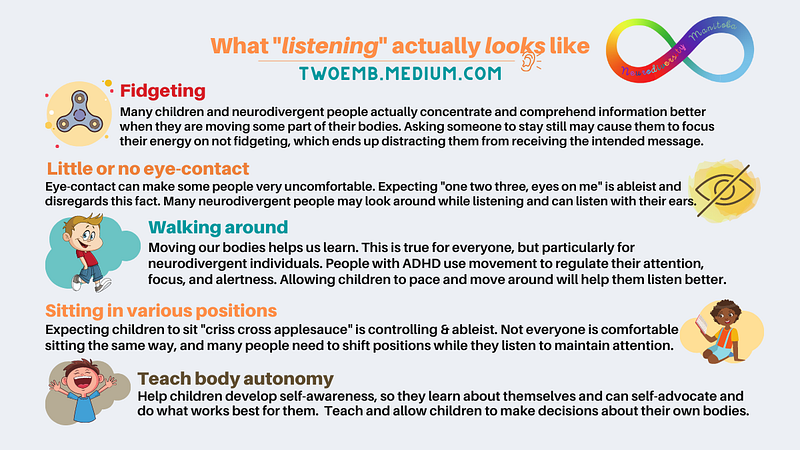
It’s important we help children develop self-awareness, so they learn about themselves and can self-advocate and do what works best for them.
Our job is to teach and allow children to make decisions about their own bodies, not try to control their bodies — that sends entirely the wrong message.
Here’s a better one:
Controlled kids grow up to become controlling adults
Another issue I’ve come across is ways in which employers rate the performance of prospective employees during interviews, as well as some items included on performance reviews even after they have the job.
Every company’s processes will be different, depending on their organization and the type of work they do. However, if you look up sample performance reviews, almost all of them have one thing in common: they rate interpersonal and communication skills based on some surface-level, neurotypical-centric behaviours.
Here’s a simplified example of what this particular section might look like on an interview rating form:
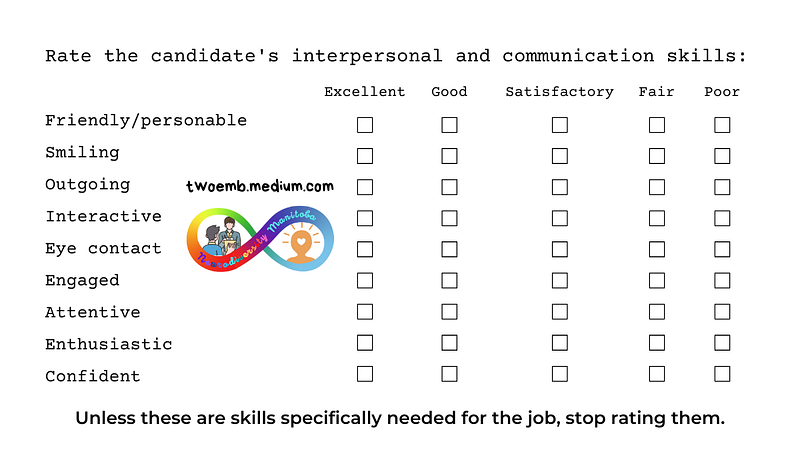
Unless this person is directly dealing with customers as their primary responsibility, many of these characteristics are irrelevant. Expecting an employee to keep up these pretences will only serve to burn them out and have their energy focused on the wrong priorities.
When the honeymoon’s over
Oftentimes when someone is excelling in a new situation, such as a new job, they call this the honeymoon period. Most of us can keep up that kind of facade for a while, but eventually our shortcomings will start to show.
For most people that’s not a big deal. They’ve already proven they’re good at the job, and most co-workers and managers are fairly forgiving of minor errors, because we are all human and imperfect.
If you’re neurodivergent, like me, this can be a much bigger deal.
Once the novelty wears off and my imperfections begin to show, I lose momentum, and my enthusiasm wanes. If the job isn’t what I thought it would be, or the work environment isn’t neurodivergent-friendly and accommodating, my performance will likely decline.
Even more significant, I won’t be able to keep up the persona I tried to present during the interview and training processes. I can put on my customer service face for a while, but no one can keep that up forever, and it’s a lot harder for neurodivergent folks.
Employers, listen up, because you’ll want to know this
Expecting employees to perform neuronormativity is ableist. This can lead to discriminating against highly-qualified and highly skilled employees who are disabled, neurodivergent, or simply don’t fake neurotypical well.
These are arbitrary, neuronormative social norms and expectations, which exclude more than 20% of the population. At least that many people have disabilities, are neurodivergent, or otherwise don’t confirm to these neurotypical-centric expectations.
It is estimated that 15–20% of people are neurodivergent (which includes Autism, ADHD, learning disabilities, and other conditions), and at least 1 in 5 Canadians (22%) live with a disability. People with disabilities are significantly less likely to be employed than those without.
Focus on what matters
We need to let go of control and embrace a little bit of chaos, especially in schools, but also in workplaces.
I have worked in classrooms where the students were permitted to fidget, roll around on the floor, walk around, etc. They could move how they needed to in order to learn, as long as it wasn’t harmful or disruptive to others.
It is a little more exhausting for the adult, so we need to engage in a lot of self-care and ensure we have a lot of recovery time in between classes, but it’s worth it.
While we need to be a bit more creative, and be a bit more patient, it creates a more inclusive environment that is more conducive to learning for everyone.
Employers that offer improved flexibility, such as allowing hybrid remote and in-person working options, will have happier, more productive staff. They may attract more creative, out-of-the-box thinkers, as well as fostering greater ingenuity in their existing staff.
Lastly, when we loosen the reins a little and take on a more laid-back style of supervision or management, this frees up our own mental space and energy to focus on our own responsibilities.
When we free up the mental bandwidth to allow our on creativity to flourish, we’ll become better mentors, teachers, or managers ourselves. Our employees or students will learn to take initiative, and they’ll likely be grateful when we back off and let them do their work in peace.
© Jillian Enright, Neurodiversity MB
Related Stories
When you join medium, as a member you’ll have access to unlimited reads for only $5 per month. If you use my referral link, I’ll earn a small commission, and you’ll earn my undying gratitude.
If you’d prefer give a one-time tip, you can support my writing on Ko-Fi — also, it’s free to follow me on Facebook and LinkedIn!
References
Delahooke, M. (2022). Brain-Body Parenting: How to stop managing behaviour and start raising joyful, resilient kids. Harper Collins.
Desautels, L. (2020). Connections Over Compliance: Rewiring our perceptions of discipline. Wyatt-MacKenzie Publishing.
Greene, R. W. (2014). The explosive child: a new approach for understanding and parenting easily frustrated, chronically inflexible children. Revised and updated. Harper.
Kohn, A. (2018). Punished By Rewards: The trouble with gold stars, incentive plans, A’s, praise, and other bribes. Houghton-Mifflin Harcourt Publishing.
Kohn, A. (2016). The Myth of the Spoiled Child: Coddled kids, helicopter parents, and other phony crises. Beacon Press.
Kohn, A. (2005). Unconditional Parenting: Moving from rewards and punishments to love and reason. Simon & Schuster, Inc.
Shanker, S., & Barker, T. (2016). Self-reg: how to help your child (and you) break the stress cycle and successfully engage with life. Penguin Press.
Shervin Venet, Alex (2021). Equity-Centred Trauma-Informed Education. W. W. Norton & Co.
Statistics Canada. (2018). A demographic, employment and income profile of Canadians with disabilities aged 15 years and over. https://150.statcan.gc.ca/n1/pub/89-654-x/89-654-x2018002-eng.htm
Stixrud, W. & Johnson, N. (2019). The Self-Driven Child: The science and sense of giving your kids more control over their lives. Penguin Books.
Walker, N. (2021). Neuroqueer Heresies: Notes on the neurodiversity paradigm, Autistic empowerment, and postnormal possibilities. Autonomous Press.


