
Schools Are Sensory Nightmares
They’re bad enough for neurotypical folks, but can be hell for neurodivergent students
Have you been inside of a school recently?
Or taken a school bus on a field trip?
This past weekend I went to the Banjo Bowl. It’s an annual CFL (Canadian football) game between the Winnipeg Blue Bombers and the Saskatchewan Roughriders. It’s tradition, it’s rowdy, and it’s a lot of fun if you like sports (which I do).
This game is always sold out. It’s louder and rowdier than most games because of the rivalry between SK and MB. I don’t even mind the loud stadium during the game because I enjoy watching football and get swept up in the excitement and competition.
I do, however, mind the crowds in the hallways, the long line-ups for everything, and the bus ride home.
We use what’s called the Park N’ Ride, where we park our car at a carpool lot and take a school bus full of fans over to the stadium. It’s only $5, it saves us from fighting traffic to get in and out of the parking lots, fighting traffic, and we avoid paying $20 for our troubles.
Anyway, I expect the bus rides to be loud and full of drunk and exuberant fans, that’s par for the course. On the way there it’s not too bad because most people haven’t had many drinks yet, and are the excitement is just starting to ramp up.
The way home is a different story.
This year we won and it was a fantastic game. It was a great game to watch, but this meant a lot more drunk fans celebrating on the bus ride back. Add that to having spent over three hours in a crowded stadium with a sold-out and very excited crowd — one’s tolerance can only be sustained for so long.
What does this have to do with schools?
Think about kids in elementary school every day. They often start their day with a bus ride, which is usually loud and mostly unsupervised (at least here, there is only the driver, who has to focus on — y’know, driving).
Then they are in busy, loud hallways, at their lockers or cubbies. Next they move into loud, often overcrowded, classrooms. Then there are announcements, recesses, gym class, fire drills, music class, all followed by yet another loud bus ride home.
And that’s just the noise. There are also bright, flickering fluorescent lights, staff and students wearing scented lotions or perfume, the smells from snacks and lunches, and the scents of various industrial cleaners (to name but a few).
To be honest, I’m surprised there aren’t more behaviour issues as a result of this sensory nightmare.
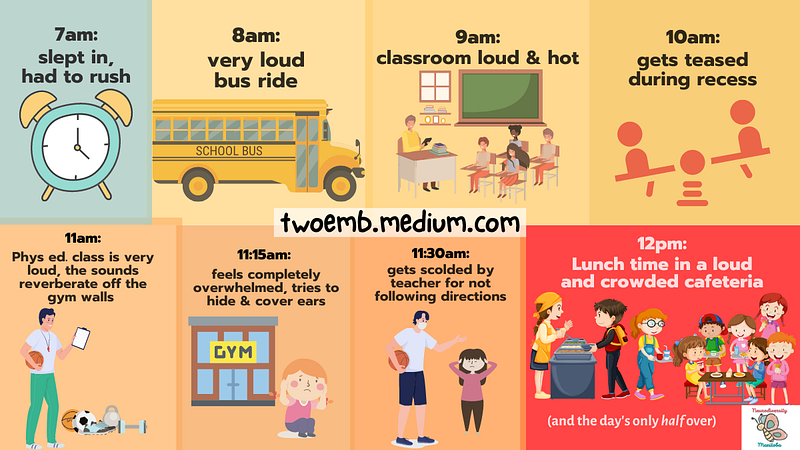
This is especially true for neurodivergent and disabled students, or anyone with sensory sensitivities.
Research suggests over 90% of Autistics have significant differences in sensory processing, and at least 40% of people with ADHD have Sensory Processing Disorder (SPD).
I had no idea this was something that was affecting me until I better understood my own neurotype, and began exploring co-occurring conditions with ADHD and autism.
Creating sensory-friendly schools
Thanks to chronic under-funding, schools don’t exactly have the option of smaller class sizes, or larger buildings with sensory-friendly areas.
However there are some low-cost tools schools can provide to help sensitive students feel a bit more comfortable.
Although most schools don’t have the budget to create dedicated sensory rooms (ones that truly meet the sensory needs of students, not seclusion rooms disguised as sensory rooms — there are very significant differences), teachers can create sensory areas within their classrooms.
These should be in a quiet area of the room, one that feels private, but not secluded (a tall order, I know, but as much as possible). Sensory areas can offer tools for both sensory-seeking and sensory-avoiding.
For example, they can be equipped with noise-cancelling headphones or ear protection, and a divider to reduce visual overstimulation.
They can also include fidget tools, sensory items (with different surfaces to touch as well as items which are visually stimulating), a wobble stool or cushion, and a balance board.
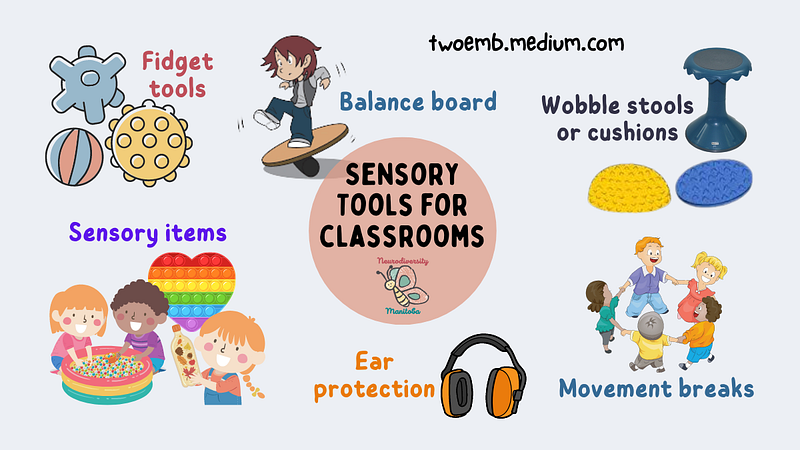
If there is some room in the budget, schools can invest in cool stuff like rocking chairs, wobble stools and cushions, weighted blankets, lap desks, and lighting projectors.
If schools have a room available, they can create sensory rooms, but they must proceed with extreme caution. Whether the space is within a classroom or a separate room in a school, there are some very important guidelines to consider.
Effective sensory rooms
- Must be a choice given to the student
- Must never be used as a punishment
- Students must never be forced to use a sensory room
- Must not have any locks on the doors
- Have a variety of options to meet as many sensory needs as possible
- Are treated as a tool, never as a reward or punishment
- Students must not be required to “earn” sensory breaks, they are tools to be used when needed
- Are available to anyone who needs them, are inclusive, and do not make the student feel ostracized, rejected, or segregated from their peers
Empathy and understanding
Many children, in particular neurodivergent children, experience their senses differently from the majority of their peers.
Children with sensory sensitivities are already experiencing increased stress from the moment they get on the bus or enter their school in the mornings.
While schools have limited funding and resources, staff can be compassionate and make efforts to understand the sensory experiences of their students.
© Jillian Enright, Neurodiversity MB

When you join medium, as a member you’ll have access to unlimited reads for only $5 per month. If you use my referral link, I’ll earn a small commission, and you’ll earn my undying gratitude.
Related Articles
References
Crasta, J. E., Salzinger, E., Lin, M. H., Gavin, W. J., Davies, P. L. (2020). Sensory Processing and Attention Profiles Among Children With Sensory Processing Disorders and Autism Spectrum Disorders. Frontiers in Integrative Neuroscience, 14. https://doi.org/10.3389/fnint.2020.00022
Ghanizadeh A. (2011). Sensory processing problems in children with ADHD, a systematic review. Psychiatry investigation, 8(2), 89–94. https://doi.org/10.4306/pi.2011.8.2.89


