
Help For Sensory Overload & Overwhelm
Triple trouble: Covid, a blizzard, then flooding — oh my!

My family has covid. At this point, it’s probably more surprising we made it this long without contracting the virus, but it still sucks. We started feeling a bit unwell on Sunday and tested positive on Monday. Thankfully we’re all fully vaccinated and our symptoms are relatively mild.
Then the real storm it. Literally.
In Manitoba, we just had the worst blizzard we’ve seen in 25 years. If you’re in Canada, you likely read about it in the news.
We expected anywhere from 30 to 80 cm of snow, which would be between one and 2.5 feet, in addition to high winds. We live on the prairies, meaning lots of open areas. Add in high winds causing blowing snow, that amounts to zero visibility and very dangerous driving conditions.
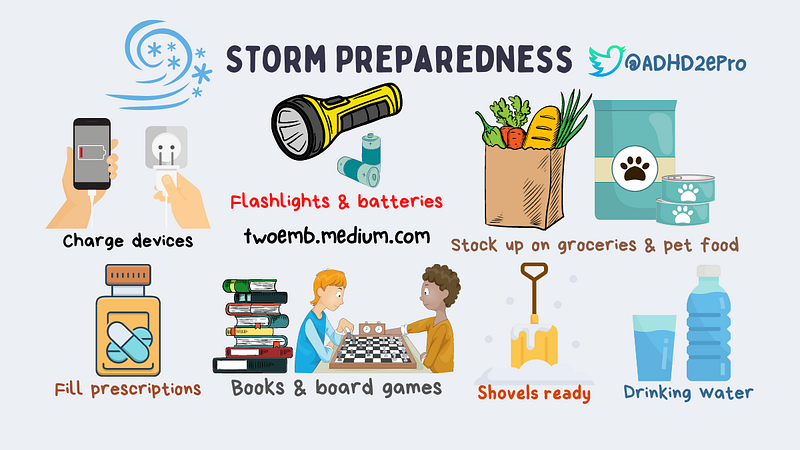
For the first time in a quarter century, much of the province shut down in anticipation. Schools were closed, residents were advised to prepare for the “storm of the century”. Our province issued an alert, and emergency preparedness lists circulated online.
What does this have to do with sensory overload?
My son and I are both neurodivergent. When you’re sick, meds are less effective. By day 3 of isolation, my son was bouncing off the walls — both literally and figuratively.
I am self-employed and my son usually attends school full-time. For about 7 hours per day, I work mostly by myself. If I have meetings with clients, I have the luxury of scheduling time in between to recharge.
We’re now on day six and none of us have left the house, but I think I left my sanity back at day 4.
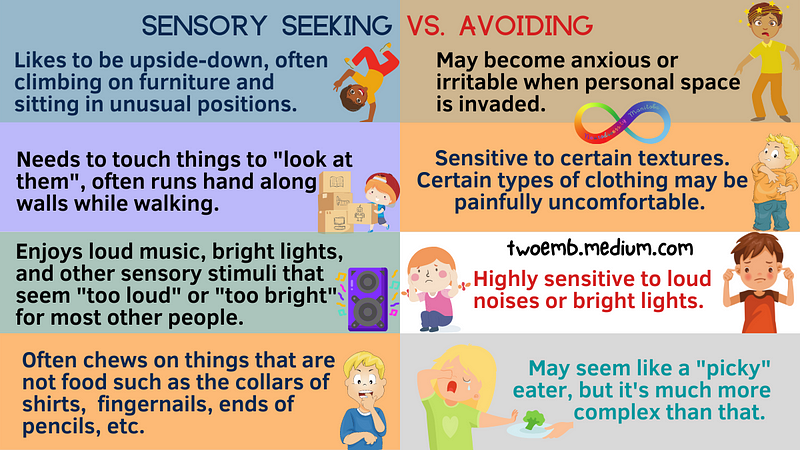
I love my son. We are alike in so many ways — so many ways — but we are different in a very important way. He is primarily a sensory-seeker and I am primarily a sensory-avoider.
This means he likes to make noise, move constantly, touch everything and everyone, and generally do All Of The Things.
My husband, who is usually a quiet guy in a group setting — and usually goes to work 5 days a week— never stops talking at home. He processes things out loud, talks to me about every minute detail, and is also the touchy-feely sort.
I love my boys, but I find this very overwhelming very quickly.
Sensory processing differences
A lot of Autistics process their senses much differently from allistics (non-Autistic people). We can become overwhelmed by bright lights, crowds, loud noises, too-tight socks, etc. much more quickly than neurotypical folks.
Research suggests over 90% of Autistics have significant differences in sensory processing, and at least 40% of people with ADHD have Sensory Processing Disorder (SPD).
Of course, there is significant individual variability. Some people are sensory-seekers, some are avoiders, and most are a combination of the two. This can depend on our nervous systems, stress levels, physical and mental health, and general mood.
Current mood: get-me-the-hell-out-of-here-now!
Like I said, I love my boys, but I have very different sensory needs from them. Fortunately, I have developed a few strategies for coping with these experiences that don’t involve running from my house screaming, which apparently is frowned upon.
What works for me
Knowing my triggers
After a few mornings of nearly losing my mind, I figured out if the boys are in the living room, I need to take my coffee and my book and go upstairs for a bit. I am an early-riser, but not a morning person, if that makes sense.
My body gets up early, but the rest of me takes hours to catch up. I need my meds, coffee, more coffee, and lots of time before I’m Ready To People.
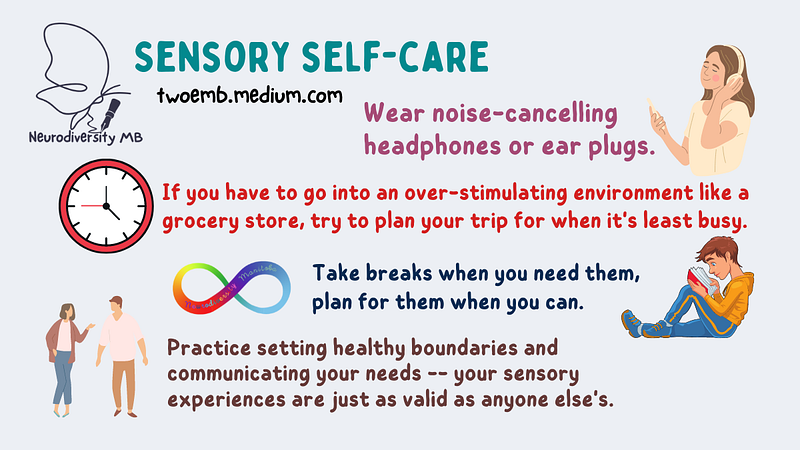
I also know excessive noise and activity around me makes me feel overwhelmed. I’ve invested in a pair of noise-cancelling headphones and they’ve been a life-saver.
Communicating my needs
Before I understood what was going on, I just thought I was crabby — well, maybe I am, but I also have legitimate sensory sensitivities. Now I know and understand this, I can communicate my needs to my family without biting their heads off.
Instead of yelling “stop that banging!” I slip on my headphones, or tell my boys I need some quiet time and go up to my room for a bit.
Planning ahead
If I’m going to spend a lot of time around others, I make sure I schedule some quiet time to recharge. I have gotten better at knowing and respecting my own limits, therefore I’m able to communicate them to others, as well as plan ahead to meet my needs.
I’m also fortunate that my chatterbox husband doesn’t mind shopping, so thankfully he does most of our family’s grocery shopping, and I get to avoid the sensory hell that is a grocery store.
If that’s not an option, some places do sensory-friendly times, where they dim the lights, lower the volume on the music, and have fewer people in the store. If you don’t mind getting out early, stores are often much quieter in the early morning hours.
Easter weekend
We’re not at all religious in our household, but our close friends do like hosting dinners for holidays. We often go to their place and everyone gathers for a big meal.
We’re so lucky we’ve found friends whose families are much like ours: a motley crew of neurodiverse people with a variety of sensory and social needs. If someone needs to sneak away or step outside to find reprieve from all the noise and activity, no one bats an eye.
In fact, my best friend goes out of her way to ensure there is a quiet space made available for those who need it. I know she wouldn’t hesitate to do what she could to help everyone feel as comfortable as possible in whatever way works best for them.
The storm has passed
Luckily, the storm wasn’t as bad as predicted. We certainly got a lot of snow and travel was not advised, but we didn’t lose power, and the worst seems to be over now.
As for Covid, we’re all doing much better. After six days cooped up in the house, I’m quite certain we’ll all be putting on our snowsuits and building a snow fort this afternoon.
Until then, I’ll be hiding in my room with a cup of coffee and my book, conserving my energy for the snowball fight that is bound to ensue.
© Jillian Enright, Neurodiversity MB

Related Stories
When you join medium, as a member you’ll have access to unlimited reads for only $5 per month. If you use my referral link, I’ll earn a small commission, and you’ll earn my undying gratitude.

References
Crasta, J. E., Salzinger, E., Lin, M. H., Gavin, W. J., Davies, P. L. (2020). Sensory Processing and Attention Profiles Among Children With Sensory Processing Disorders and Autism Spectrum Disorders. Frontiers in Integrative Neuroscience, 14. https://doi.org/10.3389/fnint.2020.00022
Ghanizadeh A. (2011). Sensory processing problems in children with ADHD, a systematic review. Psychiatry investigation, 8(2), 89–94. https://doi.org/10.4306/pi.2011.8.2.89