avatarJillian Enright

Free AI web copilot to create summaries, insights and extended knowledge, download it at here

5125

Abstract

and L. B. Billinton — image created by author on Canva</figcaption></figure><h2 id="8cf0">Hyperactivity</h2><p id="7903"><a href="https://readmedium.com/adhd-actually-the-struggle-is-real-5e763d34218a">Hyperactivity</a> can be very misunderstood. <a href="https://readmedium.com/adhd-in-adult-women-6ef386d40647">Hyperactivity does not always</a> look like someone “constantly on the go”, or acting as though they’re “driven by a motor.” A person can be physically exhausted, laying on the couch, and still be hyperactive in their thoughts.</p><p id="bf46">My brain is always bouncing all over the place, my thoughts racing in many different directions at once. There is a constant barrage of activity in my mind that never seems to stop. Most of the time I’m used to it, and sometimes it’s a benefit, as I come up with a lot of ideas for my writing.</p><p id="1d12">Other times, especially when I really need to focus on something, but my brain won’t let me — or when I’m feeling anxious and my mind keeps ruminating over the anxiety-provoking thoughts again and again —that’s when it becomes downright <i>exhausting</i>.</p><h1 id="6739">Autistic Burnout</h1><p id="1e4f">Autistic burnout is a completely different experience.</p><p id="40a8">A few times each year, I book myself a <a href="https://readmedium.com/why-camping-is-so-good-for-my-adhd-brain-67cc3e8d4b72">campsite or a rustic little cabin</a> in the woods. I pack up my dog, lots of books, and my camping gear, and “disappear” for a few days.</p><p id="2c8d">This isn’t simply self-care or a low-budget vacation, although those are fantastic too. This is an act of self-preservation, and when it’s logistically possible, one of my strategies for dealing with Autistic burnout and avoiding a full-on meltdown.</p><p id="9bdc">A meltdown for me brings incredible waves of emotion, often anger and sadness, and feeling completely out of control. I don’t think anybody enjoys feeling this way, I know I don’t, so I try to avoid it by doing what I can to prevent burnout in the first place.</p><p id="836e">Everyone’s experience is different, but for me, the two main triggers that lead to burnout — both of which I can avoid by going off into the woods — are <a href="https://readmedium.com/sensory-overload-double-trouble-acb79533b255">sensory overload</a> and fatigue from masking.</p><figure id="e6c5"><img src="https://cdn-images-1.readmedium.com/v2/resize:fit:800/1*8Wx1FUGdcBITo0WLENxFrA.png"><figcaption>Image created by author</figcaption></figure><h2 id="c50a">Sensory overwhelm</h2><p id="b72c">My biggest trigger is sensory overload. Autism is characterized by a <a href="https://doi.org/10.1093/phe/phab021">unique sensory profile</a>. Most of us have hypersensitivities in certain senses, of course, with individual differences.</p><p id="533f">Spending a prolonged period of time in a busy, loud, populated environment quickly becomes overwhelming for me. For example, I love kids, but spending time with a large group of kids will drain my reserves and leave me feeling exhausted and irritable.</p><p id="231b">This isn’t because of the children themselves, they’re awesome. It happens because of the high levels of activity and noise, and the high social demand required when interacting with children. Many things can be both fun <i>and</i> exhausting!</p><h2 id="1080">Masking</h2><p id="7825">Another culprit is <a href="https://readmedium.com/i-was-masking-for-so-long-i-lost-myself-4be35fe2cd35">masking</a>, or <a href="https://readmedium.com/uncovering-the-camouflage-ee609e003889">camouflaging</a>. These are terms we use to describe when Autistic people hide, suppress, or water down their autistic traits in order to fit in with neurotypical society.</p><p id="b0b2">There are many reasons we do this, but a few examples are masking to fit in socially, behaving in a certain way that is expected of us (such as at school and work), and avoiding criticism or rejection.</p><p id="ad50">Masking, suppressing essential parts of ourselves, is incredibly tiring and can be <a href="https://www.spectrumnews.org/features/deep-dive/costs-camouflaging-autism/">emotionally and psychologically harmful</a> in the long term.</p><p id="43c0">When we have to frequently mask at work, school, or in daily social interactions, the constant mental exertion is taxing. Many of us are analyzing conversations while also working at carefully reading body language and facial expressions.</p><p id="5661">Not to mention the ridiculous game of trying to figure out what people mean “<i>under</i>” their words when they won’t just say what they really mean!</p><h1 id="394b">What helps</h1><p id="d211">What works for me won’t work for everyone, but here are some strategies I’ve learned.</p><h2 id="56c1">Schedule downtime</h2><p id="2eb7">Schedule it in, otherwise, it may not happen. Make it a priority. Say no upon occasion, when you notice your list of commitments starting to grow, or when you just don’t feel like doing the thing.</p><h2 id="b327">Calming activities</h2><p id="26f5">Keep a reserve of calming activities. When you’re feeling upset or

Options

burnt out, it can be harder to think of things you enjoy doing, and things that help reduce your stress. It helps to have a box or shelf with some fidgets, sensory items, books, or whatever you prefer.</p><p id="d522">My favourite is reading, always reading. I also enjoy doing puzzles, painting and going for walks.</p><h2 id="e4e0">Find your stim</h2><p id="ae0d"><a href="https://readmedium.com/stimminy-cricket-8b6e38323a2b">Find the stim</a> that works for you. For me, it’s really loud music that takes over my whole nervous system. I also find tapping really calming. I tap on my shoulder or the inside of my wrists, or I tap each of my fingers to my thumb in succession.</p><p id="2516">Sometimes I shake my hands out or twirl my hair. I also do “<a href="https://readmedium.com/stimminy-cricket-8b6e38323a2b"><i>cricket feet</i></a>” where I rub my feet together. Some people like to flap their hands, jump, run, rock, twirl… whatever works for you, give it a go!</p><p id="7454">© Jillian Enright, Neurodiversity MB</p><h1 id="e785">Related Stories</h1><div id="f0d8" class="link-block"> <a href="https://readmedium.com/recovering-from-burnout-d3cabd422042"> <div> <div> <h2>Recovering From Burnout</h2> <div><h3>Practical ways to take care of yourself while recovering from burnout</h3></div> <div><p>medium.com</p></div> </div> <div> <div style="background-image: url(https://miro.readmedium.com/v2/resize:fit:320/1*H1JdYmoJzVx9IJ8OQpS4Og.png)"></div> </div> </div> </a> </div><div id="778d" class="link-block"> <a href="https://readmedium.com/why-gifted-kid-burnout-is-a-thing-c55432bb33c1"> <div> <div> <h2>Why Gifted Kid Burnout Is A Thing</h2> <div><h3>Twice Exceptionality (2e): Gifted is not the same as high-achieving</h3></div> <div><p>medium.com</p></div> </div> <div> <div style="background-image: url(https://miro.readmedium.com/v2/resize:fit:320/1*JWyG5z-kfIfweymRd84MrA.jpeg)"></div> </div> </div> </a> </div><div id="c95f" class="link-block"> <a href="https://readmedium.com/fighting-my-internalized-ableism-de1eb3d7c0b9"> <div> <div> <h2>Fighting My Internalized Ableism.</h2> <div><h3>My internalized ableism and I are doing battle and I’m going to win because I’m stubborn AF.</h3></div> <div><p>medium.com</p></div> </div> <div> <div style="background-image: url(https://miro.readmedium.com/v2/resize:fit:320/1*6RBqdxu8k_FGmA75QwumeQ.jpeg)"></div> </div> </div> </a> </div><div id="ba59" class="link-block"> <a href="https://readmedium.com/how-executive-functions-matter-in-daily-living-bfdccc04162a"> <div> <div> <h2>How Executive Dysfunction Impacts Daily Life</h2> <div><h3>How executive functions relate to ADHD, autism, and other divergent brains.</h3></div> <div><p>medium.com</p></div> </div> <div> <div style="background-image: url(https://miro.readmedium.com/v2/resize:fit:320/1*W7eqkPsBXyIbkYBG-F6pig.jpeg)"></div> </div> </div> </a> </div><div id="8615" class="link-block"> <a href="https://readmedium.com/i-was-masking-for-so-long-i-lost-myself-4be35fe2cd35"> <div> <div> <h2>I was Masking for So Long, I Lost Myself</h2> <div><h3>Or maybe I never really figured out who I was</h3></div> <div><p>medium.com</p></div> </div> <div> <div style="background-image: url(https://miro.readmedium.com/v2/resize:fit:320/1*OcDoaC4DL7ULzNw9FXVRwQ.png)"></div> </div> </div> </a> </div><p id="e946"><i>When you join medium, as a member you’ll have access to unlimited reads for only $5 per month. If you use <a href="https://twoemb.medium.com/membership">my referral link</a>, I’ll earn a small commission.</i></p><figure id="2c2d"><img src="https://cdn-images-1.readmedium.com/v2/resize:fit:800/1*mjWBUZQofjUB_IPU3yY4ng.png"><figcaption></figcaption></figure><h2 id="3325">References</h2><p id="5b72">de Vries, B. (2021). Autism and the Right to a Hypersensitivity-Friendly Workspace. <i>Public Health Ethics</i>, <i>14</i>(3), 281–287. <a href="https://doi.org/10.1093/phe/phab021">https://doi.org/10.1093/phe/phab021</a></p><p id="75b6">Raymaker, D.M., Teo, A.R., Steckler, N.A., Lentz, B., Scharer, M., Delos Santos, A., Kapp, S.K., Hunter, M., Joyce, A., Nicolaidis, C. (2020). <i>Autism in Adulthood, 2</i>(2), 132–143. <a href="https://doi.org/10.1089/aut.2019.0079">https://doi.org/10.1089/aut.2019.0079</a></p></article></body>

ADHD and Autistic Burnout

What are they, and how are they different?

Photo by Kinga Cichewicz on Unsplash

My spouse was away on business for nearly 3 of the past four weeks. We have a 9-year-old son, and I work from home trying to make a living at this writing thing.

Saturday mornings I have a regular tutoring client, and this past Saturday evening our son had a friend sleepover. The boys are both 9, so they’re quite self-sufficient, and entertain each other very well.

Sunday my husband was home. I slept 10 hours and still woke up with a migraine headache. This was a culmination of the previous month’s additional socializing, work, and executive functioning required of me — and we haven’t even gotten to the holidays yet!

ADHD Burnout

ADHD burnout can be a lot of things and will look and feel different for each person, but there are some commonalities. I can only speak from my own experiences, but hopefully they will be relatable and helpful for others.

It often comes with exhaustion, increased anxiety, and sometimes irritability. For me, it definitely brings muscle tension, headaches, anxiety, and fatigue.

I’ve always been an overachiever. Growing up I had very little internal self-worth, so my value as a person always came from what I could do for others, and what I could accomplish.

I have extremely high expectations of myself. They’re realistic in that they’re attainable, but sometimes at a significant cost to my physical and psychological health.

Having lived most of my life with undiagnosed ADHD, I internalized beliefs that I was lazy and careless. Turns out it was the opposite: I sometimes had to work significantly harder than neurotypicals to achieve the same level of success due to my divergent neurology.

Yet these negative beliefs about myself led me to overcompensate for my perceived shortcomings. I constantly felt I had to earn the acceptance of others and prove myself worthy.

Estimating time

Ironically, one positive belief I had about myself was not entirely true: I thought I had an amazing sense of time.

I really don’t.

Sure, I can make a very accurate guess of what time it is if I haven’t been hyperfocused on something, but that’s only under particular circumstances. When I zero in on something that really holds my interest, I can lose all track of time.

What’s worse for me is I constantly underestimate how much time something will take. Even things I do every. Single. Day — maybe especially those. For example, I am always in a rush or running late because I underestimate how much time I need to get ready to go somewhere.

This is no longer surprising to me, as I have learned that people with ADHD have alterations in time perception, such as difficulty estimating the passage of time.
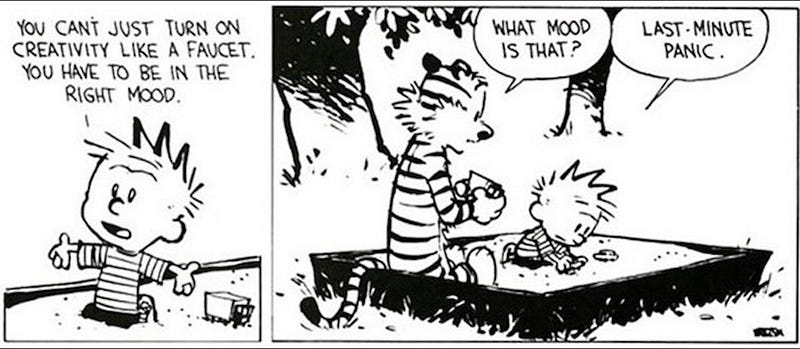
Calvin & Hobbes by Bill Watterson

Despite knowing this, the constant feeling of being in a hurry and the stress of always worrying I’m going to be late, certainly wear on me.

Additionally, it’s very easy to overcommit to things because I think they’re a smaller task than they really are. Add this to my need to prove my worth through being a Really Useful Person, and before I know it I’m feeling quite overwhelmed by the number of commitments I’ve made.

The tendency to underestimate tasks leading to overwhelm doesn’t even have to come from making commitments to others, it can be making commitments to myself.

For example, “Oh, right, last night’s dishes are still on the counter. Okay, I’ll spend two hours finishing up this writing, and then do the dishes after lunch.”

Two hours later… Four hours later… Six hours later…

Suddenly it’s 3pm, I’ve got to get ready to pick my son up from school, and haven’t washed a single dish. The next day this happens all over again, and now I’ve got two days’ worth of dishes piling up.

Thomas the tank engine created by Wilbert Awdry; ‎Christopher Awdry‎, and L. B. Billinton — image created by author on Canva

Hyperactivity

Hyperactivity can be very misunderstood. Hyperactivity does not always look like someone “constantly on the go”, or acting as though they’re “driven by a motor.” A person can be physically exhausted, laying on the couch, and still be hyperactive in their thoughts.

My brain is always bouncing all over the place, my thoughts racing in many different directions at once. There is a constant barrage of activity in my mind that never seems to stop. Most of the time I’m used to it, and sometimes it’s a benefit, as I come up with a lot of ideas for my writing.

Other times, especially when I really need to focus on something, but my brain won’t let me — or when I’m feeling anxious and my mind keeps ruminating over the anxiety-provoking thoughts again and again —that’s when it becomes downright exhausting.

Autistic Burnout

Autistic burnout is a completely different experience.

A few times each year, I book myself a campsite or a rustic little cabin in the woods. I pack up my dog, lots of books, and my camping gear, and “disappear” for a few days.

This isn’t simply self-care or a low-budget vacation, although those are fantastic too. This is an act of self-preservation, and when it’s logistically possible, one of my strategies for dealing with Autistic burnout and avoiding a full-on meltdown.

A meltdown for me brings incredible waves of emotion, often anger and sadness, and feeling completely out of control. I don’t think anybody enjoys feeling this way, I know I don’t, so I try to avoid it by doing what I can to prevent burnout in the first place.

Everyone’s experience is different, but for me, the two main triggers that lead to burnout — both of which I can avoid by going off into the woods — are sensory overload and fatigue from masking.
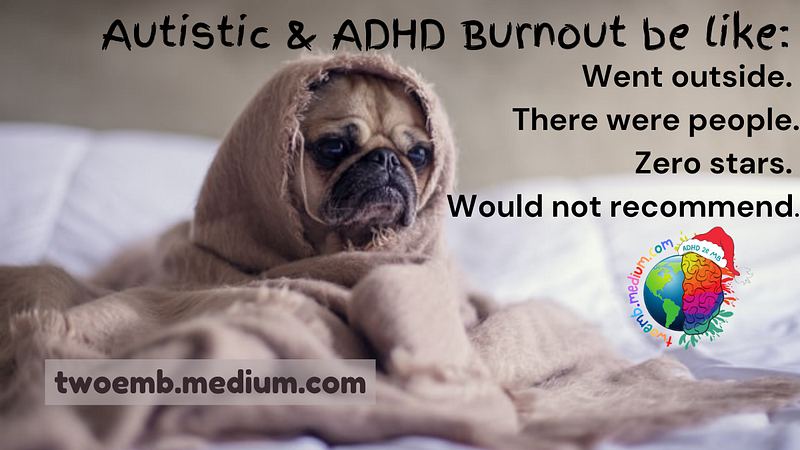
Image created by author

Sensory overwhelm

My biggest trigger is sensory overload. Autism is characterized by a unique sensory profile. Most of us have hypersensitivities in certain senses, of course, with individual differences.

Spending a prolonged period of time in a busy, loud, populated environment quickly becomes overwhelming for me. For example, I love kids, but spending time with a large group of kids will drain my reserves and leave me feeling exhausted and irritable.

This isn’t because of the children themselves, they’re awesome. It happens because of the high levels of activity and noise, and the high social demand required when interacting with children. Many things can be both fun and exhausting!

Masking

Another culprit is masking, or camouflaging. These are terms we use to describe when Autistic people hide, suppress, or water down their autistic traits in order to fit in with neurotypical society.

There are many reasons we do this, but a few examples are masking to fit in socially, behaving in a certain way that is expected of us (such as at school and work), and avoiding criticism or rejection.

Masking, suppressing essential parts of ourselves, is incredibly tiring and can be emotionally and psychologically harmful in the long term.

When we have to frequently mask at work, school, or in daily social interactions, the constant mental exertion is taxing. Many of us are analyzing conversations while also working at carefully reading body language and facial expressions.

Not to mention the ridiculous game of trying to figure out what people mean “under” their words when they won’t just say what they really mean!

What helps

What works for me won’t work for everyone, but here are some strategies I’ve learned.

Schedule downtime

Schedule it in, otherwise, it may not happen. Make it a priority. Say no upon occasion, when you notice your list of commitments starting to grow, or when you just don’t feel like doing the thing.

Calming activities

Keep a reserve of calming activities. When you’re feeling upset or burnt out, it can be harder to think of things you enjoy doing, and things that help reduce your stress. It helps to have a box or shelf with some fidgets, sensory items, books, or whatever you prefer.

My favourite is reading, always reading. I also enjoy doing puzzles, painting and going for walks.

Find your stim

Find the stim that works for you. For me, it’s really loud music that takes over my whole nervous system. I also find tapping really calming. I tap on my shoulder or the inside of my wrists, or I tap each of my fingers to my thumb in succession.

Sometimes I shake my hands out or twirl my hair. I also do “cricket feet” where I rub my feet together. Some people like to flap their hands, jump, run, rock, twirl… whatever works for you, give it a go!

© Jillian Enright, Neurodiversity MB

Related Stories

When you join medium, as a member you’ll have access to unlimited reads for only $5 per month. If you use my referral link, I’ll earn a small commission.
References

de Vries, B. (2021). Autism and the Right to a Hypersensitivity-Friendly Workspace. Public Health Ethics, 14(3), 281–287. https://doi.org/10.1093/phe/phab021

Raymaker, D.M., Teo, A.R., Steckler, N.A., Lentz, B., Scharer, M., Delos Santos, A., Kapp, S.K., Hunter, M., Joyce, A., Nicolaidis, C. (2020). Autism in Adulthood, 2(2), 132–143. https://doi.org/10.1089/aut.2019.0079

Autism
Mental Health
Psychology
Disability
Health
Recommended from ReadMedium