
Parenting
Why Camping is So Good for My Divergent Brain
Looking forward to camping all summer long

We have just returned from a week-long camping trip, one of many we have planned as part of our family tradition to spend most of the summers camping. We are tired, dirty, a little stinky… and happy.
What I most look forward to doing with my son this summer is camping, camping, and then some more camping.
Not only do we have a fantastic time, but being outdoors also benefits our bodies and brains in significant ways.
Improved Sleep
After a full day outdoors, biking, and walking everywhere, we all sleep so much better. At home, and the first night or two of camping, I can’t fall asleep until somewhere between 11 pm and 1 am. By the third night of camping, I am getting ready for bed around 9 pm and asleep by 10. I kid you not. This coming from a lifelong insomniac turned night owl.
A 2017 study found that after just one week of camping, participant’s brains produced melatonin — a hormone that promotes sleep and physiologically prepares the body for nighttime — about two hours earlier in the evening.
That certainly correlates nicely with my experience.
A earlier study had also found a bidirectional impact of sleep and ADHD on each other, meaning when one improves, the other follows suit.
I Feel Clear-Headed
In their book The Self-Driven Child, Strixrud & Johnson described a walk in nature as a “cleanse” for one’s prefrontal cortex, providing a sense of calm.
The PFC is a key brain structure implicated in ADHD, so it’s not surprising that our ADHD symptoms improve when our PFC functions better — but that goes for everyone.
You certainly don’t have to be neurodiverse to reap the benefits of time outdoors in nature!
I like to think of this PFC cleanse as more of a “decluttering” myself. The inside of my brain often feels like a dilapidated shack full of pots and pans that keep falling off the shelves. They’re rattling around creating a lot of noise and it’s a disorganized mess.
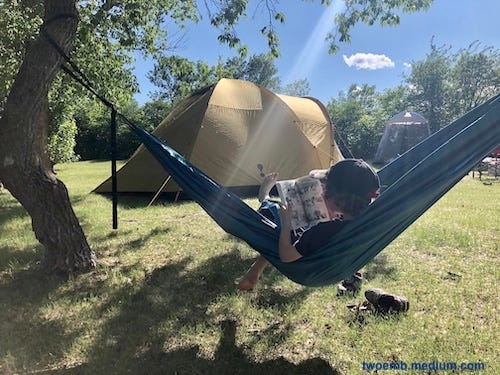
Extended time in nature is like having a professional organizer visit my brain: putting everything neatly where it belongs, sticking nice little labels on everything so I can find my thoughts more easily, even taking out the trash on their way out.
After a couple of days spent camping, that nagging what was I supposed to do that I am forgetting? feeling is gone, and the constant buzz in my head stops. I am finally able to be fully present in the moment.
Camping allows me to give my son my full attention without any distractions — without even making mental lists of the things I need to get done later.
Escape technology
Giving our son our full attention includes keeping technology turned off the entire trip. My self-imposed rule is that I may only use my phone for photos and music. Even though I utilize technology daily for my business and writing it is actually very easy, even liberating, to disconnect.
Unplugging regularly serves to remind me of my priorities. It’s funny how little you actually miss when you stop checking social media. Two years ago we did a 3-week camping road trip and upon return, my work email was ridiculous but other than that I really hadn’t missed anything important.
People with ADHD are at higher risk for addictions, including smartphones and other technology, so it’s especially important for us to monitor our screen time.
Fun
Obviously, the primary reason we go camping is to have fun together. We all enjoy going to the beach, going for hikes and bike rides, and playing card games by the campfire. Being active out in the fresh air and sunshine improves our moods. We come home exhausted yet refreshed (and dirty).
Playing in the sand, tossing the frisbee, and going swimming with our son allows us to have fun together and feel more connected. Camping is quality family time spent building sandcastles and making memories.
Even if you don’t enjoy camping, getting out with your family can be as easy as going to your local park or playground, or going for a walk on a nearby trail.
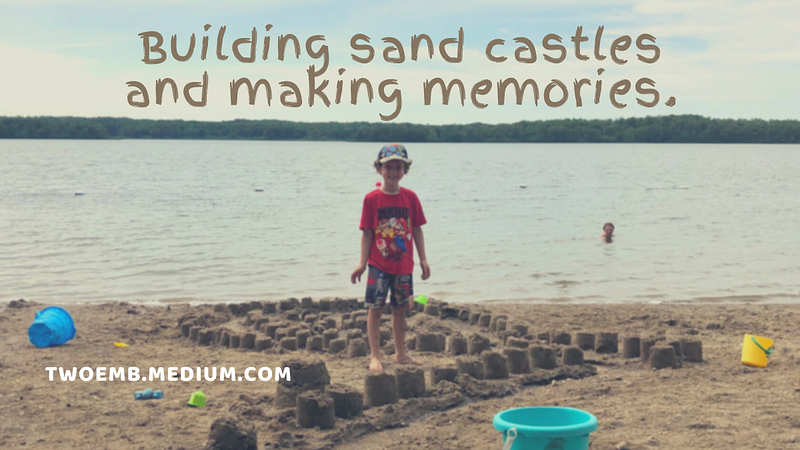
What do you most look forward to doing with your children this summer?
2022 Update
Follow along as we share the highlights of our epic camping road trip — two months of camping across Canada!
Happy summer!
© Jillian Enright, Neurodiversity MB
When you join medium, as a member you’ll have access to unlimited reads for only $5 per month. If you use my referral link, I’ll earn a small commission.
Related Stories
References
Kocyigit, S., Guzel, H.S., Acikel, B. et al. (2021). Comparison of Smartphone Addiction Level, Temperament and Character and Parental Attitudes of Adolescents with and without Attention Deficit Hyperactivity Disorder. International Journal of Mental Health and Addiction. https://doi.org/10.1007/s11469-021-00494-2
Mehta, T.R., Monegro, A., Nene, Y. et al. (2019). Neurobiology of ADHD: A Review. Current Developmental Disorders Reports 6, 235–240. https://doi.org/10.1007/s40474-019-00182-w.
Stixrud, W. & Johnson, N. (2018). The Self-Driven Child: The Science and Sense of Giving Your Kids More Control Over Their Lives. Penguin Books.
Weiss, M.D., Craig, S.G., Davies, G. et al. (2015). New Research on the Complex Interaction of Sleep and ADHD. Current Sleep Medicine Reports 1, 114–121. https://doi.org/10.1007/s40675-015-0018-8
Wright, K. P., Jr, McHill, A. W., Birks, B. R., Griffin, B. R., Rusterholz, T., & Chinoy, E. D. (2013). Entrainment of the human circadian clock to the natural light-dark cycle. Current biology : CB, 23(16), 1554–1558. https://doi.org/10.1016/j.cub.2013.06.039


