
Why Gifted Kid Burnout Is A Thing
Twice Exceptionality (2e): Gifted is not the same as high-achieving

Have you seen memes and videos on social media about “gifted kid burnout”? I was that kid, and so was my son at the ripe old age of 7 years old.
It’s not what you think
My son was reading chapter books at age six and YA novels at age 7. He could perform multiplication and division in his head by age 8. He has the vocabulary of a well-read adult and loves learning about animals and science.
He has also struggled. A lot.
We both have ADHD and anxiety. My son has struggled with social-emotional skills, and his asynchronous development made it very difficult for him to find where he fit in. Asynchronous, or variable development, means his skills and abilities develop at significantly different rates.
While his reading, comprehension, and math skills are years ahead, his social-emotional maturity and fine motor skills lag behind. While at age 7 he could hold an intellectual conversation with kids twice his age, he didn’t know how to deal with conflict or keep his emotions in check in a developmentally appropriate way.
Through grades one and two, my son’s principal had me on speed-dial. I got phone calls at least one each week about my son’s behaviour at school. Part of this was a result of his school not meeting his needs (he no longer goes there), but part of it was due to his serious struggles with emotional regulation.
My son is 9 years old now and in grade four. He has come a very long way in the past couple of years, but our public education system doesn’t seem to have moved an inch.
What is Twice Exceptional?
My son and I are both twice exceptional (2e). This means we are gifted and have a “disability”. We both have ADHD and anxiety, and are both probably Autistic. We’ve both been formally diagnosed with ADHD, but not autism.
As an aside, I don’t consider being Autistic a disability in and of itself. I find our society’s lack of knowledge, understanding, and accommodation to be disabling, a perspective I expanded on in another article entitled What is Neurodiversity?
A person who is 2e excels in certain areas of intelligence while also living with a disability. The term twice exceptional was coined back in 1985 by Dr. James Gallagher to describe students who were gifted and also displayed learning disabilities.
Despite the fact that this was 36 years ago, many educators and professionals working with children have never even heard the term.
There have since been updated definitions of twice exceptionality, expanding to include a large variety of disabilities, and not just learning disabilities. In 2015, Reis and colleagues included the following points:
- 2e student’s gifts may mask their disabilities and their disabilities may mask their gifts.
- Educational services must identify and serve both the high achievement potential and the academic and social-emotional deficits of this population of students.
- Twice- exceptional students require differentiated instruction.
There are different definitions of gifted as well, but statistically speaking, we’re the people who score in the top 2.5% in intelligence testing.
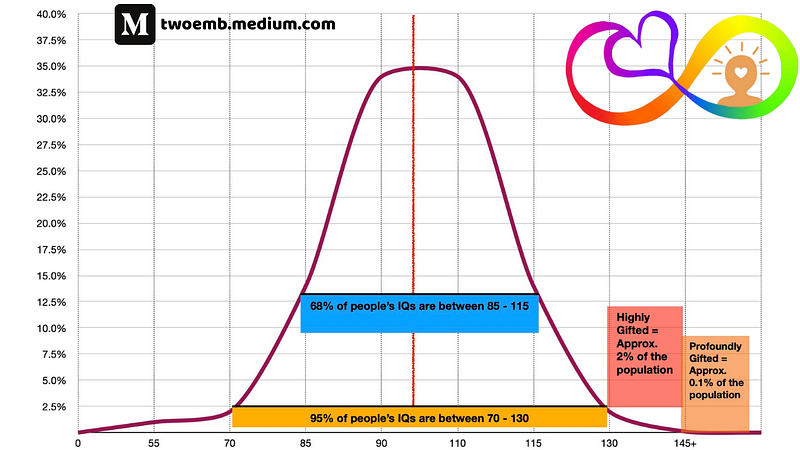
This is over-simplified, of course, because many disabled people may well score very high on an IQ test if given proper accommodations, not to mention the fact that various professionals are often the gate-keepers to formal IQ testing.
School administration must identify and refer students to psychologists for testing, or parents need to have the resources to seek out and pay for their own psychological and educational assessments for their children. These often have extremely lengthy waiting lists and are very expensive.
It’s never that simple
Giftedness and disability interact with each other, where one’s giftedness may hide some impacts of disability, and one’s disability may hide some traits of giftedness.
Unfortunately our society really likes to pigeon-hole people, reducing us down to a single label so that we fit into neat little categories.
People who have visible disabilities may be treated as less intelligent, despite having above-average intellect. People who have invisible disabilities may be expected to behave and function as though they weren’t disabled because of their intelligence.
Speaking of gate-keeping, teachers often resist or refuse to provide enrichment or acceleration for students with disabilities, preferring to focus exclusively on their deficits.
When gifted students are constantly bogged down in repetitive work well below their current academic level, they become bored and frustrated. When faced with work that is too easy, many children will try to rush through and end up making careless mistakes, only reaffirming the teacher’s belief that they “can’t be gifted” because they have a disability.
Bright minds require intellectual challenge to stay focused and attend to the tasks at hand. This is especially true for those of us with ADHD, as we become bored easily and are more likely to make careless errors when they are not stimulated by, or engaged in, their work.
At the same time, gifted students with disabilities may become frustrated and feel defeated if they are given accelerated work without any accommodations. While the work may be at their academic level, without appropriate adaptations, it may be they are asked to do something outside their capabilities.
Needing accommodations is not a justification for refusing to meet a student’s academic needs.
Catch up, folks
Anyone who works with children, especially those who support disabled or gifted children — or disabled and gifted children — has a professional and ethical responsibility to educate themselves.
Twice exceptional students have been identified as a severely misunderstood and underserved population. Back in 1997, Brody & Mills were were arguing that 2e students should have access to both gifted and special education services.
This information has been accumulating and disseminating for more than 35 years, and with the ever-increasing availability of academic resources, there’s no excuse for being ill-informed.
Increasingly, researchers are recognizing that there is an overrepresentation of children with high IQs among the neurodivergent population, so professionals need to stop assuming that a divergent brain means a less intelligent brain.
If 36 years is not long enough for you, how about 44?
Way back in 1977, Dr. William Chuickshank hypothesized that hyperactivity and distractibility may actually describe the way some high-ability students absorb information.
Dr. Chuickshank suggested that attention to all stimuli in our environment may actually enhance our knowledge acquisition, rather than interfering with it. Just because someone’s brain is all over the place, doesn’t mean they don’t have brilliant ideas, or that they aren’t learning.
In fact, it may well be the opposite.
© Jillian Enright, ADHD 2e MB
Related Stories
When you join medium, as a member you’ll have access to unlimited reads for only $5 per month. If you use my referral link, I’ll earn a small commission.

References
Baum, S. M., & Schader, R. M. (2020). Twice Exceptionality: A field whose time has come. In M. Fugate, W. Behrens, C. Boswell (Eds.). Understanding Twice-Exceptional Learners: Connecting research to practice. Routledge.
Brody, L. E., & Mills, C. J. (1997). Gifted Children with Learning Disabilities: A Review of the Issues. Journal of Learning Disabilities, 30(3), 282–296. https://doi.org/10.1177/002221949703000304
Camp, A., Pastrano, A., Gomez, V., Stephenson, K., Delatte, W., Perez, B… Guiseppi-Elie, A., et al. (2021). Understanding ADHD: Toward an Innovative Therapeutic Intervention. Bioengineering, 8(5), 56. https://doi.org/10.3390/bioengineering8050056
Crespi, B., Leach, E., Dinsdale, N., Mokkonen, M., Hurd, P. (2016). Imagination in human social cognition, autism, and psychotic-affective conditions. Cognition, 150, 181–199. https://doi.org/10.1016/j.cognition.2016.02.001
Cruickshank, W. M. (1977). Myths and Realities in Learning Disabilities. Journal of Learning Disabilities, 10(1), 51–58. https://doi.org/10.1177/002221947701000112
Gallagher, J. J. (1985). The Conservation of Intellectual Resources. Gifted International, 3(2), 7–16. https://10.1080/15332276.1985.11672687
Hughes, C. E. (2020). Giftedness and Autism Spectrum Disorders. In M. Fugate, W. Behrens, C. Boswell (Eds.). Understanding Twice-Exceptional Learners: Connecting research to practice. Routledge.
Reis, S. M., Baum, S. M., & Burke, E. (2014). An Operational Definition of Twice-Exceptional Learners: Implications and Applications. Gifted Child Quarterly, 58(3), 217–230. https://doi.org/10.1177/0016986214534976


