avatarJillian Enright

Free AI web copilot to create summaries, insights and extended knowledge, download it at here

7777

Abstract

ialThinking.com</figcaption></figure><p id="307b">The <a href="https://www.socialthinking.com">flexible thinking curriculum<b></b></a><b> </b>is good, don’t get me wrong. For it to be effective, however, it requires the adults to <a href="https://readmedium.com/teaching-kids-cognitive-flexibility-5389fb07109c">role-model</a> and set the example first and foremost. In reality, for <b>any</b> program to be effective, the adults must first role-model the behaviour they want to see in the children.</p><p id="6d26" type="7">For any program to be effective, the adults must first role-model the behaviour they want to see in the children.</p><h2 id="4829">You don’t have all the answers</h2><p id="01ae">You don’t have all the answers, and guess what? You’re not supposed to. Nobody does. The whole “ <i>it takes a village</i>” thing is true, and right now your child’s school is part of your village, whether you like it or not.</p><p id="994c">The adults who interact with and support your child at school need to communicate with you what they observe and what they are trying that is or is not working. Parents and school staff need to communicate about what they think children need to be successful and what they are doing (both at home and at school) to make that happen.</p><p id="0bb0" type="7">Whether you like it or not, right now, your child’s school is part of your village.</p><p id="6105">If you are repeatedly receiving communications from your school about recurring issues, and you don’t feel they are doing enough on their end to help your child, here are some options:</p><ul><li>First, <a href="https://adhdpro.ca/self-advocacy"><b>document</b></a> the phone calls and emails. You can make yourself a chart with the date, time, and subject or concern expressed to you to keep track of exactly how often you’re being contacted and how often the same concerns are being brought to your attention.</li><li>Note that documentation is intended to help you conceptualize the severity of the problem and provide data as to exactly how frequent the issues are happening. It is surprising how, without actual numbers, we as humans are not good at estimating how often something is occurring.</li><li>If you <b>notice a pattern</b>, now you can bring that to the school’s attention. You can ask for a meeting with the classroom teacher and administrator (or school psychologist, guidance counsellor, social worker, or anyone who has regular contact with your child at school and may have helpful insights to offer).</li><li>At the <b>meeting</b>, or in your communications with the school, ask for information about what is happening <b>before</b> the behaviour (the antecedents, triggers, environment, context, etc.). The further back in time they can go, the better, behaviour does not happen in a vacuum.</li><li>If they do not know, then they need to find out. Adults cannot effectively support a child if they do not dig down to <a href="https://readmedium.com/the-adhd-iceberg-explained-b6b61474c768"><b>look <i>beneath</i> the behaviour</b></a> for the underlying causes and contributing factors. That is the important next step.</li></ul><figure id="7f01"><img src="https://cdn-images-1.readmedium.com/v2/resize:fit:800/1*QNcapiuuhQAuv6g8JasJ8Q.png"><figcaption>Created by author</figcaption></figure><h2 id="5fb3">Behaviour is (still) communication</h2><p id="513a">If a child’s behaviour is <a href="https://readmedium.com/challenging-behaviours-in-children-c0b26d037451">maladaptive, “disruptive”,</a> harmful, or otherwise unexpected, then that behaviour is telling us something. Something is not working for that child, and if the adults want the behaviour to change, then they need to change the environment and provide the supports the child needs to succeed.</p><ul><li>If your school needs help identifying your child’s patterns or triggers, you can ask them to fill in an <a href="https://readmedium.com/the-problem-s-with-abc-charts-58ec462a0f1a">ABC chart<b></b></a><b> </b>any time they contact you about your child’s behaviour (or any time they notice the same or similar difficulties coming up).</li><li>That said, there are certainly some <a href="https://readmedium.com/the-problem-s-with-abc-charts-58ec462a0f1a">significant limitations</a> to any behavioural tracking. The biggest problem is that they oversimplify by boiling the antecedent down to one trigger when human behaviour and emotions are so much more complex than that.</li></ul><p id="1259" type="7">Tracking forms oversimplify behaviour by boiling the antecedent down to one trigger when human behaviour and emotions are so much more complex than that.</p><ul><li>The other missing piece is <b>communicating</b> with the child once everyone is calm to learn more about their experiences and perceptions. We need to find out more about their day, week, even month, to see what is building up for them, contributing to their struggles, and creating vulnerabilities.</li><li>The documentation is really just to get the school starting to look a little <a href="https://readmedium.com/gaining-a-better-understanding-of-behaviour-in-neurodiverse-children-dcc0164683dd">deeper than the surface behaviour</a>. It can improve communication between family and school, and if not, it at least creates a paper trail for all the times they contact home without having taken steps to support the student.</li><li>If the school is on board and ready to take their support to the next level, we very highly recommend the <a href="https://adhdpro.ca/cps">Collaborative & Proactive Solutions (CPS) model</a>. Your child’s school administration <i>should</i> have heard of CPS, but in case they haven’t, information for schools is available on the <a href="https://www.livesinthebalance.org/educators-schools">Lives in the Balance website</a>. This is a much deeper, and more child-centred, approach to problem solving and developing relevant and effective supports that will actually help the student.</li></ul><figure id="a395"><img src="https://cdn-images-1.readmedium.com/v2/resize:fit:800/0*lslqofBkZe_yo94V.png"><figcaption>CPS from LivesintheBalance.org</figcaption></figure><p id="5dac"><b>Extremely important:</b> Any home-school communication should be for adult information-gathering purposes only. The intent is to spot patterns, identify triggers, and identify and develop the supports that would be most needed for that child.</p><p id="a884">Home-school communication should <b>never</b> be used for school staff to “<i>tattle</i>” to parents about the child’s behaviour, it should never be used as part of a behaviour “modification” program, and most importantly, it should <b>never</b> be used with the expectation that the parent then punishes the child at home for something that happened at school.</p><p id="9b39"><a href="https://neurodiversitymb.ca/inclusive-education">Visit my website</a> for more information on <a href="https://neurodiversitymb.ca/inclusive-education">effective behaviour “tracking”</a>. Once the relevant information has been gathered, then patterns can be identified, and relevant supports can be put into place.</p><h2 id="ab0d">If the calls persist</h2><p id="54c3">If the behavioural difficulties are such that the school is calling home once a week or more, it would be wise to have a <a href="https://readmedium.com/behaviour-plans-are-useless-8da1b1b3cad">Behaviour “Intervention” Plan</a> put into place.</p><p id="1aa3">That said, the <a href="https://www.edu.gov.mb.ca/k12/specedu/bip/sample.html">BIP example</a> outlined on the Government of Manitoba’s website is …<i>not</i> <i>great</i>. It focuses too much on the <a href="https://readmedium.com/behaviour-plans-are-useless-8da1b1b3cad">student’s behaviour</a> and not enough on t

Options

he underlying contributing factors. It does outline skill development and touches a little bit on relationship-building, so that’s a start.</p><p id="a0cf">For more about developing effective, supportive, and relevant student plans, visit our previous blog post, “<a href="https://twoemb.medium.com/is-your-childs-iep-unintentionally-useless-38ee6e10da0e">Is Your Child’s IEP Unintentionally Useless?</a></p><p id="82b0">In fact, if your child has ADHD, and that ADHD impacts their functioning in school (spoiler alert: <i>it does</i>), then your child is entitled to an <a href="https://www.edu.gov.mb.ca/k12/specedu/iep/">SSP<b></b></a><b> </b>— but, like, a <b>good</b> one.</p><p id="453d">An <a href="https://readmedium.com/education-planning-for-neurodiverse-students-5d434321f6f3">effective SSP</a> should focus on what <a href="https://readmedium.com/practical-classroom-supports-16ffe40eadd2">accommodations</a> the student needs in order to do their best, what supports they may need to be on a level playing field with their peers, and should include S.M.A.R.T. goals that are intended to allow the student to thrive.</p><p id="7fa0">An SSP (or BIP, or IEP, or <i>any</i>-p) should not include goals that simply make things easier for school staff and should not focus on the child changing or stopping behaviour without very specific steps identifying the lagging skills and how the adults in the student’s life will support them to build those skills.</p><h1 id="558a">You Are SO Not Alone</h1><p id="c72a">If your heart starts racing any time your phone rings, or if you dread emails from your child’s teacher or principal, remember: <b>this is not all on you</b>. Your child is at school for more than 30 hours per week. Parents have very little, if any, control over what happens during their child’s school day.</p><p id="d2b4">Yes, you are an extremely important part of your child’s support team, and you know your child best. Yes, you can do things at home and with outside professionals to support your child. Yes, you can work collaboratively with your child’s school team to set everyone up for success.</p><p id="fc84">Your child’s school is part of your proverbial village. If they have difficulty with your child’s behaviour during their school day, then it’s up to them to look <a href="https://readmedium.com/gaining-a-better-understanding-of-behaviour-in-neurodiverse-children-dcc0164683dd"><b>beneath</b></a> the surface behaviours.</p><p id="a203">Only then can they expect you to work with them, and they with your child, to develop supports and solutions. Only then will your child truly get the support they need and deserve.</p><p id="c7fb">© Jillian Enright, Neurodiversity MB</p><figure id="09dd"><img src="https://cdn-images-1.readmedium.com/v2/resize:fit:800/1*Duv1BYukG7xt6OYbJjg1aA.png"><figcaption></figcaption></figure><h1 id="8aae">Related Articles</h1><div id="a252" class="link-block"> <a href="https://readmedium.com/education-staff-stop-gaslighting-parents-eb8f3a223dbd"> <div> <div> <h2>Education Staff: Stop Gaslighting Parents</h2> <div><h3>We need to stop turning these into ‘schools versus parents’ issues</h3></div> <div><p>medium.com</p></div> </div> <div> <div style="background-image: url(https://miro.readmedium.com/v2/resize:fit:320/1*m0egLyUjHLR0bfOBWjSbeA.png)"></div> </div> </div> </a> </div><div id="920b" class="link-block"> <a href="https://readmedium.com/behaviour-plans-are-useless-8da1b1b3cad"> <div> <div> <h2>Behaviour Plans Are For The Adults, Not The Kids</h2> <div><h3>Behaviour plans are useless, unless the adults have developed — and continue to develop — secure relationships with the…</h3></div> <div><p>medium.com</p></div> </div> <div> <div style="background-image: url(https://miro.readmedium.com/v2/resize:fit:320/1*krnW-fPPyIDsh3nErIf5Cg.png)"></div> </div> </div> </a> </div><div id="30db" class="link-block"> <a href="https://readmedium.com/the-problem-s-with-abc-charts-58ec462a0f1a"> <div> <div> <h2>The Problem(s) With ABC Charts</h2> <div><h3>The antecedents begin long before you might think</h3></div> <div><p>medium.com</p></div> </div> <div> <div style="background-image: url(https://miro.readmedium.com/v2/resize:fit:320/1*CuLTdON4iKBa6myM6-bzSA.png)"></div> </div> </div> </a> </div><div id="9978" class="link-block"> <a href="https://readmedium.com/how-do-i-advocate-for-my-child-f1d084bd68b1"> <div> <div> <h2>Effectively Advocating for Your Child</h2> <div><h3>Advice from a Professional Advocate for Supporting and Effectively Advocating for Your Child at School.</h3></div> <div><p>medium.com</p></div> </div> <div> <div style="background-image: url(https://miro.readmedium.com/v2/resize:fit:320/1*Ce82RfZv8tU-Q9jquCIPXA.jpeg)"></div> </div> </div> </a> </div><div id="de50" class="link-block"> <a href="https://readmedium.com/gaining-a-better-understanding-of-behaviour-in-neurodiverse-children-dcc0164683dd"> <div> <div> <h2>Gaining a Better Understanding of Children’s Behaviour</h2> <div><h3>You’ll have to be both a deep-sea diver and a time-traveller</h3></div> <div><p>medium.com</p></div> </div> <div> <div style="background-image: url(https://miro.readmedium.com/v2/resize:fit:320/1*oBEBY6xN6Lw1zIiR4o0azQ.jpeg)"></div> </div> </div> </a> </div><p id="553a">For more stories about supporting children and students at school, browse through my <a href="https://readmedium.com/back-to-school-series-f63fa6df1e04">Education Stories Series</a>:</p><div id="e350" class="link-block"> <a href="https://readmedium.com/back-to-school-series-f63fa6df1e04"> <div> <div> <h2>Back to School Series</h2> <div><h3>Stories to help make the transition back to school as smooth as possible</h3></div> <div><p>medium.com</p></div> </div> <div> <div style="background-image: url(https://miro.readmedium.com/v2/resize:fit:320/1*UR6j_cj_TGJEDpWN3DI0Hw.jpeg)"></div> </div> </div> </a> </div><p id="96b5"><i>When you join medium, as a member you’ll have access to unlimited reads for only $5 per month. If you use <a href="https://twoemb.medium.com/membership">my referral link</a>, I’ll earn a small commission, and you’ll earn my undying gratitude.</i></p><p id="39f0"><i>If you’d prefer give a one-time tip, you can <a href="https://ko-fi.com/neurodiversitymb">support my writing on Ko-Fi</a> — also, it’s free to <a href="https://facebook.com/NeurodiversityMB">follow me on Facebook</a> and <a href="https://linkedin.com/in/adhd2emb">LinkedIn</a>!</i></p><figure id="c930"><img src="https://cdn-images-1.readmedium.com/v2/resize:fit:800/1*6-2cLvj1EW3nutYb4C3CRA.png"><figcaption></figcaption></figure><h2 id="b53c">References</h2><p id="64e9">Dweck, Carol, S. (2007). <i>Mindset: The New Psychology Of Success</i>. Ballantine Books.</p></article></body>

Education | Advocacy

When The School Keeps Calling

If your child’s school repeatedly calls you about behaviour problems, here’s what you can do about it

Photo by Regös Környei on Unsplash

My son’s school kept calling and I was a mess

It got to the point where my heart would race every time the phone rang during the school day, and I dreaded picking it up when I saw the school’s caller ID on my phone.

I was getting phone calls or emails from the school 2–3 times each week and my son was only in second grade. Someone from the school (usually the teacher or principal) would regularly call or email to communicate (ie. to complain about) our son’s behaviour.

My heart would race every time the phone rang during the school day.

At first, I was extremely apologetic, “I’m so sorry. Of course I’ll speak to him. I don’t know why that happened. I will make sure he knows that behaviour is unacceptable” and so on. I have a Child & Youth Work diploma and a degree in psychology, I should have answers, I should be able to “solve” these problems.

Then I started reading and learning (and reading and learning and reading and learning some more).

As I mentioned in a previous article, my diploma from 2006 and degree from 2009 just weren’t cutting it as far as ADHD-related knowledge was concerned. So I sought to become an expert on ADHD, and more importantly, on my son.

Then I realized something

Most of the behaviours the school was calling me about were not entirely his fault, nor were they mine. I am not saying my son doesn’t have responsibility and accountability for his choices, he absolutely does — in as much as a 6 or 7 year old child can reasonably be held responsible, when most of what happens in his daily life is outside of his control.

As a parent, it is always my goal to work collaboratively and cooperatively with my son’s school, and to support my son’s learning in any way possible.

However, when a school repeatedly calls home with the same or similar complaints, yet have done little to support a student to succeed within the school environment… well, if they keep doing the same thing and expecting a different result, then who is really responsible here?

As Dr. Ross Greene would say, kids do well when they can. (I discuss the issue of ineffective “punishment” in another article).

Essentially if a child is lacking skills and adults are not liking the resulting behaviour, but the adults are not actively teaching those missing skills, then how can we blame the child for not having them?

As parents, we were truly doing everything we possibly could from home to support our son. We sought the advice of outside experts: we went to a child psychologist and occupational therapist. I read ALL OF THE BOOKS, listened to podcasts, followed the advice from the school’s clinical team, and was trying to teach our son the skills he needed to succeed.

In reality, was the stress and rigidity of the school environment that were contributing to and really triggering a lot of his behaviours, and we had no control over that.

School Stresses

Schools are very often loud, busy, and can be very overwhelming, especially for children with sensory hypersensitivities. Children with ADHD often have co-morbid sensory processing disorders, or experience sensory overload.

When an ADHD brain is less able to filter out the external noise, or has trouble deciding which input to attend do (so it attends to it all!), this can be incredibly overwhelming.

Schools often have unrealistic expectations for children’s developmental abilities, especially when it comes to children with ADHD or other neurodevelopmental disabilities. Sitting in a desk for 5 hours per day at ages 5–8 is neither healthy nor realistic for most children, let alone those with hyperactivity.

When children are not given the ability to move their bodies, take movement breaks, and self-regulate with physical play, then it sets them up for failure. We expect them to sit down, learn, attend, be quiet, and listen while their bodies and brains are begging for physical outlets and activities.

Schools can often have very rigid rules that are “equally” (but not actually because adults are human too) applied to all students in the effort to be “fair” to all.

If all children develop differently and are at different stages of development and have different skills and abilities… how is it fair to have the exact same expectations across the board?

I get that it’s impossible to have a separate set of written rules for each individual student, and even those would have to change day-to-day based on the child’s functioning and development. That may be unrealistic…

Actually, hold up

It’s not entirely unreasonable nor unrealistic to adapt to the child’s developmental stage, present level of functioning, and state of mind. It is well within an adult’s ability to step back and take a wider view of a situation, use professional judgement, and to choose their priorities (also pick their battles) based on what that student is capable of and what that child needs in that moment.

It is well within an adult’s ability to take a wider view of a situation, use professional judgement, and to prioritize based on what that child needs in that moment.

Hypocrisy in Education

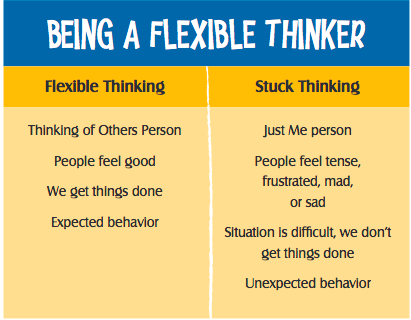
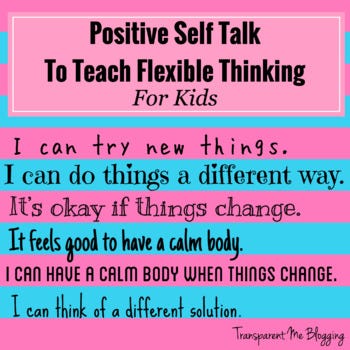
Many schools are currently teaching students about flexible thinking and growth mindset. How can the adults expect the children to practice flexible thinking if the adults are not role-modelling those skills?

Short answer: they shouldn’t.

Examples of posters that may be on some classroom walls:
From SocialThinking.com

The flexible thinking curriculum is good, don’t get me wrong. For it to be effective, however, it requires the adults to role-model and set the example first and foremost. In reality, for any program to be effective, the adults must first role-model the behaviour they want to see in the children.

For any program to be effective, the adults must first role-model the behaviour they want to see in the children.

You don’t have all the answers

You don’t have all the answers, and guess what? You’re not supposed to. Nobody does. The whole “ it takes a village” thing is true, and right now your child’s school is part of your village, whether you like it or not.

The adults who interact with and support your child at school need to communicate with you what they observe and what they are trying that is or is not working. Parents and school staff need to communicate about what they think children need to be successful and what they are doing (both at home and at school) to make that happen.

Whether you like it or not, right now, your child’s school is part of your village.

If you are repeatedly receiving communications from your school about recurring issues, and you don’t feel they are doing enough on their end to help your child, here are some options:

  • First, document the phone calls and emails. You can make yourself a chart with the date, time, and subject or concern expressed to you to keep track of exactly how often you’re being contacted and how often the same concerns are being brought to your attention.
  • Note that documentation is intended to help you conceptualize the severity of the problem and provide data as to exactly how frequent the issues are happening. It is surprising how, without actual numbers, we as humans are not good at estimating how often something is occurring.
  • If you notice a pattern, now you can bring that to the school’s attention. You can ask for a meeting with the classroom teacher and administrator (or school psychologist, guidance counsellor, social worker, or anyone who has regular contact with your child at school and may have helpful insights to offer).
  • At the meeting, or in your communications with the school, ask for information about what is happening before the behaviour (the antecedents, triggers, environment, context, etc.). The further back in time they can go, the better, behaviour does not happen in a vacuum.
  • If they do not know, then they need to find out. Adults cannot effectively support a child if they do not dig down to look beneath the behaviour for the underlying causes and contributing factors. That is the important next step.
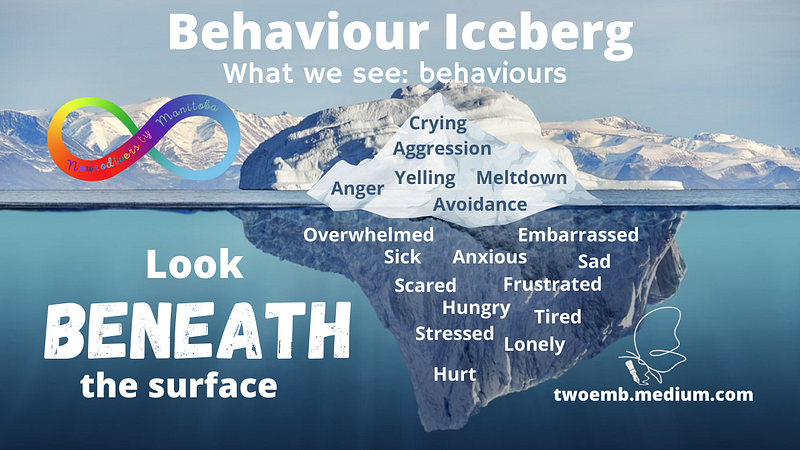
Created by author

Behaviour is (still) communication

If a child’s behaviour is maladaptive, “disruptive”, harmful, or otherwise unexpected, then that behaviour is telling us something. Something is not working for that child, and if the adults want the behaviour to change, then they need to change the environment and provide the supports the child needs to succeed.

  • If your school needs help identifying your child’s patterns or triggers, you can ask them to fill in an ABC chart any time they contact you about your child’s behaviour (or any time they notice the same or similar difficulties coming up).
  • That said, there are certainly some significant limitations to any behavioural tracking. The biggest problem is that they oversimplify by boiling the antecedent down to one trigger when human behaviour and emotions are so much more complex than that.

Tracking forms oversimplify behaviour by boiling the antecedent down to one trigger when human behaviour and emotions are so much more complex than that.

  • The other missing piece is communicating with the child once everyone is calm to learn more about their experiences and perceptions. We need to find out more about their day, week, even month, to see what is building up for them, contributing to their struggles, and creating vulnerabilities.
  • The documentation is really just to get the school starting to look a little deeper than the surface behaviour. It can improve communication between family and school, and if not, it at least creates a paper trail for all the times they contact home without having taken steps to support the student.
  • If the school is on board and ready to take their support to the next level, we very highly recommend the Collaborative & Proactive Solutions (CPS) model. Your child’s school administration should have heard of CPS, but in case they haven’t, information for schools is available on the Lives in the Balance website. This is a much deeper, and more child-centred, approach to problem solving and developing relevant and effective supports that will actually help the student.

CPS from LivesintheBalance.org

Extremely important: Any home-school communication should be for adult information-gathering purposes only. The intent is to spot patterns, identify triggers, and identify and develop the supports that would be most needed for that child.

Home-school communication should never be used for school staff to “tattle” to parents about the child’s behaviour, it should never be used as part of a behaviour “modification” program, and most importantly, it should never be used with the expectation that the parent then punishes the child at home for something that happened at school.

Visit my website for more information on effective behaviour “tracking”. Once the relevant information has been gathered, then patterns can be identified, and relevant supports can be put into place.

If the calls persist

If the behavioural difficulties are such that the school is calling home once a week or more, it would be wise to have a Behaviour “Intervention” Plan put into place.

That said, the BIP example outlined on the Government of Manitoba’s website is …not great. It focuses too much on the student’s behaviour and not enough on the underlying contributing factors. It does outline skill development and touches a little bit on relationship-building, so that’s a start.

For more about developing effective, supportive, and relevant student plans, visit our previous blog post, “Is Your Child’s IEP Unintentionally Useless?

In fact, if your child has ADHD, and that ADHD impacts their functioning in school (spoiler alert: it does), then your child is entitled to an SSP — but, like, a good one.

An effective SSP should focus on what accommodations the student needs in order to do their best, what supports they may need to be on a level playing field with their peers, and should include S.M.A.R.T. goals that are intended to allow the student to thrive.

An SSP (or BIP, or IEP, or any-p) should not include goals that simply make things easier for school staff and should not focus on the child changing or stopping behaviour without very specific steps identifying the lagging skills and how the adults in the student’s life will support them to build those skills.

You Are SO Not Alone

If your heart starts racing any time your phone rings, or if you dread emails from your child’s teacher or principal, remember: this is not all on you. Your child is at school for more than 30 hours per week. Parents have very little, if any, control over what happens during their child’s school day.

Yes, you are an extremely important part of your child’s support team, and you know your child best. Yes, you can do things at home and with outside professionals to support your child. Yes, you can work collaboratively with your child’s school team to set everyone up for success.

Your child’s school is part of your proverbial village. If they have difficulty with your child’s behaviour during their school day, then it’s up to them to look beneath the surface behaviours.

Only then can they expect you to work with them, and they with your child, to develop supports and solutions. Only then will your child truly get the support they need and deserve.

© Jillian Enright, Neurodiversity MB

Related Articles

For more stories about supporting children and students at school, browse through my Education Stories Series:

When you join medium, as a member you’ll have access to unlimited reads for only $5 per month. If you use my referral link, I’ll earn a small commission, and you’ll earn my undying gratitude.

If you’d prefer give a one-time tip, you can support my writing on Ko-Fi — also, it’s free to follow me on Facebook and LinkedIn!

References

Dweck, Carol, S. (2007). Mindset: The New Psychology Of Success. Ballantine Books.

Adhd
Parenting
Education
Schools
Psychology
Recommended from ReadMedium