
Parenting & Advocacy
Be Your Child’s Best Advocate
Expert advice to help you effectively advocate for your child at school

How can I effectively advocate for my child at school?
If your child seems to be needing additional support at school, do not hesitate to reach out to the support team. Positive communication between the school and home is one of the greatest predictors of children’s social and behavioural success at school, and the earlier the better.
Don’t wait for something big to happen and then react, be proactive. If your child has had struggles in the past, be open and honest about them. Let the teacher know what has worked well for your child in the past so that the school can be prepared to support the student and set them up for success.
The school support team usually consists of their teacher, the school principal, the resource teacher, and the guidance counsellor. If your child has an SSP/IEP, or has required in-school support in the past, this team may also include the division’s school psychologist and social worker. These people are usually awesome, so please do not be intimidated by or worried about their involvement unless or until given a reason to be.
Cooperation and collaboration
First and foremost, start with the assumption that everyone is doing the best they can with the tools, skills, and resources available to them. If your child’s needs are not being met, you may just need to sit down with the classroom teacher and resource professional and discuss how they can help.
If more involvement is needed, then go ahead and ask for it, then proceed with the assumption that everyone has your child’s best interests in mind.
Start with open dialogue and a willingness to be collaborative. Aim to work as a team to do what is best for your child, then check in frequently to ensure the plans are being put into place, and to see how they are going.
Teachers may currently be feeling too overwhelmed, or may not want to “bother” you and ask for ideas, but if you initiate conversation they will likely be more than willing to discuss concerns and ask questions. Most teachers have a desire to help each student flourish and a desire to get to know them better.
Be patient with your child’s school, but do not accept less for your child because there is a pandemic. Children with disabilities need even greater advocacy during this time, not less.
With that said, remember that teachers only have so much sway and are working in a large system that has an extremely stringent hierarchy. Some teachers are pulling out all the stops for their students, but encounter a lot of red tape and resistance from their administrators.
Teachers lucky enough to have progressive, compassionate, strong administrators still have a paltry budget to work with. Our public education system is grossly under-funded, so please be kind and patient with your child’s teachers. Most are doing the very best they can with the limited resources available to them.
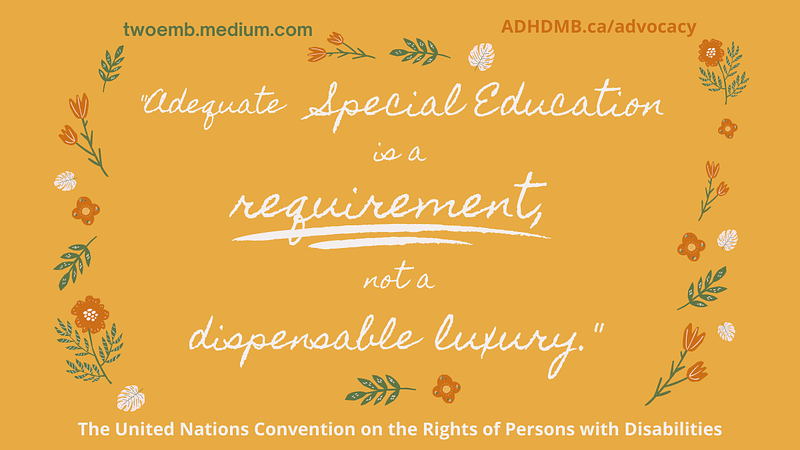
Children with disabilities deserve, need, and must be treated as equally valuable and important members of their communities, and this includes their school community. Adequate special education is a requirement, not a “dispensable luxury” (U.N. CRPD, 2006).
Children with disabilities deserve to be treated as valuable members of their communities, and this includes their school community.

Follow the Appropriate Chain of Command
If you need help advocating for your child, below is a guideline for getting the process started. If you are unsure as to the procedure to follow, check your division’s website as they may have an organizational chart or concern procedure posted. I have posted a guide with a suggested protocol on my website as well.
- After meeting with your child’s teacher and resource professional, send an email thanking them for meeting with you and summarizing the next steps agreed upon to support your child. End your email expressing your willingness and desire to help in any way you can and invite them to contact you (and/or your child’s co-parent) with any questions.
- If this does not bring about a resolution, and you’ve tried working with the teacher, next contact your school’s principal, in writing. If you speak on the phone or in person, take notes and follow up with an email summarizing your conversation so that you have documentation of the communication. Ask for concrete steps that will be taken, as well as timelines, and follow up on these.
- I suggest parents and caregivers keep a record of communication with school staff and other professionals when advocating for your child. This is to help parents keep contacts with professionals organized and to visualize the efforts parents are making on behalf of their children.
- If you have a school support team, you may seek their input as well. As mentioned, this team may include a school psychologist, resource teacher, guidance counsellor, or social worker. These professionals are there to advocate for and support the students, so please do not hesitate to seek out their help and expertise.
- If at any point in this process you feel you need a support person to attend a meeting with you, that is your right. It can be intimidating and overwhelming to meet with school teams, so it may be helpful to have someone you trust along for moral support, or even to take notes so that you can review them later once emotions have settled.
- If you have tried working with the teacher and principal and are not satisfied, contact the principal’s next-in-charge. For some divisions this is a Director of Student Services. This may differ by region, but your school division’s website should have a guide for parents for escalating concerns. If not, they may have an organizational chart outlining the roles and responsibilities of each team member.
- If you are not satisfied, and have tried your best with the principal and Director of Student Services, next contact your division’s Assistant Superintendent. Maintain documentation.
- Please note, record-keeping is not intended to be combative or confrontational, nor as a strategy to “catch” someone making a mistake. Good documentation will help you stay organized during a stressful time and may be important to reference in the future.
- If you have made diligent efforts to work with the Director of Student Services and the Assistant Superintendent and you are still not satisfied, contact your division’s Superintendent. As you will have been in contact with other divisional senior administration, it is likely they will have already been made aware of your concerns.
On the Manitoba Education website, they have a formal dispute resolution protocol listed. This may look slightly different across provinces.
The Ministry of Education website also has a brochure called Working Together: A Parent’s Guide to Formal Dispute Resolution.

It has been my experience that many people within the system either don’t know this process, or don’t guide parents to this information, meaning that parents and caregivers aren’t provided the details on what steps to take next if they don’t feel heard somewhere along the way.
This brochure is available on the Student Services website and we have also uploaded a PDF file onto my website to help make it more widely available and accessible.
When More is Needed
In my experience, if you are not getting the help you need from your school’s senior administration, or if the problem is such that it requires assistance from someone with greater authority. Depending on where you live, these may be some of the next steps to take:
- Parents have the right to hire or contact an advocate. This can be a private advocate the family hires on their child’s behalf, or a non-profit organization that can assist. The Manitoba Advocate also plays a role in advocating for children in the public education system. They are an independent office. Visit their website to learn more about their role in advocating for children and youth.
- If you are not satisfied, you can then file a formal complaint with your division’s board of trustees. Each division has a different board of trustees which should be listed on your school division’s website. School trustees are elected officials whose prime responsibility is to function as a board to set policy regarding the provision of educational services.
- If no resolution can be found at this level, families in our province can contact the Inclusion Support Branch of Manitoba’s Department of Education.
- If none of these processes brings about a satisfactory resolution, families can bring their concerns right to the Minister of Education. A Minister of Education is an elected Member of the Legislative Assembly (MLA) who is then appointed a portfolio based on their qualifications and experience, such as the ministry of education and training. They are your representative at the Provincial level.
- If you are unsatisfied with both your Division’s School Board and the Ministry’s response, you can then formally request that the Minister appoint a 3-person committee to review the board’s decision. You may also wish to involve your region’s MLA as a local representative in the Legislative. Elections Canada has a handy online search tool for finding your MLA based on your home or school locations.
- Another option is to contact your local Legal Aid office, or to hire an Education Lawyer. Hiring a lawyer privately would be a very expensive option. If you are unable to get assistance and have gotten this far, I strongly recommend hiring a professional advocate before exploring the legal route. If you’ve gotten this far, you may also consider changing your child’s school or exploring other options for meeting their academic needs.
You are entitled to apply for a school of choice, either within another division, or outside your school’s division altogether. You are also entitled to homeschool your child if you feel this is in their best interest.
Remember, your child’s mental health and psychological well-being are more important than academic achievement. Students can catch up on missed work, but the psychological impact of being mistreated in school can be much more significant.

Keep Calm and Advocate On
Collaboration & cooperation
With all that said, sometimes teachers don’t have the time, support, resources, or experience to provide the support needed. This may not be their fault, they may need more support from their school leadership, from their resource and guidance departments, or from their division.
Education in Manitoba (and in Canada) is sorely under-funded, so resources are always stretched thin. In fact, teachers may be playing the part of a professional when they ask for your patience, but inside they may be nearly as frustrated as you are. Most educators wish they had unlimited resources so they could pull out all the stops for every single student in every single one of their classes.
Especially at this time when they are already stressed due to Coronavirus concerns, teachers are overwhelmed and overworked. Please be compassionate toward yourself, your child, and their school support team.
When you feel yourself getting heated, save that email in your drafts folder and come back to it after at least 24 hours, or send it to yourself or a close friend first. Seek advice from an unbiased person you trust, seek support from your co-parent and/or close friends and vent to them first, rather than in an email to the school.
Remember that it is in the best interest of your child to get along with their school, so do your very best to communicate in a calm, respectful, and cooperative manner. This may not always be easy, so seek support when you need it.
This process can be incredibly long, stressful, arduous, and taxing. And while all of these meetings and formal disputes are happening, children are still suffering and not receiving the support they need. So in the mean time, parents may choose to homeschool, or move their child to a different school that may be better equipped to meet their needs.
Find a support network
Parents & caregivers: Find a support network. Find one now and lean on them. Whether it be other families who have children with disabilities, trusted neighbours, close friends, family members, whomever. Don’t forget to take care of yourself.
This system was designed for “ typical” students and is not set up for those outside the “norm”. There have been small steps toward improvement over the past decade, but progress is very slow and change takes too long, so gather your village and support each other because we are better parents and advocates when we are in a good place ourselves. Be kind to yourselves and to each other.
As your child grows older, and as is developmentally appropriate, they will need to develop self-advocacy skills in order to speak up for themselves.
Developing these skills begins with understanding their own neurodiversity, how it impacts them, what their strengths are, and what specific supports they find helpful. This way they know what to ask for when they do need help.
As they mature, our children will need to learn how to advocate for themselves in a respectful yet confident way. This means learning what their rights are, standing up for them, yet taking personal responsibility where appropriate. It’s a difficult balance that most of us are still working on as adults, but these skills will be very important for our children in their future endeavours.
© Jillian Enright, Neurodiversity MB
Small self-promotion
If you would like to learn more, I am hosting a live webinar on advocating for children and students in school.
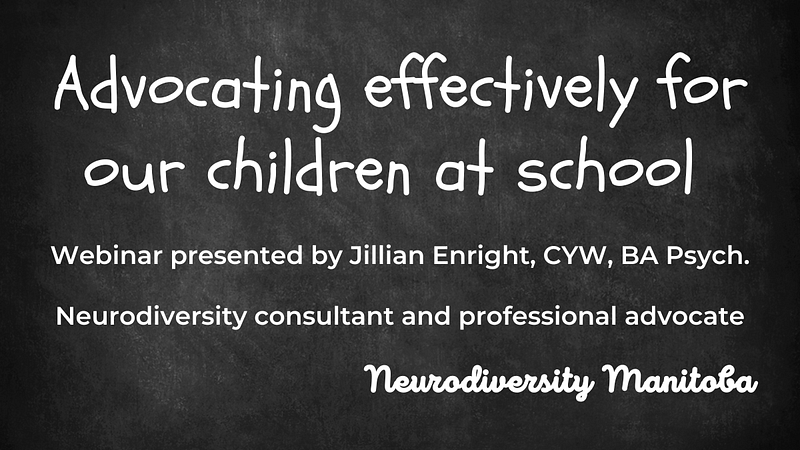
The live webinar will be Monday, February 27, 2023 from 6:00pm to 7:15pm, however it will also be recorded and available for purchase on my website.
Further Resources
Please visit my website for a list of Neurodiversity Resources available, both in Manitoba and online.
Advocacy and Support
If you need assistance advocating for your child, contact me and I can recommend and provide resources or arrange services.

When you join medium, as a member you’ll have access to unlimited reads for only $5 per month. If you use my referral link, I’ll earn a small commission, and you’ll earn my undying gratitude.
If you’d prefer give a one-time tip, you can support my writing on Ko-Fi — also, it’s free to follow me on Facebook!
Related Stories
References
El Nokali, N. E., Bachman, H. J., & Votruba-Drzal, E. (2010). Parent involvement and children’s academic and social development in elementary school. Child development, 81(3), 988–1005. https://doi.org/10.1111/j.1467-8624.2010.01447.x
Rossetti, Z., Burke, M., Rios, K., Tovar, J. A., Schraml-Block, K., Rivera, J. I., Cruz, J., Lee, J. D. (2021). From Individual to Systemic Advocacy: Parents as Change Agents. Exceptionality, 29(3), 232–247, DOI: 10.1080/09362835.2020.1850456
The United Nations. (2006). Convention on the Rights of Persons with Disabilities. Treaty Series, 2515, 3.


