avatarJillian Enright

Free AI web copilot to create summaries, insights and extended knowledge, download it at here

5915

Abstract

tively communicate, convey, negotiate or assert their own interests, desires, needs, and rights.</p><p id="943e">When I read the word ability, I don’t think of an individual’s <i>capacity</i> for self-advocacy. I think of one’s ability to self-advocate in terms of how those around us facilitate, respect, allow, and create space for people to advocate for their own needs and rights.</p><p id="aeee">For example, my son is a very strong and determined self-advocate, and has been from a very young age. He had an <a href="https://readmedium.com/education-planning-for-neurodiverse-students-5d434321f6f3">Individualized Education Plan</a> (IEP) in grade two when he was still six years old. He was aware of some of the accommodations outlined in his IEP, as they had an affect on his daily school experience.</p><p id="7f93">One day his principal was attempting to enforce an expectation contrary to what was outlined in my son’s IEP. My son, rightfully, stood up for himself, informing his principal that his plan needed to be followed.</p><p id="eeac">Granted, at six years old, he was likely not as tactful as they might have preferred, but this is how children develop their self-advocacy skills. We can guide children in taking a respectful approach — tact comes with age, maturity, and practice — but all attempts at self-advocacy should be encouraged.</p><p id="9710">Self-advocacy is a <a href="https://www.understood.org/articles/en/the-importance-of-self-advocacy">very important skill</a> for children to learn, especially neurodivergent and disabled children, whose rights are not always respected. We need to help children understand their own needs, figure out what kinds of supports or accommodations are most helpful, and teach them effective ways of communicating this information to others.</p><h2 id="8ee2">Autism Advocacy</h2><p id="8815">Autism advocacy is something that has a problematic past — and present. Certain organizations treat Autistics as though we cannot, or should not, speak for ourselves. They view Autistic children as “broken” and seek ways to “fix” them, rather than offer person-centred supports.</p><p id="d331">These so-called charities ignore Autistic voices and presume to know better, despite the fact that most of those organizations don’t have Autistic people in leadership positions — a huge red flag.</p><p id="e51f">Certain organizations continue to recommend <a href="https://readmedium.com/the-gold-standard-for-autistic-children-e815e9e7316a">harmful practices</a>, despite many Autistic adults having clearly explained why these practices are outright abusive.</p><p id="3335">How can any person or group claim to advocate for a community, yet continue to ignore us, and push something we have clearly stated causes us harm?</p><p id="1f80">They can’t and should have their charity status revoked. Worse, one such organization’s revenue is more than $3.4 million annually, <a href="https://www.charityintelligence.ca/charity-details/474-autism-speaks-canada">but less than 60%</a> of that actually goes to “services” and supports for the people they claim to serve.</p><p id="7ada">If you’re ever looking to make a donation, please first look at where your money will go. A charity’s overhead <a href="https://www.canadiancharitylaw.ca/blog/how_much_should_canadian_charity_spend_on_overhead/"><i>should</i> be between 20–30%</a> of their revenue, leaving 70–80% of their funding for their program participants and the population they serve. If it’s significantly more than that, you’ll want to question what (and whom) your charitable dollars are <i>really</i> supporting.</p><figure id="24f0"><img src="https://cdn-images-1.readmedium.com/v2/resize:fit:800/1*BdT869iptNcNLhjIqiXrQQ.png"><figcaption>Created by author</figcaption></figure><h2 id="bfe2">Own voices</h2><p id="9f28">Advocacy is about the <i>individuals</i> for whom you advocate. It is not about virtue signalling, infantilizing people, or lifting yourself up as “saviour” to a community.</p><p id="53b9">As <a href="undefined">Tori Morales</a> so eloquently explained in their <a href="https://readmedium.com/two-ways-advocacy-movements-exclude-autistic-people-and-how-you-can-do-better-b4bf706df5a3">recent article</a>, advocacy should not be about performing, it should be about creating meaningful change.</p><p id="837f">If you’re advocating for a group to which you do not belong, make sure you’re listening more than talking. Chances are we didn’t <i>ask</i> for your help. And if you aren’t lifting up our voices, we don’t want your “help”.</p><p id="cb62">© Jillian Enright, Neurodiversity MB</p><h1 id="f51d">Related Articles</h1><div id="8094" class="link-block"> <a href="https://readmedium.com/the-gold-standard-for-autistic-children-e815e9e7316a"> <div> <div> <h2>The “Gold Standard” for Autistic Children</h2> <div><h3>So many Autistic people explain how and why ABA is abusive and harmful, yet many professionals continue to push it.</h3></div> <div><p>medium.com</p></div> </div> <div> <div style="background-image: url(https://miro.readmedium.com/v2/resize:fit:320/1*5VbSSaoH9OnaRiYPXEg-uw.jpeg)"></div> </div> </div> </a> </div><div id="a165" class="link-block"> <a href="https://readmedium.com/how-do-i-advocate-for-my-child-f1d084bd68b1"> <div> <div> <h2>Be Your Child’s Best Advocate</h2> <div><h3>Advice from a Professional Advocate for Supporting and Effectively Advocating for Your Child at School.</h3></div> <div><p>medium.com</p></div> </div> <div> <div style="background-image: url(https://miro.readmedium.com/v2/resize:fit:320/1*Ce82RfZv8tU-Q9jquCIPXA.jpeg)"></div

Options

          </div>
        </div>
      </a>
    </div><div id="f9c9" class="link-block">
      <a href="https://readmedium.com/the-social-model-of-disability-c7af919892e0">
        <div>
          <div>
            <h2>The Social Model of Disability</h2>
            <div><h3>How this aligns with the neurodiversity paradigm</h3></div>
            <div><p>medium.com</p></div>
          </div>
          <div>
            <div style="background-image: url(https://miro.readmedium.com/v2/resize:fit:320/1*mu5tWBIPB6kk83ew121rtg.png)"></div>
          </div>
        </div>
      </a>
    </div><div id="ee49" class="link-block">
      <a href="https://readmedium.com/two-ways-advocacy-movements-exclude-autistic-people-and-how-you-can-do-better-b4bf706df5a3">
        <div>
          <div>
            <h2>Two Ways Advocacy Movements Exclude Autistic People, And How You Can Do Better</h2>
            <div><h3>There is space for autistic and disabled people in all good movements</h3></div>
            <div><p>medium.com</p></div>
          </div>
          <div>
            <div style="background-image: url(https://miro.readmedium.com/v2/resize:fit:320/0*sOaC1ekPtWdHR3h4)"></div>
          </div>
        </div>
      </a>
    </div><p id="777d"><i>When you join medium, as a member you’ll have access to unlimited reads for only $5 per month. If you use <a href="https://twoemb.medium.com/membership">my referral link</a>, I’ll earn a small commission, and you’ll earn my undying gratitude.</i></p><p id="35a5"><i>If you’d prefer give a one-time tip, you can <a href="https://ko-fi.com/neurodiversitymb">support my writing on Ko-Fi</a> — also, it’s free to <a href="https://facebook.com/NeurodiversityMB">follow me on Facebook</a> and <a href="https://linkedin.com/in/adhd2emb">LinkedIn</a>!</i></p><figure id="cf61"><img src="https://cdn-images-1.readmedium.com/v2/resize:fit:800/1*xo18dan5_-iLekYuRxcsOg.png"><figcaption></figcaption></figure><h2 id="f448">Further information</h2><p id="7196"><i>More articles, also written by Actually Autistic self-advocates, explaining why the puzzle piece symbol is problematic:</i></p><div id="fef2" class="link-block">
      <a href="https://www.learnfromautistics.com/the-problem-with-the-autism-puzzle-piece/">
        <div>
          <div>
            <h2>The Problem with the Autism Puzzle Piece - Learn From Autistics</h2>
            <div><h3>For years, Autistic people have been condemning the use of the colorful jigsaw puzzle piece that stands as an…</h3></div>
            <div><p>www.learnfromautistics.com</p></div>
          </div>
          <div>
            <div style="background-image: url(https://miro.readmedium.com/v2/resize:fit:320/0*YD-ZCfYFtyo8YI23)"></div>
          </div>
        </div>
      </a>
    </div><div id="2b4b" class="link-block">
      <a href="https://themighty.com/2021/03/autism-puzzle-piece-problem/">
        <div>
          <div>
            <h2>The Problem With the Autism Puzzle Piece</h2>
            <div><h3>One of the easiest ways to connect a person to a cause is through symbols. We see them everywhere - the peace sign, the…</h3></div>
            <div><p>themighty.com</p></div>
          </div>
          <div>
            <div style="background-image: url(https://miro.readmedium.com/v2/resize:fit:320/0*a8unROEaVoQmPEb3)"></div>
          </div>
        </div>
      </a>
    </div><div id="cb71" class="link-block">
      <a href="https://www.altogetherautism.org.nz/autism-no-puzzle-nothing-wrong-with-us/">
        <div>
          <div>
            <h2>Autism no puzzle, nothing wrong with us - Altogether Autism</h2>
            <div><h3>Many autistic people strongly dislike the puzzle piece as a symbol for autism, writes Paula Jessop, Altogether Autism's…</h3></div>
            <div><p>www.altogetherautism.org.nz</p></div>
          </div>
          <div>
            <div style="background-image: url(https://miro.readmedium.com/v2/resize:fit:320/0*IY61eRyK67DnMWd_)"></div>
          </div>
        </div>
      </a>
    </div><h2 id="fc25">The autistic self-advocacy network (ASSAN):</h2><div id="0062" class="link-block">
      <a href="https://autisticadvocacy.org/">
        <div>
          <div>
            <h2>Home</h2>
            <div><h3>ASAN December Newsletter Dear friends, 2022 is nearly here! Thank you for spending 2021 with us, fighting for a better…</h3></div>
            <div><p>autisticadvocacy.org</p></div>
          </div>
          <div>
            <div style="background-image: url(https://miro.readmedium.com/v2/resize:fit:320/0*HAMK2LNRO2_FHRoP)"></div>
          </div>
        </div>
      </a>
    </div><h2 id="0d6f">References</h2><p id="bf29">Baggs, M. (2019). The Meaning of Self-Advocacy. <i>Thinking person’s guide to Autism</i>. <a href="http://www.thinkingautismguide.com/2019/02/the-meaning-of-self-advocacy.html">https://thinkingautismguide.com/2019/02/the-meaning-of-self-advocacy.html</a></p><p id="9e34">Petri, G., Beadle-Brown, J., Bradshaw, J. (2020). Redefining Self-Advocacy: A Practice Theory-Based Approach. <i>Journal of Policy and Practice in Intellectual Disabilities, 17</i>: 207–218. <a href="https://doi.org/10.1111/jppi.12343">https://doi.org/10.1111/jppi.12343</a></p><p id="5943">Rossetti, Z., Burke, M., Rios, K., Tovar, J. A., Schraml-Block, K., Rivera, J. I., Cruz, J., Lee, J. D. (2021). From Individual to Systemic Advocacy: Parents as Change Agents. <i>Exceptionality, 29</i>(3), 232–247, DOI: <a href="https://doi.org/10.1080/09362835.2020.1850456">10.1080/09362835.2020.1850456</a></p></article></body>

Advocacy Is Not About You

It’s about lifting up the voices of the people for whom you advocate
Created by author on Canva

Advocacy

Advocacy is defined in the dictionary asany action that speaks in favour of, recommends, argues for a cause, supports or defends, or pleads on behalf of others.”

When we think of advocacy, we often think of professionals and formal organizations. As Mel Baggs wrote, that is only one aspect of advocacy:

“Advocacy is fundamentally about true equality, respect, and power, and about recognizing and changing the current imbalances in all of those things.” — Mel Baggs

Advocacy has also been described as everyday behaviours that cannot be separated from other actions people take, because advocacy and self-advocacy are often woven into other practices (i.e. everyday living).

Advocacy encompasses forms of solidarity, information-sharing, education, and support — oftentimes by members of the community themselves connecting, sharing resources, and supporting each other.

There are three types of advocacy: individual, systemic, and self-advocacy.

1) Individual Advocacy

In individual advocacy a person, or group of people, concentrate their efforts on just one or two individuals.

For example, when a family hires me to advocate for their child, I am advocating for a particular individual — hopefully, as a collective group, we are all working together and advocating for that child.

When I attend a meeting with a family, or on a family’s behalf, the child must be my number one priority. If we all don’t keep this in mind, it is very easy for our vision to become clouded by our own egos.

I must enter into a relationship with the other professionals with the attitude that they understand their own organization and how it works better than I do, and it is not my place to tell them how to do their jobs.

I must approach the conversation with humility, openness, and a spirit of cooperation and collaboration.

If I get caught up in needing to be right or to prove my point, then I am centring the conversation around myself. This attitude will put people on the defensive and will render me much less effective, meaning I am not doing right by the child.

If people are feeling territorial and are not open to hearing a different perspective, then they are making it about themselves, and losing sight of the common goal of doing what’s best for the child.

The child’s voice should be centred in the conversation. We must ask them what they want, what are their concerns, and what are their goals? Only when we’ve truly given them an opportunity to freely express themselves can we proceed with their needs as the primary focus.

2) Systems Advocacy

Systems advocacy is about changing policies, laws or rules that impact how someone lives their life. For example, when we lobby for changes to our education system to improve inclusion and supports for neurodivergent and disabled students, this is a form of systems advocacy.

When we advocate on behalf of a community, it is very important that we are first listening to that community. Having been self-employed for 12 years, I have little experience with unions, however one related memory stands out for me.

It was time for contract negotiations, and our union reps were working with our organization’s board to agree on terms of employment moving forward. I remember hearing this was going on, and later being told that an agreement had been reached.

Staff were not invited to any union meetings, representatives didn’t come around and speak to the various departments (it was a small organization), and we weren’t sent any surveys nor asked questions about what we wanted.

That is systems advocacy without actual advocacy. Our advocates spoke on our behalf without consulting us. They fought for what they assumed we wanted, rather than making sure they were going to bat for what we truly needed and wanted.

We do this to neurodivergent and disabled people all the time — especially children, but to adults as well. We assume we know what’s best for someone else, which is patronizing and infantilizing. When we make assumptions we often get a lot wrong.

Regardless of a person’s mode of communication, or the nature of their disability, everyone has a right to have their voice heard and their autonomy respected. If we speak over someone for whom we are supposed to be advocating, we end up doing more harm than good.
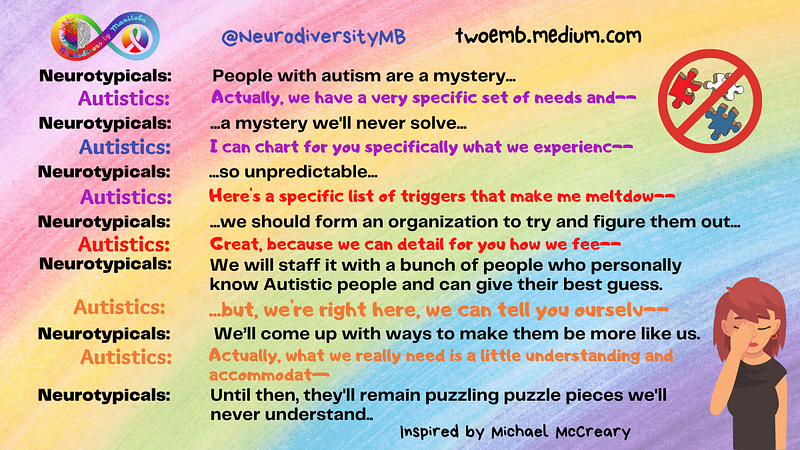
Image created by author — (original dialogue written by Michael McCreary)

3) Self-Advocacy

Broadly speaking, self-advocacy is defined as the act of representing oneself, one's views, or one’s interests. More specifically, self-advocacy refers to an individual’s ability to effectively communicate, convey, negotiate or assert their own interests, desires, needs, and rights.

When I read the word ability, I don’t think of an individual’s capacity for self-advocacy. I think of one’s ability to self-advocate in terms of how those around us facilitate, respect, allow, and create space for people to advocate for their own needs and rights.

For example, my son is a very strong and determined self-advocate, and has been from a very young age. He had an Individualized Education Plan (IEP) in grade two when he was still six years old. He was aware of some of the accommodations outlined in his IEP, as they had an affect on his daily school experience.

One day his principal was attempting to enforce an expectation contrary to what was outlined in my son’s IEP. My son, rightfully, stood up for himself, informing his principal that his plan needed to be followed.

Granted, at six years old, he was likely not as tactful as they might have preferred, but this is how children develop their self-advocacy skills. We can guide children in taking a respectful approach — tact comes with age, maturity, and practice — but all attempts at self-advocacy should be encouraged.

Self-advocacy is a very important skill for children to learn, especially neurodivergent and disabled children, whose rights are not always respected. We need to help children understand their own needs, figure out what kinds of supports or accommodations are most helpful, and teach them effective ways of communicating this information to others.

Autism Advocacy

Autism advocacy is something that has a problematic past — and present. Certain organizations treat Autistics as though we cannot, or should not, speak for ourselves. They view Autistic children as “broken” and seek ways to “fix” them, rather than offer person-centred supports.

These so-called charities ignore Autistic voices and presume to know better, despite the fact that most of those organizations don’t have Autistic people in leadership positions — a huge red flag.

Certain organizations continue to recommend harmful practices, despite many Autistic adults having clearly explained why these practices are outright abusive.

How can any person or group claim to advocate for a community, yet continue to ignore us, and push something we have clearly stated causes us harm?

They can’t and should have their charity status revoked. Worse, one such organization’s revenue is more than $3.4 million annually, but less than 60% of that actually goes to “services” and supports for the people they claim to serve.

If you’re ever looking to make a donation, please first look at where your money will go. A charity’s overhead should be between 20–30% of their revenue, leaving 70–80% of their funding for their program participants and the population they serve. If it’s significantly more than that, you’ll want to question what (and whom) your charitable dollars are really supporting.
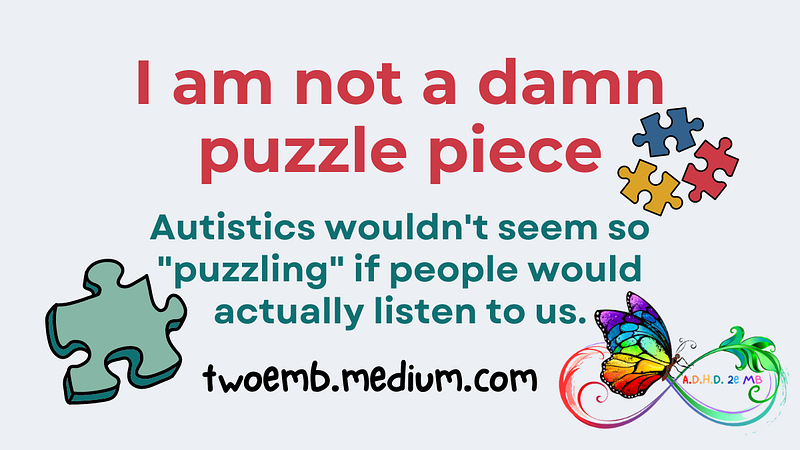
Created by author

Own voices

Advocacy is about the individuals for whom you advocate. It is not about virtue signalling, infantilizing people, or lifting yourself up as “saviour” to a community.

As Tori Morales so eloquently explained in their recent article, advocacy should not be about performing, it should be about creating meaningful change.

If you’re advocating for a group to which you do not belong, make sure you’re listening more than talking. Chances are we didn’t ask for your help. And if you aren’t lifting up our voices, we don’t want your “help”.

© Jillian Enright, Neurodiversity MB

Related Articles

When you join medium, as a member you’ll have access to unlimited reads for only $5 per month. If you use my referral link, I’ll earn a small commission, and you’ll earn my undying gratitude.

If you’d prefer give a one-time tip, you can support my writing on Ko-Fi — also, it’s free to follow me on Facebook and LinkedIn!
Further information

More articles, also written by Actually Autistic self-advocates, explaining why the puzzle piece symbol is problematic:

The autistic self-advocacy network (ASSAN):

References

Baggs, M. (2019). The Meaning of Self-Advocacy. Thinking person’s guide to Autism. https://thinkingautismguide.com/2019/02/the-meaning-of-self-advocacy.html

Petri, G., Beadle-Brown, J., Bradshaw, J. (2020). Redefining Self-Advocacy: A Practice Theory-Based Approach. Journal of Policy and Practice in Intellectual Disabilities, 17: 207–218. https://doi.org/10.1111/jppi.12343

Rossetti, Z., Burke, M., Rios, K., Tovar, J. A., Schraml-Block, K., Rivera, J. I., Cruz, J., Lee, J. D. (2021). From Individual to Systemic Advocacy: Parents as Change Agents. Exceptionality, 29(3), 232–247, DOI: 10.1080/09362835.2020.1850456

Advocacy
Mental Health
Psychology
Neurodiversity
Autism
Recommended from ReadMedium