
Education
Effective Education Planning
Must-haves for creating effective Individual Education Plans (IEPs) for students
Building upon my previous article, Manitoba’s SSP Handbook Needs An Upgrade, I will outline some practical ways that these documents can serve their intended purpose.
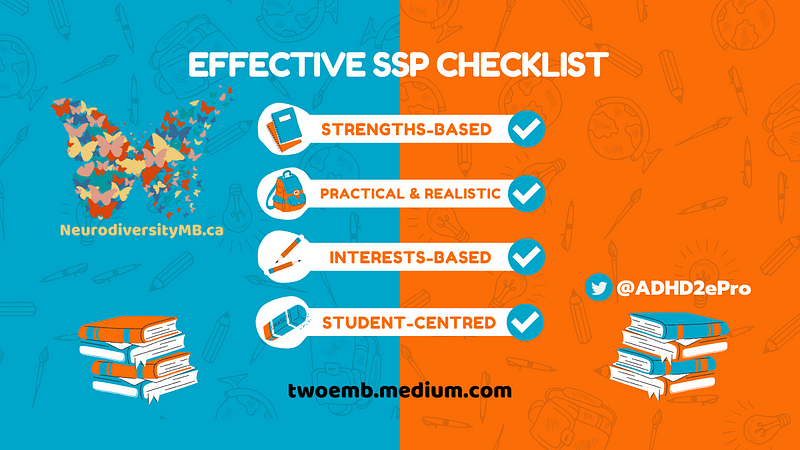
Individual Education Plans (IEPs) are now called Student-Specific Support Plans (SSPs) here in Manitoba. Whatever their name, a student’s individualized support plan should:
- Inform school staff about a student’s needs, strengths, accommodations, and the best ways to provide support.
- Focus on the student’s strengths and utilize both the student’s strengths and interests to help develop their areas of struggle.
- Put the onus primarily on the school and the adults to provide appropriate supports and accommodations, especially when the child is young, or when they are new to using a support plan.
- Include a long-term plan for gradually transitioning the responsibility over to the student, and teaching the student self-advocacy skills, as developmentally appropriate.
- Clearly outline these supports, accommodations, and best-practices in a way that is realistic and easy for school staff to understand and follow.
The last point is where a lot of education planning documents fall short.
Get real
As in, realistic and practical.
Individual Education Plans may contain fantastic information and great recommendations, but if they are full of professional jargon or have unrealistic recommendations that the school doesn’t have the resources to follow, then they won’t be very useful to the student (or to anyone).
As I mentioned in my previous article, it is the obligation of the school administration to advocate for their students and to push for the resources they need in order to provide appropriate support and accommodations.
That said, these processes take time, and the students are the ones left floundering in the interim, and it’s the classroom teacher and students that are left to try to work together with only partial resources available to them.
That isn’t fair to anyone.
Staff Guidance
An important part of providing resources is ensuring that staff have adequate qualifications, skills, and training in order to meet the needs of all students.
What I have found is that quite often school staff have a meeting, review and update the SSP, then that SSP is filed away in a drawer to gather dust while everyone fumbles along doing the best they can without proper guidance.
School staff need in-the-moment guidance showing them examples for “when this happens, here is what you do.” SSP and assessment reports may be too complex or too general for the staff to make use of them if they don’t know how to handle specific scenarios in the moment.
Have I Mentioned… Resources?
Again, this comes down to the politicians and policy-makers (here, the Manitoba Government) providing adequate funding that is specifically earmarked for these types of supports and training.
Schools need:
- Adequate funding so as to recruit, hire, train, and retain qualified, experienced, and skilled staff.
- Adequate funding so as to have the time and finances to pay staff to attend additional relevant training.
- The mandate that administrators provide the time, coverage, and support for staff to attend relevant training opportunities. This requires adequate funding to hire support staff to cover while their colleagues are at workshops.
- Most importantly, opportunities for clinical teams and experts to provide on-the-job guidance, mentorship, and training for school staff. Once again, this requires the funding to hire adequate clinicians and other professionals, so they have the to share their expertise.
…did I mention adequate funding?
February 2022 note: Given that it is National Inclusive Education Month, this is a great time to pressure our government representatives to better fund public education, and ensure adequate supports are available for all staff and students in all schools.
Effective staff training
I cannot stress this enough:
“An hour or two of on-the-job training is much more worthwhile than 8 hours of sitting at a workshop and retaining maybe 40% of what we hear.” — (Mure & Dros, 2015).
If administrators can spare the time and expense of just one hour per month (or more if they can!) of on-the-job training for their staff, they will reap the benefits in spades.
For example, a 2010 study found that teachers rated on-site training and training in their classroom as significantly more effective than workshops or conferences (Dunst & Raab, 2010
Staff will feel empowered when they are given the proper tools to do their jobs, rather than being thrown in unprepared and then held accountable (dare we say, blamed?) when things go wrong.
Most importantly, the students will reap the benefits of competent, confident support staff in their schools and classrooms. It is often the students that shoulder most of the blame when things go wrong, leading to poorer academic outcomes and lower self-esteem.
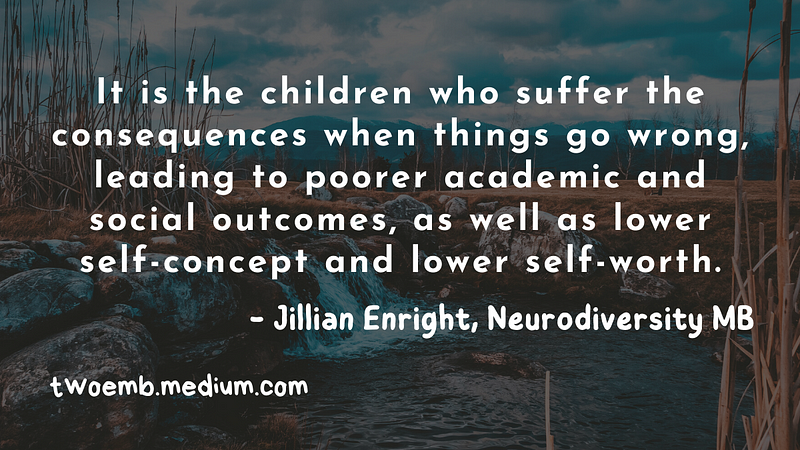
It is the students who suffer the consequences when things go wrong, leading to poorer academic and social outcomes, as well as lower self-concept and self-worth.
Practical and realistic solutions
The next time you’re sitting in a school meeting and everyone around the table feels satisfied that you’ve come up with wonderful accommodations and recommendations, make sure that lovely document does not become irrelevant the moment it’s signed and filed.
Before you put the proverbial rubber stamp on that SSP, ask one very important question: Practically speaking, what will this look like in the day-to-day life of the school staff and the student?
How exactly, and specifically, will we be implementing these accommodations and recommendations?
Go through the student’s day step-by-step if you have to (spoiler alert: you have to, if you want to be effective). Outline exactly where the struggles come up, and what the adults can do moment-to-moment to help that student develop the skills they need to manage, work around, and overcome these difficulties.
Practically speaking, what will this look like in the day-to-day life of the school staff and the student?
At the end of the day, the student’s needs must come first. Each and every student has the right to accommodations that put them on a level playing field with their peers.
The goal of any planning document for a student must be to make the student’s school life easier and to support them to be successful. The goal is not to make the adult’s lives easier, but when we provide the right supports for the student and adequate training for staff, the two will come hand-in-hand.
Related Stories Series
When you join medium, as a member you’ll have access to unlimited reads for only $5 per month. If you use my referral link, I’ll earn a small commission, and you’ll earn my undying gratitude.
References
Dunst, C. J., & Raab, M. (2010). Practitioners’ Self-Evaluations of Contrasting Types of Professional Development. Journal of Early Intervention, 32(4), 239–254. https://doi.org/10.1177/1053815110384702
Murre, JMJ., & Dros J. (2015). Replication and Analysis of Ebbinghaus’ Forgetting Curve. PLOS ONE 10(7): e0120644. https://doi.org/10.1371/journal.pone.0120644
Information and Resources
To learn more, visit:
CADDAC — The Individual Education Plan (IEP)
Understood.org — what is an IEP?
For more information on writing effective SSPs, please see my previous article.
If you need assistance advocating for your child, or if you are seeking training for your staff, please do not hesitate to contact me.


