February Is Inclusive Education Month
Let’s make this one actually count

February is Inclusive Education Month in Canada
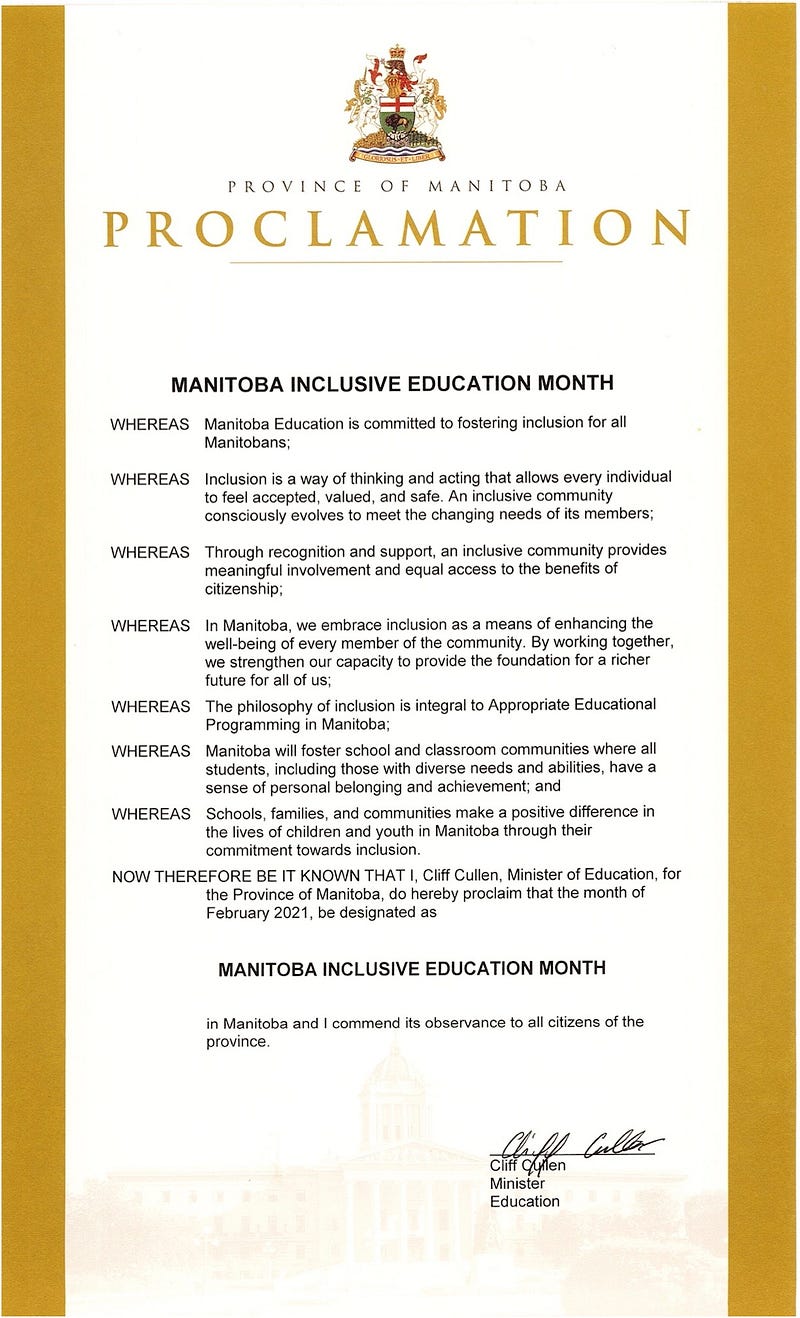
And what does that mean?
Last year, our (now former) Minister of Education regurgitated 15-year-old so-called “inclusion” policy, posting the above declaration on social media, then doing absolutely nothing else.
This inclusion proclamation is vague and general, with no specific actions or commitments made to better the experience of neurodivergent and disabled students in our public school system.
Thanks for nothing, Honourable Minister Cliff Cullen.
If you can’t find the proclamation, don’t worry: it’s not you, it’s them. That’s because the proclamation wasn’t even posted on the Government of Manitoba’s Education website, nor anywhere other than some division websites.
There were no public awareness campaigns, professional development or staff training around inclusion, nor updated policies.
So, I have taken the liberty of outlining each proclamation (again, taken word-for-word from 15-year-old policy with no action points) for transparency’s sake.
My hope is that education and inclusion advocates and parents (like myself) can team up to pressure our government to actually implement policies and procedures that meet these mandates.
We want schools and school staff to be supported and empowered to follow both the spirit and intent of this proclamation, as well as Manitoba’s philosophy of inclusion.
Inclusive Education Month in Manitoba
Proclamation #1
“ Manitoba Education is committed to fostering inclusion for all Manitobans.”
- How? What specifically is the Manitoba government doing to foster inclusion in our public schools?
- What resources will the Manitoba Government provide to schools in order to allow them to follow through on this proclamation?
- The formal dispute guide has not been updated in 15 long years, since 2006. When will this be updated to reflect current reality?
- How will the Manitoba government provide education to parents, caregivers, and school staff about the formal dispute process, so that families are aware of their rights and of how to proceed with a formal complaint?
Proclamation #2
“Inclusion is a way of thinking and acting that allows every individual to feel accepted, valued, and safe. An inclusive community consciously evolves to meet the changing needs of its members.”
- How? How do we know if students feel accepted, valued, and safe? How do we measure this?
In light of this being inclusive education month, I finally shared a bit of the story that led me to become an inclusion advocate:
Get smart
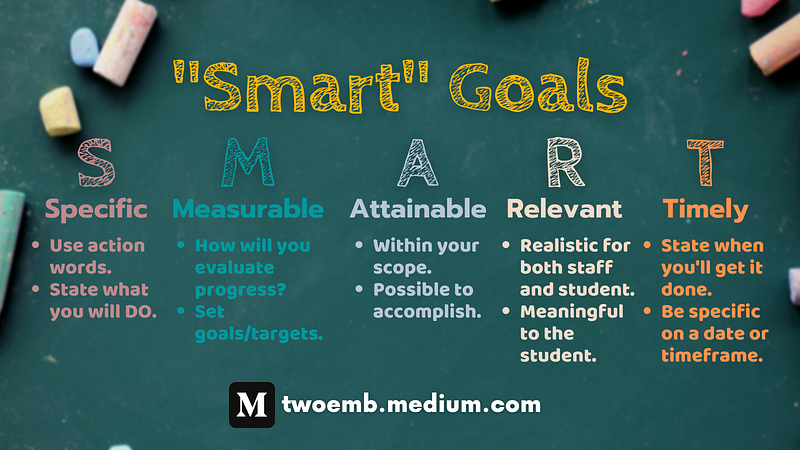
- We need S.M.A.R.T. Goals: specific, measurable, attainable, realistic/relevant, and time-oriented/time-bound:
- What resources does the Manitoba Government provide to schools in order to allow them to follow through on this proclamation?
- When teachers and administrators continue to be allowed to exclude children with disabilities, either due to extra supports they may need, or as a way of behaviour management, this sends the message to everyone in the school (most importantly that particular student) that they are not accepted, valued, or welcome.
- Making children work in different rooms, suspending children for misbehaviour rather than investigating the antecedents and supporting the student to learn better coping strategies, making children stand in the hall when they are disruptive, etc. are shaming, exclusionary, ineffective, and harmful to the child.
Proclamation #3
“Through recognition and support, an inclusive community provides meaningful involvement and equal access to the benefits of citizenship.”
- Um, what? What does this even mean? Who defines what is “meaningful” to a child with a disability? (Hint: it should be the child, not the provincial government or school staff).
- How? What resources does the Manitoba Government provide to schools in order to allow them to follow through on this proclamation?
- What are the benefits of citizenship anyway?
- Proclamations with a lot of vague generalizations are pretty useless.
Proclamation #4
“In Manitoba, we embrace inclusion as a means of enhancing the well-being of every member of the community. By working together, we strengthen our capacity to provide the foundation for a richer future for all of us.”
- What exactly does this mean?
- How? What resources does the Manitoba Government provide to schools in order to allow them to follow through on this proclamation?
- Once again, proclamations with a lot of vague generalizations are useless.
Proclamation #5
“The philosophy of inclusion is integral to Appropriate Educational Programming in Manitoba.”
Um, duh.
- Yes, and….? What resources does the Manitoba Government provide to schools in order to allow them to follow through on this proclamation?
- Once again, proclamations with a lot of vague generalizations are useless.
- This philosophy was last updated 15 years ago, in 2006. When will our provincial policy-writers update this document with more specific, meaningful, and practical directives?
Proclamation #6
“Manitoba will foster school and classroom communities where all students, including those with diverse needs and abilities, have a sense of personal belonging and achievement.”
- Exactly how are we fostering inclusive schools? What resources does the Manitoba Government provide to schools in order to allow them to follow through on this proclamation?
- Aren’t students with diverse needs and abilities still students? Why do they need a separate caveat in this sentence? They should not be “othered”, or put into a separate category, this is the opposite of inclusion.
- How do we know all students feel a sense of personal belonging? How do we measure this? When will official actually ask children and their families about their experiences, and asking them what can be better? How and when will our provincial government bridge the divide between the policies and the actual human beings who are directly impacted by those policies?
- We just had a new budget released with specific funding earmarked for students with disabilities. Who will decide how that is spent, school administrators? Are those administrators going to meet with students and families to determine how that money will best be spent?
- There needs to be meaningful community consultation. Meaningful means that administrators actually listen to students and families and truly use their input to direct their decision-making.
- We need S.M.A.R.T. Goals: specific, measurable, attainable, realistic/relevant, and time-oriented/time-bound.
Proclamation #7
“Schools, families, and communities make a positive difference in the lives of children and youth in Manitoba through their commitment towards inclusion.”
- Okay, right, yes… and… How so? That’s a nice sentiment, but what exactly does it mean for children and youth, particularly students with disabilities here in Manitoba?
- How are schools, families’ and communities making a difference? How are they committing “towards” inclusion? Why aren’t they committing to inclusion, full stop?
So… now what?
Now we band together and tell our new Minister of Education, MLA Wayne Ewasko, about our experiences in Manitoba’s public education system. We need to let Minister Ewasko know what our children need to experience authentic, meaningful inclusion and to have their needs met.
If you could wave a magic wand and make anything happen at your child’s school (talking our under-funded Manitoba public school system) — what would it be?
You can email Minister Ewasko’s office yourself at [email protected], or email [email protected]* to share your thoughts, needs, wants, and wishes. I have posted a copy of my open letter to MLA Ewasko on my website.
Rather than accepting another empty proclamation, let’s tell our provincial government exactly how our neurodivergent and disabled children would actually feel included, welcome, cared for, and have their needs met in Manitoba’s public schools.
Because inclusive education starts at the top and the bottom.
Jillian Enright, CYW, BA Psych. Inclusion and Education Advocate Neurodiversity Manitoba
**Please share far and wide, especially in groups of Manitoba parents/caregivers of children with disabilities.**
*If you email me, please indicate whether you wish to remain anonymous and your name will not be included with any comments or concerns shared.
- Emails and any communications shared privately will remain confidential unless we have your permission to share.
Related Stories
When you join medium, as a member you’ll have access to unlimited reads for only $5 per month. If you use my referral link, I’ll earn a small commission, and you’ll earn my undying gratitude.