
Education & Advocacy
Children with Disabilities are NOT an Afterthought
Pandemic parenting and child advocacy
Originally posted on August 29, 2020
The following is not in any way intended as a knock on teachers, who are doing the very best they can with paltry budgets, very limited resources, and poor government support (and calling it poor is being generous).
This issue is much larger, and stems from a lack of provincial funding for education here in Manitoba, and across Canada.
September 15, 2020 Update
Karen Sharma, Executive Director of The Manitoba Human Rights Commission, wrote and shared an open letter to Kelvin Goertzen, who was then Minister of Education in Manitoba.
This letter outlined the rights of students with disabilities as they relate to Covid-19 while in class, hybrid and/or distance learning, and reminded school administrators of their responsibility to ensure accommodations are being met wherever and however students may be learning.
Children with disabilities can not, should not, and will not be an afterthought.
Local Education Issues
On August 24, 2020, the Province of Manitoba announced an “additional”(so-called additional, not but not really, and I’ll explain why…) $52 million in funding to “focus on putting in place the public health measures needed to keep students and staff as safe as possible while learning.”
So, why is this not really and truly additional funding? Because the full sum is not presently in the pockets of the school divisions. It is funding that is earmarked for schools, but each school has to apply for grants, prove and explain why they need the funding, and then cross their fingers and hope they get it… eventually.
This does not help schools now, when they desperately need it the most. Parents are, understandably, asking schools a million and one questions and unfortunately schools don’t have the answers because the province haven’t given them enough information. Parents, teachers, and students need plans, like yesterday, not in a few months’ time. School staff cannot plan for funding they don’t yet have and may never receive.
How can parents possibly send their children back to school when they don’t know what it’s going to look like?
They shouldn’t have to and may not be able to.
Here’s the kicker: What happens if parents of children with special needs don’t want to send their children back to school yet, because they feel the school is unprepared, or they don’t have enough information to feel confident in sending them, and decide to homeschool them?
The school loses its funding for that child because they’re not registered and in class. So, if and when that student is ready to return, their school will have to re-apply and wait for their funding all over again.
It’s a catch-22, it’s not fair, and it disproportionately impacts children with special needs and their families.
But wait. It gets worse…
June 2021 Update
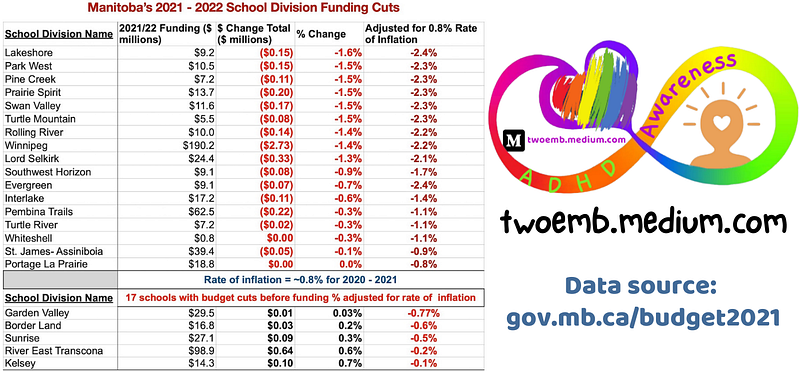
Well the school year is coming to a close and Manitobans still have an important question for our provincial government: where the heck is the funding that was promised to our schools for the 2020–2021 school year?
Where is the funding that was promised to our schools for the 2020–2021 school year?
In May 2021, the government promised that $15M of the $58M that was promised for the 2020–2021 school year is being carried over to the 2021–2022 school year.
Wait, what?!… WHY?!
Teachers, school staff, and parents have been (and still are) desperately begging our government for increased resources as the Covid-19 pandemic reached its second and third waves.
In November 2020, the Manitoba Teachers’ Society shared an open letter renewing their call on the provincial government to use the $85.4 million in federal education funding to hire more staff, increase access to teacher and student mental health resources, provide sick time coverage for substitutes, and deliver much higher levels of direct public health support to all schools.
The government has repeatedly claimed to value Manitoba teachers and to care about our children’s education, yet continued to withhold funding that would have made a significant difference in the lives of those very teachers and students they claimed to support.
It has been established that the Covid-19 pandemic disproportionately impacted individuals with disabilities across all sectors, and has affected students with disabilities far greater than their peers (Sutton, 2021).
Opinion: Students with disabilities continue to be underserved so that our provincial government can boast tax cuts and corporate tax exemptions and claim to be making a “record” investment in education (they’re not), when really they’re just withholding money this year so it looks like they’re giving schools a lot next year.
We Cry Foul
This isn’t supposed to happen. Legally, this isn’t even allowed to happen.
There have been Supreme Court Decisions (Moore vs. B.C., 2012), as well as the United Convention on the Rights of Persons with Disabilities, that have decreed this should not, and legally cannot, happen.
A fantastic summary on the implications of these is available on the Inclusive Education Canada website.
Key points from this article include:
- “adequate special education is not “a dispensable luxury.”
- “human rights law requires education providers to make their services accessible to persons with disabilities.”
- “the CRPD prohibits discrimination against children with disabilities and mandates the right to inclusive education.”
Most relevant to our current situation is this:
“School districts in Canada must take a proactive approach to budgeting and programming, to ensure that the rights of students with disabilities to accommodation are taken into account. Appropriate budgeting by provincial governments is also crucial. School districts make program choices within budgetary envelopes determined by provincial governments. Children and families must be ensured of their right to the benefits of public education in an inclusive community or neighbourhood school.”
Note the word proactive.
Children with disabilities are not, should not, and can not be an afterthought.
Both provincial and divisional budgeting must include their needs, and schools must be considerate of these needs when planning for our return to school.
Manitoba’s stated philosophy of inclusion falls far short of this and is very weak in comparison to the statements made in the CRPD.
I understand that this is an incredibly challenging and unprecedented situation. However, that is even more true for persons with disabilities (Sutton, 2021) and their families.
I’m somewhat sympathetic, but not sorry to say that the coronavirus is no excuse to continue putting the needs of neurodiverse students and students with disabilities on the back-burner.
Children with disabilities deserve, need, and must be treated as equally valuable and important members of our communities, including our school communities. They have every right to appropriate access to education, and parents are exhausted and tired of having to fight for this every step of the way.
It’s long past time for our provincial government and school divisions to step up and carry more of this responsibility, because parents and families cannot do it alone, and children should not continue to suffer due to poor funding and poor planning.
Steps for Advocacy
If you need help advocating for your child, ensure you have done the following:
- Contact your school’s principal, in writing. If you speak on the phone or in person, take notes and follow up with an email summarizing your conversation so that you have documentation of the communication.
- If you have a school support team, you may seek their input as well. This may include a school psychologist, resource teacher, guidance counsellor, or social worker.
- If you are not satisfied, contact the principal’s next-in-charge. For some divisions this is a Director of Student Services.
- If you are not satisfied, contact your division’s Assistant Superintendent.
- If you are not satisfied, contact your division’s Superintendent. If you have been in contact with other divisional senior administration, it is likely they will have been aware of your concerns.
On the Manitoba Education website, they have a formal dispute resolution protocol listed. This may look slightly different for each division. In our experience, these are the next steps to take:
- Parents have the right to hire or contact an advocate. This can be a private advocate the family hires on their child’s behalf, or a non-profit organization that can assist. The Manitoba Advocate also plays a role in advocating for children in the public education system.
- If you are not satisfied, you can then file a formal complaint with your division’s board of trustees. Each division has a different board of trustees which should be listed on your school division’s website.
- If no resolution can be found at this level, families can contact the Inclusion Support Branch of Manitoba’s Department of Education.
- Finally, if none of these processes brings about a satisfactory resolution, families can bring their concerns right to the Minister of Education. A Minister of Education is an elected Member of the Legislative Assembly (MLA) who is then appointed a portfolio based on their qualifications and experience, such as the ministry of education and training. They are your representative at the Provincial level.
This process can be incredibly long, stressful, arduous, and taxing. And while all of these meetings and formal disputes are happening, children are still suffering and not receiving the support they need. So in the mean time, parents may choose to homeschool, or move their child to a different school that may be better equipped to meet their needs.
Parents & caregivers: Find a support network. Find one now and lean on them. Whether it be other families who have children with disabilities, trusted neighbours, close friends, family members, whomever. Don’t forget to take care of yourself.
Our social, political, and education systems were designed for typically developing individuals and are not set up for those of us who are outside the norm.
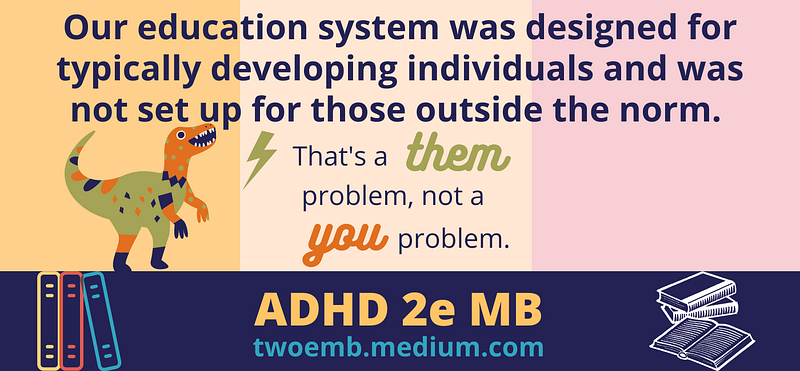
Guess what? That’s a them problem, not a you problem.
There have been small steps toward improvement over the past decade, but progress is slow and change takes too long.
So gather your village and support each other because we are better parents and advocates when we ourselves are in a good place.
Be kind to yourself and to each other.
Related Stories
When you join medium, as a member you’ll have access to unlimited reads for only $5 per month. If you use my referral link, I’ll earn a small commission, and you’ll earn my undying gratitude.

Resources and Support
Council of Canadians with Disabilities
Right-to-Education (and their Case Law Summary of the Moore vs. BC case)
The U.N. Convention on the Rights of Persons with Disabilities (CRPD)
If you need assistance advocating for your child, contact us and we can recommend and provide resources, arrange support services, or provide referrals.
About the Author
Jillian is an ADHD 2e Coach and Child Advocate in Manitoba, Canada.
Jillian has a diploma in Child & Youth Work and a Degree in Psychology, as well as being the parent of an amazing 2e/ADHD child.
Visit and facebook.com/ADHD2ePro to learn more.
Follow us on Twitter @ADHD2eMB.

References
Moore v. British Columbia (Education), 2012 SCC 61, [2012] 3 S.C.R. 360.
Sutton, H. (2021). COVID-19 disproportionately impacts students with disabilities across all sectors. Journal of Disability Compliance for Higher Education, 26(6), P. 9. https://doi.org/10.1002/dhe.3097.
The United Nations. (2006). Convention on the Rights of Persons with Disabilities. Treaty Series, 2515, 3.


