avatarJillian Enright

Free AI web copilot to create summaries, insights and extended knowledge, download it at here

3667

Abstract

p id="d78e" type="7">“We don’t see that issue at school, it must be a home problem”</p><h2 id="7fd2">Did you also know?</h2><p id="5653">A lot of school-related issues don’t show up <i>at</i> school for a variety of reasons.</p><p id="280e">Many children are struggling in school because they do not feel entirely safe or comfortable there. As a result, they are also not comfortable enough to communicate — either through words or behaviour — their <a href="https://readmedium.com/misbehaviour-is-stress-behaviour-f077cee16f43">stress</a>.</p><p id="5725">In those cases, children “white knuckle” it through their day, barely holding themselves together, then either implode or explode when they get home to their safe space.</p><figure id="100a"><img src="https://cdn-images-1.readmedium.com/v2/resize:fit:800/1*r13TYVGew-eEZHZSTeny0w.png"><figcaption>Created by author</figcaption></figure><p id="9c07">Similarly, children with reading or attention difficulties may try to hide them for fear of looking “stupid” in front of their classmates. Children are very quick to identify where they are in relation to their peers, they’ll notice right away if they are behind, and many will be embarrassed about this.</p><p id="1950">Parents, who have the ability to spend one-on-one quality time with their kids, are much more likely to notice when their child is struggling. Their child is also more likely to be honest with their parent than they are with their teacher, especially if they are not feeling entirely comfortable at school.</p><p id="90d9">Yet when parents bring their concerns to schools, they’re often told things like, “<i>we don’ t see that issue here, so it must be a home issue</i>”. Caregiver concerns are often minimized and dismissed, or blamed solely on the parents.</p><h2 id="70da">Assumptions make an ass out of u…</h2><p id="f6c8">There’s a lot of blame and judgement of parents, especially from school staff who don’t themselves have children, or educators who have antiquated views about how children learn.</p><p id="20f5">When my son was struggling at school, that was one of the very questions asked — “<i>well, what are they doing at home</i>?”</p><p id="e625">A hell of a lot, thank you very much. We spent thousands of hours and dollars chasing down every resource we possibly could to help him. Yet the assumption was that our son’s behaviour problems at school must have been caused by “bad” parenting.</p><h2 id="50d9">We’re not immune</h2><p id="e920">Parents, advocates, humans — none of us are immune to getting sucked into the blame game either. We might blame teachers or school staff for the failings of an education system over which they have little control.</p><p id="95fe">When we blame teachers for larger systemic issues, it’s a bit like blaming the server when our food isn’t cooked properly. More often than not, they’re the front-line worker, the messenger. They may well be the one trying their damnedest to do the best they can with paltry resources and minimal support.</p><p id="b740" type="7">When we blame teachers for larger systemic issues, it’s a bit like blaming the server when our food isn’t cooked properly.</p><h2 id="7b1c">The art of misdirection</h2><p id="4458">Those in government would be thrilled if we continued casting blame on teachers and parents, pitting one against the other, making this an us versus them issue. That would distract us all from holding politicians accountable for getting us into — and <i>keeping</i> us in — this mess.</p><p id="83da" type="7">Before we start throwing shade, we need to remember who is already standing in the shadows.</p><p id="7925">Instead of fighting

Options

amongst ourselves, we need to rally together, keeping the best interests of our children and students at the forefront.</p><p id="0cd3">If school staff and parents banded together and pressured our government to get off their asses and actually <i>do</i> something about our education crisis, we could stop banging our heads against proverbial walls.</p><p id="2e67">Maybe even kick down a door or two.</p><p id="528a">© Jillian Enright, Neurodiversity MB</p><h1 id="e318">Related Articles</h1><div id="c7da" class="link-block"> <a href="https://readmedium.com/our-kids-deserve-so-much-better-12d9e9d27808"> <div> <div> <h2>Our Kids Deserve So Much Better</h2> <div><h3>Manitoba’s government insists on wasting money which should be spent on bettering public education in our province</h3></div> <div><p>medium.com</p></div> </div> <div> <div style="background-image: url(https://miro.readmedium.com/v2/resize:fit:320/1*kMUt2QicbMq9onQUvesaDQ.png)"></div> </div> </div> </a> </div><div id="c581" class="link-block"> <a href="https://readmedium.com/the-squeaky-wheel-gets-the-funding-a2b3bf36a20"> <div> <div> <h2>The Squeaky Wheel Gets The Funding (and Support)</h2> <div><h3>Behaviour problems or failing academically shouldn’t be the only reasons children receive appropriate supports at…</h3></div> <div><p>medium.com</p></div> </div> <div> <div style="background-image: url(https://miro.readmedium.com/v2/resize:fit:320/1*bZm_erCeGpD9z7sN0FrIcA.png)"></div> </div> </div> </a> </div><div id="4e33" class="link-block"> <a href="https://readmedium.com/is-your-child-struggling-in-school-c6cb480a73dd"> <div> <div> <h2>Students Struggle While Schools Deny Services</h2> <div><h3>Children who mask their disabilities are often denied services because they don’t appear to be struggling</h3></div> <div><p>medium.com</p></div> </div> <div> <div style="background-image: url(https://miro.readmedium.com/v2/resize:fit:320/1*g-EUKvtI3SqffMk-38nBVw.jpeg)"></div> </div> </div> </a> </div><div id="1c9d" class="link-block"> <a href="https://readmedium.com/funding-public-education-cb22ad371f5e"> <div> <div> <h2>Funding Public Education</h2> <div><h3>Change must start at the top, then work its way down</h3></div> <div><p>medium.com</p></div> </div> <div> <div style="background-image: url(https://miro.readmedium.com/v2/resize:fit:320/1*3ERv_iv1f7fHfpv5PLiN-A.jpeg)"></div> </div> </div> </a> </div><p id="f2d7"><i>When you join medium, as a member you’ll have access to unlimited reads for only $5 per month. If you use <a href="https://twoemb.medium.com/membership">my referral link</a>, I’ll earn a small commission, and you’ll earn my undying gratitude.</i></p><p id="2030"><i>If you’d prefer give a one-time tip, you can <a href="https://ko-fi.com/neurodiversitymb">support my writing on Ko-Fi</a> — also, it’s free to <a href="https://facebook.com/NeurodiversityMB">follow me on Facebook</a> and <a href="https://linkedin.com/in/adhd2emb">LinkedIn</a>!</i></p></article></body>

Education Staff: Stop Gaslighting Parents

We need to stop turning these into ‘schools versus parents’ issues

Spy vs Spy created by Antonio Prohías — (image created by author)

And parents: stop placing all the blame on teachers

Public education is in serious trouble, and has been for a very long time. We’re too busy being angry at one another, pointing the finger back and forth between parents and school staff, we’re completely forgetting who is primarily responsible.

I fully admit to being one who has called out teachers and school staff for unhelpful, even harmful, behaviour in schools. Sometimes this is necessary in order to protect children and students.

We must remember, however, that focusing on an individual will not likely improve matters beyond that particular situation.

Our school systems are so poorly funded, we can’t even properly identify students needing support, let alone provide it.

A significant cause of distressing incidents and mistreatment of students is the absolutely piss-poor job we do of educating, training, and supporting our school staff.

Our school systems are so poorly funded, we can’t even properly identify students needing support, let alone provide it.

So before we start throwing shade, we need to remember who is already standing in the shadows.

Did you know?

The long waiting lists for assessments and supports in our public schools are only a fraction of the picture. Many students and families are denied even being placed on the waiting list if their child’s issues are not considered “serious” enough, as determined by the school teams.

Instead of continuing to add students to the waitlists as needed, school administrators are gate-keeping and triaging, telling families that resources are so scarce, they must “conserve” them for only the most serious needs.

Families are regularly told that students must have very obvious struggles in order to qualify for supports, regardless of diagnoses. They are being told their children do not quality for SSPs (IEPs, student-specific plans) unless they are very obviously struggling.

This is against the Appropriate Education Programming (AEP) act here in Manitoba, which is a regulation, meaning schools are legally obligated to follow it.

In other jurisdictions this goes against similar legislation, such as the Free and Appropriate Public Education (FAPE) act, and the Individuals with Disabilities Education Act (IDEA) in the U.S.

Schools are legally obligated to follow these acts, and in many cases, they are not. In fact, there are situations in which schools truly cannot follow the regulations due to extreme staffing and funding shortages.

“We don’t see that issue at school, it must be a home problem”

Did you also know?

A lot of school-related issues don’t show up at school for a variety of reasons.

Many children are struggling in school because they do not feel entirely safe or comfortable there. As a result, they are also not comfortable enough to communicate — either through words or behaviour — their stress.

In those cases, children “white knuckle” it through their day, barely holding themselves together, then either implode or explode when they get home to their safe space.
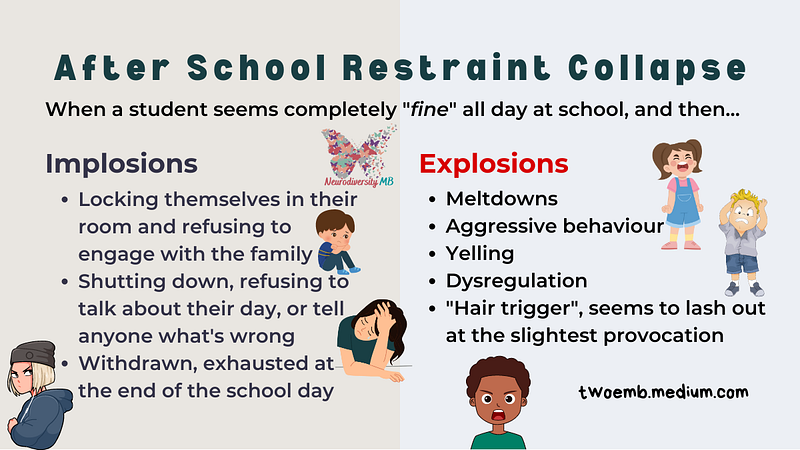
Created by author

Similarly, children with reading or attention difficulties may try to hide them for fear of looking “stupid” in front of their classmates. Children are very quick to identify where they are in relation to their peers, they’ll notice right away if they are behind, and many will be embarrassed about this.

Parents, who have the ability to spend one-on-one quality time with their kids, are much more likely to notice when their child is struggling. Their child is also more likely to be honest with their parent than they are with their teacher, especially if they are not feeling entirely comfortable at school.

Yet when parents bring their concerns to schools, they’re often told things like, “we don’ t see that issue here, so it must be a home issue”. Caregiver concerns are often minimized and dismissed, or blamed solely on the parents.

Assumptions make an ass out of u…

There’s a lot of blame and judgement of parents, especially from school staff who don’t themselves have children, or educators who have antiquated views about how children learn.

When my son was struggling at school, that was one of the very questions asked — “well, what are they doing at home?”

A hell of a lot, thank you very much. We spent thousands of hours and dollars chasing down every resource we possibly could to help him. Yet the assumption was that our son’s behaviour problems at school must have been caused by “bad” parenting.

We’re not immune

Parents, advocates, humans — none of us are immune to getting sucked into the blame game either. We might blame teachers or school staff for the failings of an education system over which they have little control.

When we blame teachers for larger systemic issues, it’s a bit like blaming the server when our food isn’t cooked properly. More often than not, they’re the front-line worker, the messenger. They may well be the one trying their damnedest to do the best they can with paltry resources and minimal support.

When we blame teachers for larger systemic issues, it’s a bit like blaming the server when our food isn’t cooked properly.

The art of misdirection

Those in government would be thrilled if we continued casting blame on teachers and parents, pitting one against the other, making this an us versus them issue. That would distract us all from holding politicians accountable for getting us into — and keeping us in — this mess.

Before we start throwing shade, we need to remember who is already standing in the shadows.

Instead of fighting amongst ourselves, we need to rally together, keeping the best interests of our children and students at the forefront.

If school staff and parents banded together and pressured our government to get off their asses and actually do something about our education crisis, we could stop banging our heads against proverbial walls.

Maybe even kick down a door or two.

© Jillian Enright, Neurodiversity MB

Related Articles

When you join medium, as a member you’ll have access to unlimited reads for only $5 per month. If you use my referral link, I’ll earn a small commission, and you’ll earn my undying gratitude.

If you’d prefer give a one-time tip, you can support my writing on Ko-Fi — also, it’s free to follow me on Facebook and LinkedIn!

Education
Schools
Parenting
Politics
Special Education
Recommended from ReadMedium