avatarJillian Enright

Free AI web copilot to create summaries, insights and extended knowledge, download it at here

6056

Abstract

3YD1sZ6iHLWpWemLCBzPw.png"><figcaption>Dr. Ross Greene (photo by author)</figcaption></figure><h2 id="9348">Kids do well if they can</h2><p id="2af4">If readers get nothing else out of this blog post, I want the following two points to be made abundantly clear:</p><ul><li>Academic success is not an acceptable reason or excuse to deny a child their right to accommodations and supports for their disability.</li><li>Social-emotional health is much more important than academic performance and children do not learn well when they are highly <a href="https://doi.org/10.1080/02673843.2019.1596823">stressed</a>, <a href="https://childmind.org/article/classroom-anxiety-in-children/">anxious</a>, fearful, or working so hard to mask that they cannot absorb what is being taught.</li></ul><h2 id="440a">I repeat:</h2><p id="1861" type="7">Academic success is not an excuse to deny a student accommodations and supports for their disability.</p><figure id="5d64"><img src="https://cdn-images-1.readmedium.com/v2/resize:fit:800/1*kgCTX_MiVcZv8a8YON2jEg.jpeg"><figcaption>Photos by author — NeurodiversityMB.ca</figcaption></figure><p id="88e2">Perhaps just as harmful, please do not tell a child with ADHD or a learning disability “<i>you’re so smart, you just need to work harder and apply yourself</i>.” They would if they could. They very likely can, but first, they need (and have the right to receive) the appropriate help to do so.</p><p id="cb24">All students deserve to be able to show the very best of themselves, not just <i>good enough</i> based on the classroom teacher’s opinion. Meaning: if a child is doing well academically, but it’s causing them significant psychological, emotional, or social difficulty, then they still require accommodations so that they can be their best self without it taking a toll on their mental health.</p><p id="c6e3">Beyond <a href="https://readmedium.com/instead-of-inclusion-were-getting-budget-cuts-ed86d1df1610">assessment</a>, we want to instil in students a love of learning and foster joy in curiosity. If a student is very bright, but school is a daily slog which they dread every day, then their chances of meeting their potential and pursuing higher education decrease every year that goes by without proper support.</p><p id="aa75">Children with ADHD are at <a href="https://doi.org/10.1016/j.neubiorev.2021.01.022">higher risk</a> for academic underperforming and underachieving, so it is especially important for schools to ensure these students feel engaged and supported.</p><h2 id="b2f3">Security and Belonging</h2><p id="ba34">Beyond academics, the core subjects are not the only thing children learn at school. In fact, there have been many studies clearly demonstrating that students <a href="https://doi.org/10.1371/journal.pone.0120644">forget a significant portion</a> of the academic content they are taught in school.</p><p id="9558">What they do learn and remember meaningfully are relationships: Relationships with peers, teachers, and other school staff. Public safety data in Canada indicates that <a href="https://www.safecanada.ca/bullying-in-canada/">47% of parents</a> report their child has experienced <a href="https://readmedium.com/anti-bullying-articles-resources-b1106bf2bab5">bullying</a> in school. Children with ADHD are <a href="https://doi.org/10.1177/0886260502238731">13% more likely</a> to experience bullying and social challenges, that’s up to <a href="https://doi.org/10.1002/pits.20358">60% of children with ADHD</a> who might experience <a href="https://readmedium.com/i-survived-relentless-and-severe-bullying-at-school-2e6e235c288f">bullying</a>.</p><p id="2dc7">Much more important than memorizing multiplication tables, all children in schools need to learn about neurodiversity, disabilities, and celebrating individual differences in general.</p><p id="fb58">When whole classes and schools are taught facts about neurodiversity, those students are <a href="https://doi.org/10.1177/1362361320937088">significantly less likely</a> to bully other children for being different and are much more likely to be kind and inclusive toward those children. Knowledge and understanding go a long way toward fostering acceptance — acceptance of our peers, and acceptance of ourselves, and all the strengths and struggles that come with our neurodiverse brains.</p><p id="1cea" type="7">“When children are taught facts about disabilities, those students are significantly less likely to bully other children for being different, and much more likely to be kind and inclusive.”</p><p id="97e8">When students are given appropriate <a href="https://readmedium.com/accommodations-are-not-privileges-a02c74b3d79a">accommodations</a> and support they are less anxious, less stressed, and more able to engage with their peers because they feel more comfortable at school. The <a href="https://caddac.ca/document/classroom-accommodations-for-specific-impairments">CADDAC<b></b></a><b> </b>has some great suggestions for specific accommodations and supports for various ADHD symptoms that can impact children at school.</p><p id="56fa">In closing, I will reiterate the two most important points I wanted to make clear in this post:</p><ul><li>Academic success is not an acceptable reason or excuse to deny a child their right to accommodations and supports for their disability.</li><li>Social-emotional health is much more important than academic performance and children do not learn well when they are highly stressed, anxious, fearful, or working so hard to mask that they cannot absorb what is being taught.</li></ul><p id="e168">If you are concerned about your neurodivergent child and need help <a href="https://readmedium.com/how-do-i-advocate-for-my-child-f1d084bd68b1">advocating</a> for them, please do not hesitate to <a href="https://neurodiversitymb.ca/contact-1">contact me</a>.</p><p id="8ab1">© Jillian Enright, Neurodiversity MB</p><p id="1842"><i>When you join medium, as a member you’ll have access to unlimited reads for only $5 per month. If you use <a href=

Options

"https://twoemb.medium.com/membership">my referral link</a>, I’ll earn a small commission, and you’ll earn my undying gratitude.</i></p><figure id="2d48"><img src="https://cdn-images-1.readmedium.com/v2/resize:fit:800/1*aJ-Tc--UEAjJOM70kdPr3A.png"><figcaption></figcaption></figure><p id="d062"><i>If you’d prefer give a one-time tip, you can <a href="https://ko-fi.com/neurodiversitymb">support my writing on Ko-Fi</a> — also, it’s free to <a href="https://facebook.com/NeurodiversityMB">follow me on Facebook</a>!</i></p><p id="b9da"><b><i>Subscribe to <a href="https://insightsfromeducate.substack.com/welcome">Insights from Educate </a>for a midweek dose of professional learning and inspiration from authentic voices in education.</i></b></p><figure id="d57c"><img src="https://cdn-images-1.readmedium.com/v2/resize:fit:800/1*75X_AixoZXocR_3Irk_vEw.png"><figcaption></figcaption></figure><h1 id="8cd5">Related Stories</h1><div id="b2f0" class="link-block"> <a href="https://readmedium.com/instead-of-inclusion-were-getting-budget-cuts-ed86d1df1610"> <div> <div> <h2>Instead of Inclusion, We’re Getting Budget Cuts</h2> <div><h3>Worst inclusive education month ever</h3></div> <div><p>medium.com</p></div> </div> <div> <div style="background-image: url(https://miro.readmedium.com/v2/resize:fit:320/1*-T699JwboZdQjgnKxOQw7w.png)"></div> </div> </div> </a> </div><div id="a366" class="link-block"> <a href="https://readmedium.com/the-squeaky-wheel-gets-the-funding-a2b3bf36a20"> <div> <div> <h2>The Squeaky Wheel Gets The Funding (and Support)</h2> <div><h3>Behaviour problems or failing academically shouldn’t be the only reasons children receive appropriate supports at…</h3></div> <div><p>medium.com</p></div> </div> <div> <div style="background-image: url(https://miro.readmedium.com/v2/resize:fit:320/1*bZm_erCeGpD9z7sN0FrIcA.png)"></div> </div> </div> </a> </div><div id="7cde" class="link-block"> <a href="https://twoemb.medium.com/how-do-i-advocate-for-my-child-f1d084bd68b1"> <div> <div> <h2>How to be an Effective Advocate for your Child</h2> <div><h3>Advice from a Professional Advocate for Supporting and Effectively Advocating for Your Neurodiverse Child at School.</h3></div> <div><p>twoemb.medium.com</p></div> </div> <div> <div style="background-image: url(https://miro.readmedium.com/v2/resize:fit:320/1*Ce82RfZv8tU-Q9jquCIPXA.jpeg)"></div> </div> </div> </a> </div><div id="d303" class="link-block"> <a href="https://readmedium.com/back-to-school-series-f63fa6df1e04"> <div> <div> <h2>Back to School Series</h2> <div><h3>Stories to help make the transition back to school as smooth as possible</h3></div> <div><p>medium.com</p></div> </div> <div> <div style="background-image: url(https://miro.readmedium.com/v2/resize:fit:320/1*UR6j_cj_TGJEDpWN3DI0Hw.jpeg)"></div> </div> </div> </a> </div><h1 id="0e2b">Further Resources</h1><p id="7ccc">I have compiled an extensive list of <a href="https://neurodiversitymb.ca/mb-resources">Manitoba-local</a> and <a href="https://adhdmb.ca/online-resources/">online</a> <a href="https://adhdmb.ca/mbresources/">resources</a> for ADHD.</p><p id="456a">I also have an <a href="https://twoemb.medium.com/how-do-i-advocate-for-my-child-f1d084bd68b1">article</a> with advice for <a href="https://readmedium.com/how-do-i-advocate-for-my-child-f1d084bd68b1">advocating effectively</a> for your child.</p><figure id="bc3c"><img src="https://cdn-images-1.readmedium.com/v2/resize:fit:800/1*Wb5iO0M7gM8klBXJ6FdtZg.png"><figcaption></figcaption></figure><h2 id="9fca">References</h2><p id="bfb0">Cook, A., Ogden, J., & Winstone, N. (2020). The effect of school exposure and personal contact on attitudes towards bullying and autism in schools: A cohort study with a control group.<i> Autism : the international journal of research and practice, 24</i>(8), 2178–2189. <a href="https://doi.org/10.1177%2F1362361320937088">https://doi.org/10.1177/1362361320937088</a></p><p id="e8a8">Farone, S., Banaschewski, T., Coghill, D. Zhengh, Y.… Wang, Y., et al. (2021). The World Federation of ADHD International Consensus Statement: 208 Evidence-based conclusions about the disorder. <i>Neuroscience & Biobehavioral Reviews</i>. <a href="https://doi.org/10.1016/j.neubiorev.2021.01.022">https://doi.org/10.1016/j.neubiorev.2021.01.022</a></p><p id="2b35">Murre, J. & Dros, J. (2015). Replication and Analysis of Ebbinghaus’ Forgetting Curve<i>. PLOS ONE 10</i>(7): e0120644. <a href="https://doi.org/10.1371/journal.pone.0120644">https://doi.org/10.1371/journal.pone.0120644</a></p><p id="9f69">Pascoe, M. C. , Hetrick, S. E., Parker, A. G. (2020). The impact of stress on students in secondary school and higher education. <i>International Journal of Adolescence and Youth, 25</i>(1), 104–112, DOI: <a href="https://doi.org/10.1080/02673843.2019.1596823">10.1080/02673843.2019.1596823</a></p><p id="2cb6">Unnever, J. D. & Cornell, D. G.. (2003). Bullying, Self Control and ADHD. <i>Journal of Interpersonal Violence, 18</i>(2): 129–147. <a href="https://psycnet.apa.org/doi/10.1177/0886260502238731">https://doi.org/10.1177/0886260502238731</a></p><p id="0905">Wiener, J., Mak, M. (2008). Peer victimization in children with Attention-Deficit/Hyperactivity Disorder. <i>Psychology in the Schools, 46</i>(2). <a href="https://doi.org/10.1002/pits.20358">https://doi.org/10.1002/pits.20358</a></p></article></body>

Advocacy & education

Students Struggle While Schools Deny Services

Children who mask their disabilities are often denied services because they don’t appear to be struggling

Photo by Angelina Litvin on Unsplash

Are you seeing your child struggling in school, yet the school doesn’t feel it’s “that bad”?

I grow weary of hearing comments along the lines of “they’re not struggling enough to qualify for resources.”

Based on whose measure of “struggling”?

If a parent is expressing concern, then the child is obviously struggling in some way, otherwise, the parent wouldn’t be bringing it up. It’s time that schools* started taking parent concerns seriously, rather than trying to sweep them under the rug, minimize them, avoid taking responsibility, or put up a fight in order to see if the parent is serious enough to push.

Not all parents know how to advocate for their child or know when it’s within their rights to do so. It’s not fair for children whose parents with more resources — time, access to information, and money — to be given better services and supports because the squeaky wheel gets the grease.

Note: *This is absolutely not all schools, nor all teachers, nor all administrators. Many school staff go above and beyond for their students and all schools in Manitoba are underfunded, under-resourced, understaffed, and overstressed.

Unfortunately, schools have been put into the position where they have to triage in order to ensure their very limited resources are available for the students who need them most.

My focus here is on those teachers and administrators who don’t take parent concerns seriously or think that a child is doing fine simply because there aren’t obvious behaviours or indicators that are easy to spot. Some children are very good at “masking” or hiding their struggles, and some students do very well on standardized testing yet are still seriously struggling.

Behaviour issues and poor academic performance are not the only indicators of a struggling child.

Masking Jeopardizes Mental Health

Masking can be a result of a child developing strategies to “fit in” with their peers, not wanting to stand out, or being afraid or embarrassed to ask for help when they need it.

It can also be a result of having behaviours repeatedly punished, being bullied, or being shamed for problems related to their disability (such as a child with ADHD behaving impulsively and speaking out of turn in class) to the point where these behaviours are suppressed.

Suppressing, or masking, behaviours is not the same as providing support for the underlying causes. Masking can have a serious negative effect on people’s mental health, self-esteem, and wellbeing.

When it comes to accessing resources and referrals at school, this usually means either the student’s behaviour is disruptive, or their struggles are made obvious on standardized tests.

As I’ve said, those are not the only two ways in which children struggle, and it’s long past time all schools recognize that and prioritize student mental health and social-emotional learning.

Behaviour issues and poor academic performance are not the only indicators of a struggling child.

What masking can look like:

  • The school reports that your child is doing very well, yet your child has a meltdown when they come home from school or is regularly very emotional and exhausted after school.
  • Your child does well on academic tasks, but this comes at a great cost. They may spend hours on homework in order to get it right, show traits of perfectionism, and have a great deal of stress and anxiety about their school work or about school in general.
  • Your child is struggling socially: expresses feeling lonely, describes being left out, or has frequent trouble with peers at school.
  • Your child seems to have a poor self-concept, low self-worth and doesn’t seem to really know who they are or have a strong sense of self.

Please note: These are general examples, but of course masking will not be the only reason for children experiencing these struggles at school. It is even more challenging when a child with ADHD is also academically very bright or gifted, as their intelligence may also overcompensate for their challenges related to their neurodiversity.

(There are actually quite a few aspects of giftedness that overlap with ADHD, such as emotional intensity, but I digress…).
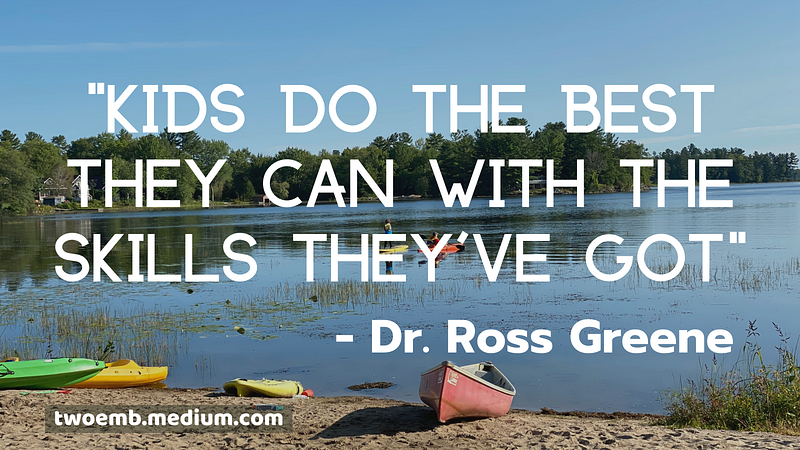
Dr. Ross Greene (photo by author)

Kids do well if they can

If readers get nothing else out of this blog post, I want the following two points to be made abundantly clear:

  • Academic success is not an acceptable reason or excuse to deny a child their right to accommodations and supports for their disability.
  • Social-emotional health is much more important than academic performance and children do not learn well when they are highly stressed, anxious, fearful, or working so hard to mask that they cannot absorb what is being taught.

I repeat:

Academic success is not an excuse to deny a student accommodations and supports for their disability.
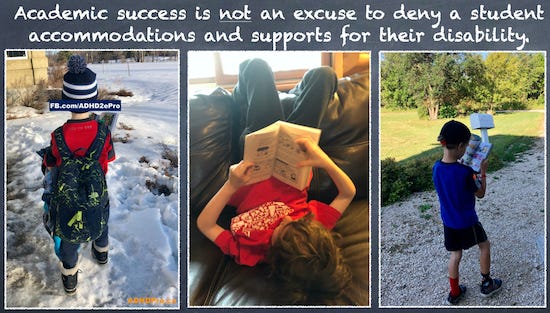
Photos by author — NeurodiversityMB.ca

Perhaps just as harmful, please do not tell a child with ADHD or a learning disability “you’re so smart, you just need to work harder and apply yourself.” They would if they could. They very likely can, but first, they need (and have the right to receive) the appropriate help to do so.

All students deserve to be able to show the very best of themselves, not just good enough based on the classroom teacher’s opinion. Meaning: if a child is doing well academically, but it’s causing them significant psychological, emotional, or social difficulty, then they still require accommodations so that they can be their best self without it taking a toll on their mental health.

Beyond assessment, we want to instil in students a love of learning and foster joy in curiosity. If a student is very bright, but school is a daily slog which they dread every day, then their chances of meeting their potential and pursuing higher education decrease every year that goes by without proper support.

Children with ADHD are at higher risk for academic underperforming and underachieving, so it is especially important for schools to ensure these students feel engaged and supported.

Security and Belonging

Beyond academics, the core subjects are not the only thing children learn at school. In fact, there have been many studies clearly demonstrating that students forget a significant portion of the academic content they are taught in school.

What they do learn and remember meaningfully are relationships: Relationships with peers, teachers, and other school staff. Public safety data in Canada indicates that 47% of parents report their child has experienced bullying in school. Children with ADHD are 13% more likely to experience bullying and social challenges, that’s up to 60% of children with ADHD who might experience bullying.

Much more important than memorizing multiplication tables, all children in schools need to learn about neurodiversity, disabilities, and celebrating individual differences in general.

When whole classes and schools are taught facts about neurodiversity, those students are significantly less likely to bully other children for being different and are much more likely to be kind and inclusive toward those children. Knowledge and understanding go a long way toward fostering acceptance — acceptance of our peers, and acceptance of ourselves, and all the strengths and struggles that come with our neurodiverse brains.

“When children are taught facts about disabilities, those students are significantly less likely to bully other children for being different, and much more likely to be kind and inclusive.”

When students are given appropriate accommodations and support they are less anxious, less stressed, and more able to engage with their peers because they feel more comfortable at school. The CADDAC has some great suggestions for specific accommodations and supports for various ADHD symptoms that can impact children at school.

In closing, I will reiterate the two most important points I wanted to make clear in this post:

  • Academic success is not an acceptable reason or excuse to deny a child their right to accommodations and supports for their disability.
  • Social-emotional health is much more important than academic performance and children do not learn well when they are highly stressed, anxious, fearful, or working so hard to mask that they cannot absorb what is being taught.

If you are concerned about your neurodivergent child and need help advocating for them, please do not hesitate to contact me.

© Jillian Enright, Neurodiversity MB

When you join medium, as a member you’ll have access to unlimited reads for only $5 per month. If you use my referral link, I’ll earn a small commission, and you’ll earn my undying gratitude.
If you’d prefer give a one-time tip, you can support my writing on Ko-Fi — also, it’s free to follow me on Facebook!

Subscribe to Insights from Educate for a midweek dose of professional learning and inspiration from authentic voices in education.

Related Stories

Further Resources

I have compiled an extensive list of Manitoba-local and online resources for ADHD.

I also have an article with advice for advocating effectively for your child.

References

Cook, A., Ogden, J., & Winstone, N. (2020). The effect of school exposure and personal contact on attitudes towards bullying and autism in schools: A cohort study with a control group. Autism : the international journal of research and practice, 24(8), 2178–2189. https://doi.org/10.1177/1362361320937088

Farone, S., Banaschewski, T., Coghill, D. Zhengh, Y.… Wang, Y., et al. (2021). The World Federation of ADHD International Consensus Statement: 208 Evidence-based conclusions about the disorder. Neuroscience & Biobehavioral Reviews. https://doi.org/10.1016/j.neubiorev.2021.01.022

Murre, J. & Dros, J. (2015). Replication and Analysis of Ebbinghaus’ Forgetting Curve. PLOS ONE 10(7): e0120644. https://doi.org/10.1371/journal.pone.0120644

Pascoe, M. C. , Hetrick, S. E., Parker, A. G. (2020). The impact of stress on students in secondary school and higher education. International Journal of Adolescence and Youth, 25(1), 104–112, DOI: 10.1080/02673843.2019.1596823

Unnever, J. D. & Cornell, D. G.. (2003). Bullying, Self Control and ADHD. Journal of Interpersonal Violence, 18(2): 129–147. https://doi.org/10.1177/0886260502238731

Wiener, J., Mak, M. (2008). Peer victimization in children with Attention-Deficit/Hyperactivity Disorder. Psychology in the Schools, 46(2). https://doi.org/10.1002/pits.20358

Adhd
Education
Advocacy
Inclusion
Schools
Recommended from ReadMedium