avatarJillian Enright

Free AI web copilot to create summaries, insights and extended knowledge, download it at here

3497

Abstract

ducation-planning-for-neurodiverse-students-5d434321f6f3">IEP</a>. The teacher was well aware of our son’s needs, strengths, and challenges.</p><p id="8bd8">After my son complained of being bored, I reached out to the teacher and asked about our son’s enriched curriculum, as discussed at our earlier meeting. The teacher told me she needed my son to demonstrate his ability to complete the current work before she would allow him to work ahead.</p><p id="9ad2"><i>That was not at all what we had discussed</i>.</p><p id="f18f">He had already demonstrated his abilities on his psychoeducational assessment, that’s what it’s for. That’s why the teacher was given a copy and the school psychologist explained the entire document in-depth to all of us.</p><p id="5b11">My son was refusing to complete the current work because to him it was tedious, repetitive, and boring. The information provided with our son’s IEP explained that gifted students should only be required to demonstrate understanding before being able to move on.</p><p id="f5f9">Rather than completing several cut-and-paste booklets in their entirety, he should have been asked to do a page or two from each one, then given something more challenging.</p><h2 id="de9b">An adapted curriculum is not a privilege</h2><p id="a8f5">I’ve heard similar stories from other parents of <a href="https://readmedium.com/and-then-there-were-2-e-fce186c74d29">2e</a> children. When the student’s behaviour in class was not meeting the teacher’s expectations, the teacher denied the child access to their gifted programming.</p><p id="223f"><i>This is not okay</i>.</p><p id="d9c4">I’ve also heard too many stories of children being denied movement or <a href="https://readmedium.com/schools-are-sensory-nightmares-d2f57d0c61db">sensory breaks</a> as a form of punishment, or having their breaks withheld as a “motivator”, to be used as a reward for compliance.</p><p id="8b8f">Many kids are being denied access to these regulation tools because they are not following the teacher’s instructions, despite the student clearly communicating they need a break — which is exactly why they weren’t listening in the first place.</p><p id="2975"><i>Just finish these questions, then you can have a break</i>,” they are told.</p><p id="3dd0">This is <i>so</i> not okay.</p><figure id="00fb"><img src="https://cdn-images-1.readmedium.com/v2/resize:fit:800/1*dxpWUczQt0zt6cf0_9F4WQ.png"><figcaption>Created by author</figcaption></figure><p id="71f0">For one, their accommodations and needs are <i>not</i> privileges which can be offered or withheld at the adult’s whim.</p><p id="21c3">They should <i>never</i> be used as a tool to manipulate or force the student into complying. Students with documented disabilities have a legal right to the supports and accommodations they need to be successful.</p><p id="6f2d">Secondly, the whole point of a break is to help the child expend some energy, or have their sensory needs met, then return more physically and mentally ready to learn.</p><p id="7ab1">The purpose is not to push the child until they become dysregulated, at which time the <i>adult</i> indicates the student needs a break because now they’re upset.</p><p id="99e7">The purpose of breaks is to <i>prevent</i> or reduce dysregulation, to help the student learn to <a href="https://readmedium.com/interoception-and-emotion-regulation-fd6d5b877f2c">notice and interpret their body’s signals</a>, so they can learn to <i>self</i>-manage and self-

Options

regulate.</p><p id="9668">It is entirely unfair and unreasonable to set a child up to fail by <a href="https://readmedium.com/the-pain-of-internalized-stigma-51a455e3e91e">refusing to meet their needs</a>, then further punishing them when they act out <i>because their needs were not met</i>.</p><h2 id="adc7">In summary</h2><ol><li><b>Let kids move their bodies in class</b>. They’ll learn better, behave better, and movement makes us all happier and healthier.</li><li><b>Never take away recess.</b> Ever. If a student is behind, taking away recess only catches them up for that day. It doesn’t help the adults figure out why the student is falling behind, nor how to help prevent this from happening again.</li><li><b>Accommodations are not privileges.</b> They are tools and supports to which students are legally entitled, meant to meet their needs and help them do their best. They <i>cannot</i> be taken away, nor contingent on behaviour.</li></ol><blockquote id="c846"><p>“Play is often talked about as if it were a relief from serious learning, but for children, play is serious learning.” <i>— Mr. Fred Rogers</i></p></blockquote><p id="3570">© Jillian Enright, Neurodiversity MB</p><figure id="82e5"><img src="https://cdn-images-1.readmedium.com/v2/resize:fit:800/1*yrXRujUY7VC66xXRlAbRBg.png"><figcaption></figcaption></figure><p id="7945"><i>When you join medium, as a member you’ll have access to unlimited reads for only $5 per month. If you use <a href="https://twoemb.medium.com/membership">my referral link</a>, I’ll earn a small commission, and you’ll earn my undying gratitude.</i></p><h1 id="d67e">Related Articles</h1><div id="7efb" class="link-block"> <a href="https://readmedium.com/why-gifted-kid-burnout-is-a-thing-c55432bb33c1"> <div> <div> <h2>Why Gifted Kid Burnout Is A Thing</h2> <div><h3>Twice Exceptionality (2e): Gifted is not the same as high-achieving</h3></div> <div><p>medium.com</p></div> </div> <div> <div style="background-image: url(https://miro.readmedium.com/v2/resize:fit:320/1*JWyG5z-kfIfweymRd84MrA.jpeg)"></div> </div> </div> </a> </div><div id="8846" class="link-block"> <a href="https://readmedium.com/the-pain-of-internalized-stigma-51a455e3e91e"> <div> <div> <h2>The Sting Of Internalized Stigma</h2> <div><h3>The day our son wished he had different parents</h3></div> <div><p>medium.com</p></div> </div> <div> <div style="background-image: url(https://miro.readmedium.com/v2/resize:fit:320/1*hMBFVTMj2XNX5t0Hxge4cg.png)"></div> </div> </div> </a> </div><div id="0e1c" class="link-block"> <a href="https://readmedium.com/schools-are-sensory-nightmares-d2f57d0c61db"> <div> <div> <h2>Schools Are Sensory Nightmares</h2> <div><h3>They’re bad enough for neurotypical folks, but can be hell for neurodivergent students</h3></div> <div><p>medium.com</p></div> </div> <div> <div style="background-image: url(https://miro.readmedium.com/v2/resize:fit:320/1*gxbl-HTNiWWY-XQazmVpWw.png)"></div> </div> </div> </a> </div></article></body>

Accommodations Are Not Privileges

People do not have to earn that to which they are legally entitled

Created by author on Canva

It’s not special treatment

I wrote this article focused on students in elementary school, however much of the same principles apply to anyone with a disability requiring any form of accommodation.

Businesses, employers, and other public institutions should be making their services and job opportunities accessible to all.

And, should a person requiring accommodations be the best qualified for the position and is hired, those accommodations are considered doing the bare minimum to provide an inclusive workplace. Accommodating a disability — regardless of context or environment — is simply doing the right thing, it is not special treatment.

Asynchrony

When I was in grade seven I was in a 7/8 split class. I was really bored with most of the work, so my teacher allowed me to do a lot of the grade eight curriculum instead.

One day I got into trouble for something (I can’t remember what it was, but I’m sure I did it) and my teacher said my behaviour was not “mature” enough to demonstrate an ability to work above my grade level.

Riiiiight. A 12 year old is not demonstrating the same level of maturity as a 14 year old. Shocker.

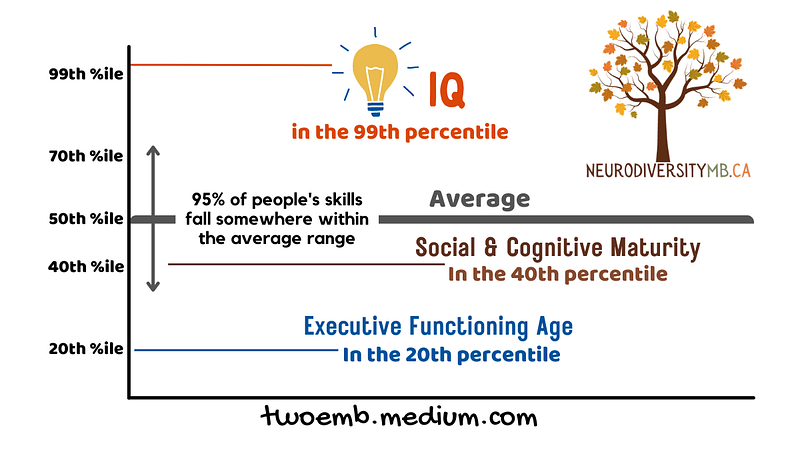
What I (still) need people to understand is intellectual or academic abilities are not the same thing as maturity.

Gifted and twice exceptional students develop asynchronously: this means while some cognitive abilities well exceed the average for their age, other developmental areas lag behind.
Created by author

Granted, this was about 25 years ago, the neurology and cognitive development of twice exceptional learners was not well understood when I was a pre-teen. I’m sure a lot has changed since then, right?

Right?!

Demonstrating (mis)understanding

A few years ago my son was in grade two. He had an IEP which indicated he is twice exceptional (2e — gifted with ADHD), and therefore would need an adapted education plan to meet his academic needs.

Well into the second week, my son was bringing home cut-and-paste learn-to-read activities. He complained about being bored at school. Given he was already reading well above grade level, I was not surprised.

We had met with the classroom teacher prior to the school year starting and had gone over everything outlined in his IEP. The teacher was well aware of our son’s needs, strengths, and challenges.

After my son complained of being bored, I reached out to the teacher and asked about our son’s enriched curriculum, as discussed at our earlier meeting. The teacher told me she needed my son to demonstrate his ability to complete the current work before she would allow him to work ahead.

That was not at all what we had discussed.

He had already demonstrated his abilities on his psychoeducational assessment, that’s what it’s for. That’s why the teacher was given a copy and the school psychologist explained the entire document in-depth to all of us.

My son was refusing to complete the current work because to him it was tedious, repetitive, and boring. The information provided with our son’s IEP explained that gifted students should only be required to demonstrate understanding before being able to move on.

Rather than completing several cut-and-paste booklets in their entirety, he should have been asked to do a page or two from each one, then given something more challenging.

An adapted curriculum is not a privilege

I’ve heard similar stories from other parents of 2e children. When the student’s behaviour in class was not meeting the teacher’s expectations, the teacher denied the child access to their gifted programming.

This is not okay.

I’ve also heard too many stories of children being denied movement or sensory breaks as a form of punishment, or having their breaks withheld as a “motivator”, to be used as a reward for compliance.

Many kids are being denied access to these regulation tools because they are not following the teacher’s instructions, despite the student clearly communicating they need a break — which is exactly why they weren’t listening in the first place.

Just finish these questions, then you can have a break,” they are told.

This is so not okay.
Created by author

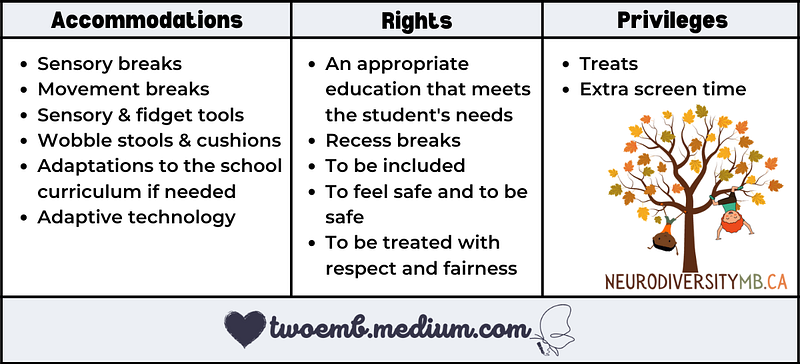
For one, their accommodations and needs are not privileges which can be offered or withheld at the adult’s whim.

They should never be used as a tool to manipulate or force the student into complying. Students with documented disabilities have a legal right to the supports and accommodations they need to be successful.

Secondly, the whole point of a break is to help the child expend some energy, or have their sensory needs met, then return more physically and mentally ready to learn.

The purpose is not to push the child until they become dysregulated, at which time the adult indicates the student needs a break because now they’re upset.

The purpose of breaks is to prevent or reduce dysregulation, to help the student learn to notice and interpret their body’s signals, so they can learn to self-manage and self-regulate.

It is entirely unfair and unreasonable to set a child up to fail by refusing to meet their needs, then further punishing them when they act out because their needs were not met.

In summary

  1. Let kids move their bodies in class. They’ll learn better, behave better, and movement makes us all happier and healthier.
  2. Never take away recess. Ever. If a student is behind, taking away recess only catches them up for that day. It doesn’t help the adults figure out why the student is falling behind, nor how to help prevent this from happening again.
  3. Accommodations are not privileges. They are tools and supports to which students are legally entitled, meant to meet their needs and help them do their best. They cannot be taken away, nor contingent on behaviour.

“Play is often talked about as if it were a relief from serious learning, but for children, play is serious learning.” — Mr. Fred Rogers

© Jillian Enright, Neurodiversity MB

When you join medium, as a member you’ll have access to unlimited reads for only $5 per month. If you use my referral link, I’ll earn a small commission, and you’ll earn my undying gratitude.

Related Articles

Education
Accessibility
Schools
Parenting
Neurodiversity
Recommended from ReadMedium