
Instead of Inclusion, We Got Budget Cuts
Went to inclusive education month, and all I got were these lousy funding cuts
It’s supposed to be national inclusive education month in Canada. To mark the occasion, one might think politicians would use this opportunity to announce fantastic new projects and policies for improving accessibility and inclusion in our schools.
This would be a great time to announce specific funding for inclusion training for education staff, money to hire more clinicians and support staff, or at least bring back lunch programs and other programs that have stopped due to funding cuts.
Apparently not. Apparently our politicians think inclusive education month is a great time to insult the intelligence of their constituents. There are many examples of this, but I only need a couple to illustrate my point.
It’s even worse than it looks
If you’re on the outside looking in and are thinking our public education system is in a bad place, I’m sorry to say, it’s worse than that. What you see is only the tip of the proverbial iceberg.
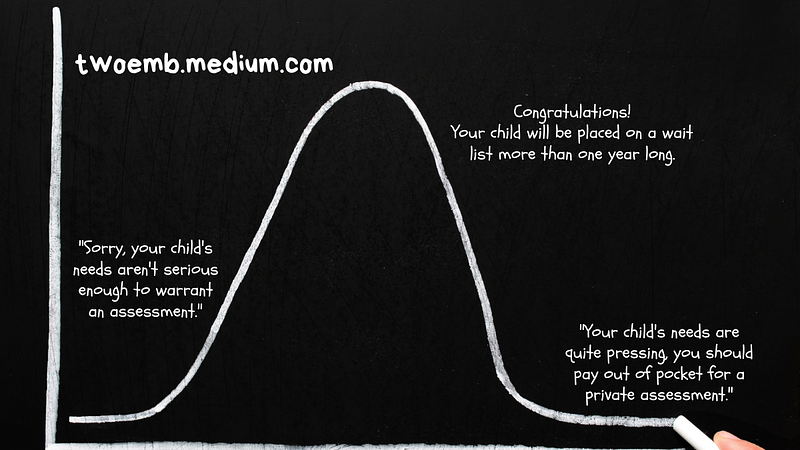
The long waiting lists for assessments and supports in our public schools are only a fraction of the picture. Many students and families are denied even being placed on the waiting list if their child’s issues are not considered “serious” enough, as determined by the school teams.
Instead of continuing to add students to the waitlists as needed, school administrators are gate-keeping and triaging, telling families that resources are so scarce, they must “conserve” them for only the most serious needs.
But wait, there’s more.
The students whose needs are not considered urgent enough for the child to be assessed by the division’s school psychologist are going without, or making do with some piecemeal supports, developed without the crucial information a formal assessment can provide.
On the other end of the spectrum, there are the students whose needs are so apparent, they can’t possibly wait for the school psychologist to fit them in, their waitlist is much too long.
Those families are told not to wait because their child’s needs are too urgent. They are encouraged to seek out private assessments, which cost upwards of $4,000 in most Canadian provinces.
So the students who need support, but can scrape by without, are doing so (with inadequate substitutes). They are not on the psychologist’s waitlist, so they don’t count toward the backlog of assessments which grew while schools were shutdown due to the covid pandemic.
Families who can afford to pay for private assessments, or whose insurance will cover at least some of the cost, do so in order to get their child the help they need. Those students don’t show up on the province’s statistics when estimating wait times for psychoeducational assessments either.
In my experience as an advocate and consultant for neurodivergent and disabled students, wait times have more than doubled over the past three years, increasing from approximately 6 months to more than one year.
Those are only the students who fall somewhere in the middle and are granted the dubious honour of being permitted to wait for at least one year while the tail ends of the spectrum are cut off.
Meanwhile, in Manitoba…
To rub salt in the wound, yesterday our minister of education announced preliminary figures for the 2023/2024 education budget.
In an embarrassing display of hyperbole and willful ignorance, our education minister called his below-inflation-rates funding increase “astronomical”.
Seriously, he did.
I have receipts.
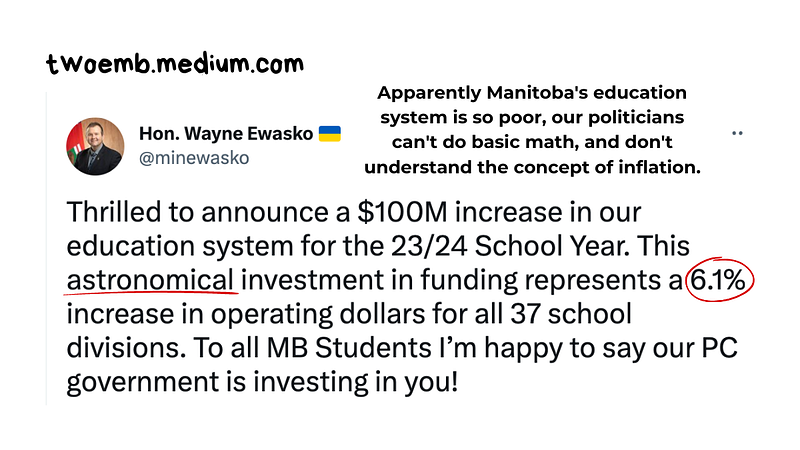
Depending on where you live, this may sound impressive, or a laughably small funding increase. For Manitoba, it’s definitely the latter. The primary reason 6.1% is nowhere near astronomical is because this “increase” doesn’t even reach the rate of inflation.
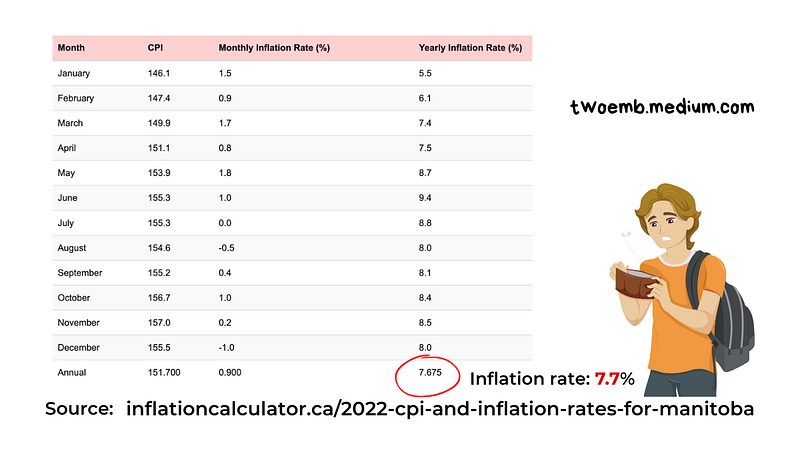
Our minister of education pulled a similar stunt last year, calling yet another funding ‘increase’ lower than the rate of inflation “historic”, stating it was the largest increase ever in our provincial government’s history.
Yes, that’s because of inflation, you jackass.
Even an increase of 0.01% over the previous year’s budget will be the “biggest ever” because everything gets more expensive every year.

I can’t decide which is worse. If our politicians really are as stupid as they act, or if they are smart but play dumb. Either way, they’re screwing us over — worse, they’re fucking with our children’s education.
© Jillian Enright, Neurodiversity MB
Related Articles
When you join medium, as a member you’ll have access to unlimited reads for only $5 per month. If you use my referral link, I’ll earn a small commission, and you’ll earn my undying gratitude.
If you’d prefer give a one-time tip, you can support my writing on Ko-Fi — also, it’s free to follow me on Facebook and LinkedIn!


