Playing Politics With Our Children’s Education
Our government claims they’ve increased education funding

Update: April 20, 2022
This morning, Statistics Canada reported that Canada’s inflation rate rose to 6.7%, the largest increase on record since 1991 — that’s over thirty years ago.
Everything is getting more expensive. Manitoba hasn’t publicly released their breakdown of funding per division for 2022–2023, so I can’t crunch those numbers, but our division made a public presentation of next year’s budget, so I know what our numbers look like…. and they’re not good.
Really not good.
We’re technically receiving a 3.07% increase in funding. Three. Percent. Even based on the previously very conservative estimates of a 3.24% rate of inflation, that’s still a .17% decrease once you factor in the increase costs to the schools.
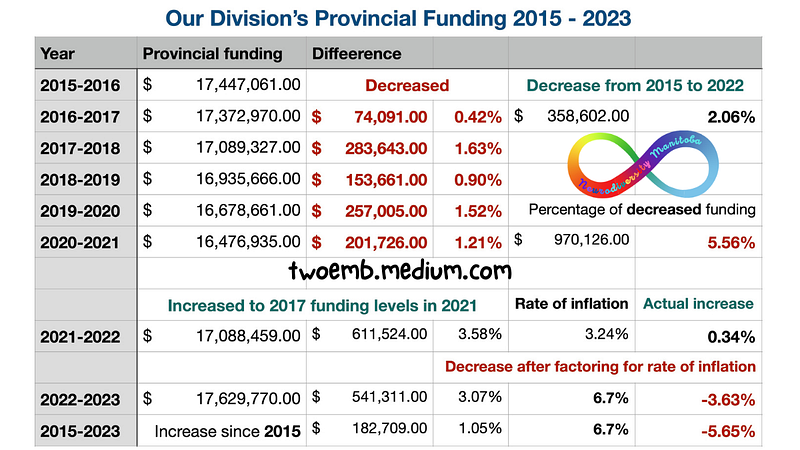
With an inflation rate of 7% (and rising), that’s comparable to a 3.63% decrease in funding for our division next year. I do realize it’s not a perfect translation, but I’m not an accountant, and our province is not being transparent with their figures.
At the end of the day, as costs are rising exponentially for everyone, schools have to do more with less while our government boasts of funding “increases”.
False claims of education funding increases
Manitoba’s government continues to claim they’ve increased education funding, yet anyone who actually crunches the numbers can see this is disingenuous.
Obviously this isn’t a new tactic, nor is it one used exclusively by any one political party, they all play these games. I hate games like these, which is probably (one of the many reasons) why I would make for a terrible politician.
Last year, when our former education minister was bragging about supposed funding increases, I decided to do a little math. It’s not my speciality, but luckily there exist calculators and spreadsheets for anyone who wishes to delve into the figures.
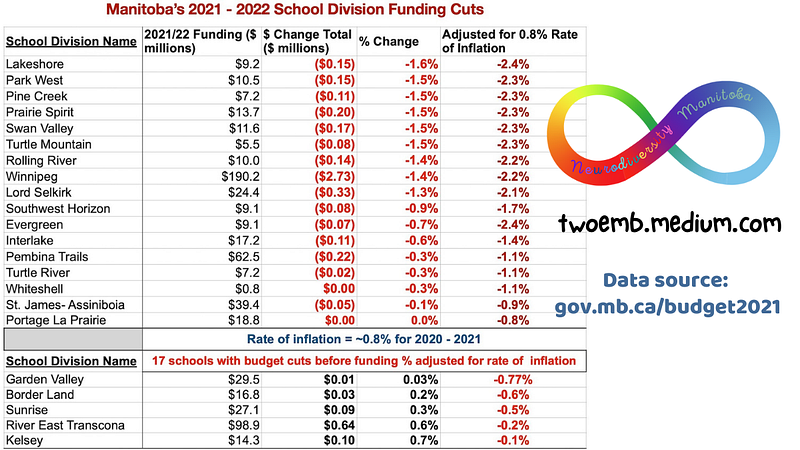
This year, our provincial government is playing a similar game. Our new education minister is boasting of a $7 million increase in funding for “special needs” students.
Side note to government officials: Most of us dislike the term “special needs” as many experience it as infantilizing and condescending. We’re disabled. We’re neurodivergent. We’re Deaf. We’re Autistic. These are not dirty words.
We’re human beings, not a homogenous group to be lumped into a “special” category, but I digress (often).
Seven million dollars sounds like a lot of money, doesn’t it?
Manitoba has over 690 schools, so $7 million only amounts to approximately $10K per school. Not a lot when funding models are looking at multiple millions of dollars, with many divisions currently operating on a deficit.
But wait, it gets worse!
At least two additional problems are conspicuously absent from these political attempts to paint a pretty picture of education funding.
One, our government has also been bragging about adding twenty new schools.
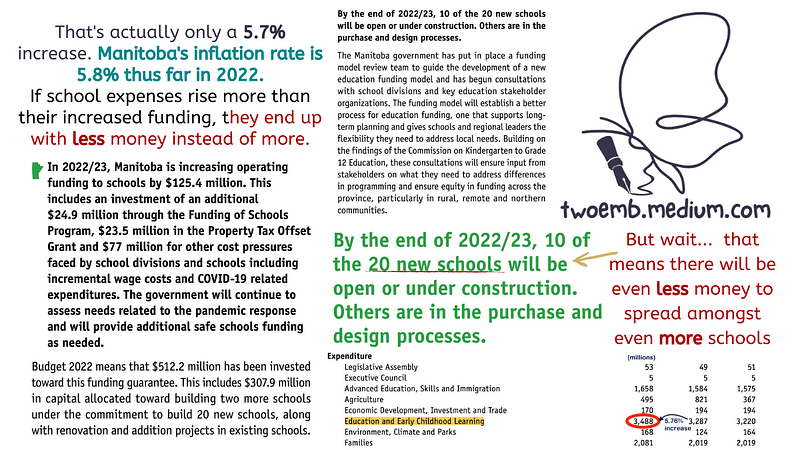
Obviously, more schools and reduced funding mean even less money to go around. In 2020 we had 690 schools. An additional $7 million divided amongst 690 schools is $10,144. $7 million divided amongst 710 schools will be just $9,859.
For reference, our small rural division currently has 27 schools. If our division were to receive $9,859, that would amount a paltry $365 per school. That would hardly cover the annual cost toilet paper, let alone provide any benefit to the students.
Our small division of approximately 2,300 students has an estimated $33 million in operating costs. Assuming we’d get an equal share of that funding (which we would not), $9K is only 0.03% of our annual expenses. That’s not a typo, that’s not 3%, it’s 0.03%.
If your expenses were $100 and you were given 3 additional cents, how much help would that be?
Given there are nearly 200,000 students in Manitoba, our division of 2,300 has approximately 1.1% of our province’s student body, meaning we’re likely to get even less than 0.03%.
But wait, there’s more!
When the province consistently decreases a division’s funding over 5 years, then provides a very small (I’m talking teeny tiny) increase, it’s not really an increase.
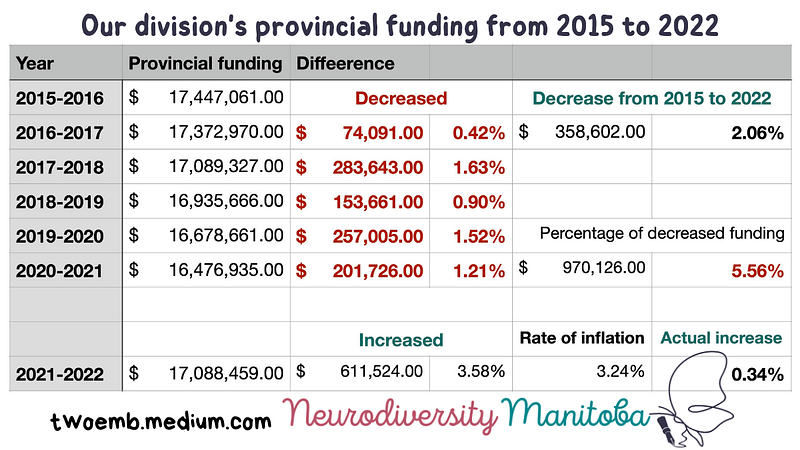
In 2015, the provincial government gave our division $17.4 million. In 2021–2022, the province gave us $17.09 million. That’s a decrease of 2% over 5 years. That doesn’t even account for factors such as inflation and increased enrolment.
“Special needs” funding
The second major problem is this additional $7 million is ear-marked for “special needs” students who are considered to have Level 2 or 3 support needs.
Level 2 support is defined as a student who has multiple disabilities:
“The student has a combination of two or more severe disabilities that produce severe multiple developmental, behavioural, and/or learning difficulties.”
Level 3 support is defined as a student who has severe or profound disabilities:
“The student has a combination of extremely severe disabilities that produce profound multiple developmental, behavioural, and/or learning difficulties.”
Therein lies the rub.
Or, more accurately, therein lies yet another hole in the story of our provincial government.
As a result of year-over-year funding decreases, our division has gone from two clinicians qualified to assess students for learning and developmental disabilities, down to only one clinician who is qualified to perform these assessments.
That’s one lonely clinician for an entire division of more than 2,300 students. Even before this reduction and before Covid shut-downs, wait times for a psycho-educational assessment were between 6 to 8 months.
Since these changes, wait times have increased to one to two years.
It is much more difficult to identify and articulate a student’s needs without the funding to employ qualified staff to assess and describe those needs in the first place.
If you look at the application form for Level 2 and 3 funding, it focuses on:
- Assistance needed for personal care and hygiene (i.e. needing help in the bathroom).
- Interpreter services needed for Deaf or non-speaking students.
- Severe behaviour concerns — the form specifically asks administrators filling out the form to describe how the student’s behaviours are dangerous to themselves and/or others.
- The form asks for the results of the most recent formal assessment.
Although the applications do not appear to require a student to have a formal diagnosis, only those students whose behaviours are most disruptive, or support needs require most staff time, will be eligible for this funding.
While the government claims to be spending an additional $7 million on “special needs”, this is money held in government coffers, only to be disrupted at their discretion.
This money will be doled out on an as-needed basis, only after administrators jump through government hoops to apply for — and maybe receive — an annual amount per student who meets the government’s criteria.
Interesting that someone in a governmental office, who has no idea who the child is, or any idea what their daily school experience is, sits in judgement of whether or not their needs are sufficient to receive funding for needed supports.
Maybe interesting isn’t the word for it.
© Jillian Enright, Neurodiversity MB
Related Stories
When you join medium, as a member you’ll have access to unlimited reads for only $5 per month. If you use my referral link, I’ll earn a small commission, and you’ll earn my undying gratitude.