
Education & Advocacy
Thinking Outside the Box: Challenging the Status Quo
The frustration with accommodations at school

Full disclosure: I am not good with bureaucracy. I know there are rules and processes in place in an effort to keep things fair and to ensure there is regulation and oversight. I get that red tape sometimes serves a purpose. I also admit to being somewhat — okay, quite… okay, very impatient.
I grow weary of hearing variations of we can’t do that, it’s out of our hands, or it’s how the system works and we can’t change it. I acknowledge that change is difficult, but sometimes these are just cop-outs and reluctance to get a little bit creative and resourceful.
You CAN. You can and WE can. Change is not easy, and the larger the bureaucracy, the slower the change. I’m not advocating for total anarchy here (not today at least). Let’s change the system from within in a positive and collaborative way, but let’s not merely throw up our hands in defeat without even trying to push for change when it is sorely needed.
Sometimes professionals become complacent and just accept no for an answer — or worse, stop asking altogether when they assume, based on past experience, the answer will be no. When people and their ideas get rejected so often, sometimes they simply stop asking and give up trying.
This is not okay. Seriously.
People deserve to work and learn in an environment where they are heard and where change is possible. The status quo is unacceptable; we must learn and change and grow as we find new and better ways of doing things. Stagnation is unhealthy and unhelpful. Plus, it’s boring, and we folks with ADHD love novelty.
People deserve to work and learn in an environment where they are heard and where change is possible.
When parents or educators see what they feel is a fairly simple solution for a problem in school the possibility should at least be considered. In fact, when parents, educators, and other professionals are coming up with ideas and suggestions, rather than simply pointing out problems, this should be rewarded and encouraged.

This brings me to the original reason for this post (we folks with ADHD might go off on tangents upon occasion…), my question for parents and caregivers:
Is your child’s school providing appropriate accommodations and required services during this time of distanced education?
Are your school’s division and school team doing everything they can to follow your child’s IEP (or SSP, or BIP, or whatever letters they are currently using) via in-class, hybrid, or online learning?
I fully recognize the extreme challenge educators are facing having gone from in-class instruction to online platforms, to one-on-one in-class supports, to hybrid learning, back to in-class, to who-knows-what school will look like tomorrow, let alone next week.
Teachers, I hear you banging your heads against the proverbial wall, and maybe the real wall some days too. Please rest assured, I am advocating for school staff as well as students (honestly, I’m surprised our Minister of Education hasn’t blocked me on Twitter yet, but the year is young).

Dear Teachers: I see you and appreciate you. I know many of you have been advocating for your students louder and longer than almost anyone else.
Education is a Team Sport
The onus is on a team of people, not any one person or role, to work together and come up with solutions that will meet the needs of each individual student. Not an easy task by any means. A very important task nonetheless, and one that parents, caregivers, and students have every right to expect.
As a parent, caregiver, or student, if you have concerns or needs that are not being met, please don’t feel as though you cannot ask for support or accommodation because of the challenging circumstances we are all experiencing. Education is a right to which all children deserve access, and it’s up to the parents and school teams to work together to make that happen.
ALL children are entitled to appropriate education, and it’s up to the parents and school teams to work together to make that happen.
National Legislation
When their son was discriminated against due to his learning disability, the Moore family filed a complaint to the British Columbia Human Rights Commission, a fight they bravely took all the way to Supreme Court of Canada in 2012.
Those who have advocated for their children within the school system know how exhausting this battle can be.
The final decision in the Moore case (Moore vs B.C., 2012) states that students with disabilities are entitled to receive the accommodation measures they need to access and benefit from the service of public education.
There isn’t a clause that says “except when there’s a global pandemic” or “except when it’s difficult to do”.
Our Schools are Underfunded
As I acknowledged in a previous blog post, the onus ultimately falls on our provincial government to provide better funding and increase resources allocated to schools so these expectations are more realistic and attainable.
It is unfair and unreasonable for our government to tell teachers and school staff, you absolutely must do this, but we won’t give you the adequate resources to do so. Also, parents will be angry with you when you don’t, but we politicians will never accept responsibility for underfunding education. Good luck!
That said, it is up to the adults to continue to push for change, to advocate for our children, and to hold our policy-makers accountable.
It is unconscionable for our government to tell teachers and school staff, you absolutely must do this, but we won’t give you the adequate resources to do so.
Now more than ever, children with disabilities need appropriate support and must have their needs met, even if that requires a little ingenuity and creativity.
Provincial Legislation
In Manitoba, our Appropriate Education Act requires, in part:
- A principal must ensure that a pupil is assessed as soon as possible if they are having difficulty meeting expected learning outcomes.
- A principal must ensure that a student is referred for specialized assessment if differentiated instruction and adaptations are insufficient to assist the student in meeting learning outcomes.
A principal must ensure that an individual education plan is prepared for a pupil that identifies:
- How the school team will meet the student’s needs to help them reach the goals in their plan;
- The plan must be prepared with the assistance of the teacher and other in-school personnel [usually the school psychologist, social worker, and/or guidance counsellor];
- The plan must take into account a student’s behavioural or health care needs, if any;
- The plan must be updated annually or sooner if required by a change in a student’s behaviour or needs.
The principal must ensure that the student’s parents, and the student if appropriate, are given the opportunity to
- Participate in preparing and updating the student’s plan; and
- Be accompanied and assisted by a person of their choosing when doing so.
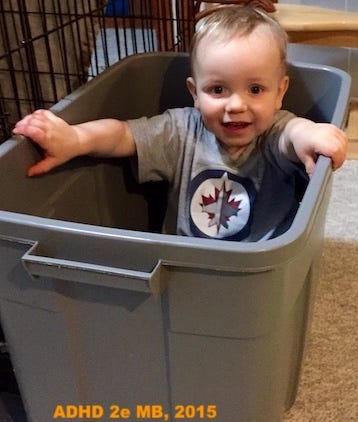
No Excuses
While everything is more challenging right now, children with disabilities are not an afterthought, and meeting their needs is not a luxury we can dispense with for the duration of the pandemic.
Now more than ever, children requiring accommodations must have their needs met, even if that requires a little ingenuity and creativity.
Gratitude
Thank you to teachers who are right now putting their health at risk during the Covid pandemic to provide an education to our children.
Thank you to those teachers who push against the system, who advocate hard for their students, and who put so much of themselves into their work because they know it matters.
It matters to those kids, and to their parents. So, thank you.

Subscribe to Insights from Educate for a midweek dose of professional learning and inspiration from authentic voices in education.

References
Moore v. British Columbia (Education), 2012 SCC 61, [2012] 3 S.C.R. 360.
Sethi, A., Voon, V., Critchley, H. D., Cercignani, M., & Harrison, N. A. (2018). A neurocomputational account of reward and novelty processing and effects of psychostimulants in attention deficit hyperactivity disorder. Brain : a journal of neurology, 141(5), 1545–1557. https://doi.org/10.1093/brain/awy048
The Public Schools Act 2015 (MB). C.C.S.M. c. P250, Appropriate Educational Regulation (Can.).


