
Education
Gifted Education Is “Special” Education
Different needs still require different approaches, regardless of where they fall on the continuum
First off, I don’t particularly care for the term “special education” for any type of unique academic needs, and I particularly dislike the term “special needs” for children with disabilities.
These terms clump a vast range of disabilities and differences into one category, “othering” neurodivergent and disabled students, implying they do not belong with the majority of their classmates.
The term special needs is incredibly imprecise. There are a large number of differences and disabilities, and the majority of neurodivergent and disabled people, including myself, prefer identity-first language.
My experience
When my son’s school was failing to meet his needs, I began calling around to see what programming was available nearby.
One principal I spoke with told me “ We don’t have gifted education in Manitoba because all kids are gifted.”
Um. No.
Actually…
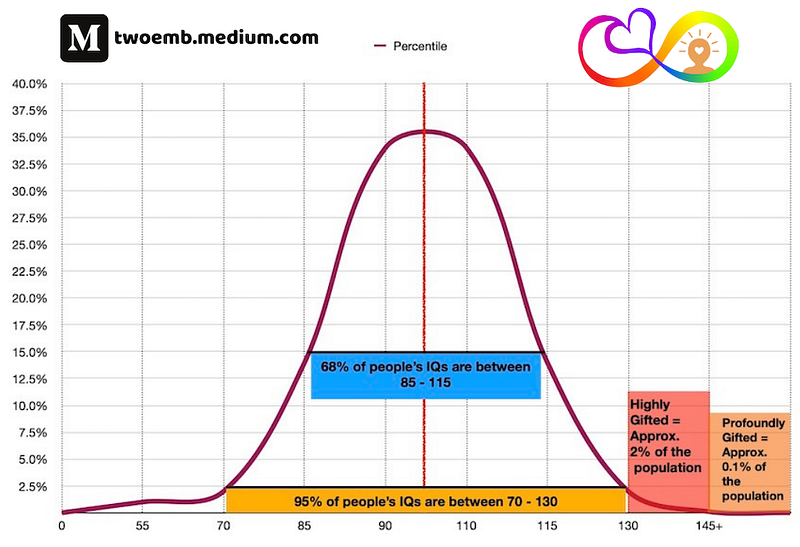
By definition, only 2.5% of children are cognitively gifted. All children are equally important and valuable and all children have gifts, but not all children are neurodivergent in this way. That is why it is called neuro-divergence: because it diverges from the neurological norm.
Asking for their needs to be met is not asking for special treatment, it’s asking for fair treatment. 2e students shouldn’t be disregarded because of some preconceived notions and misconceptions about what gifted education means.
“2e students are among the most under-identified and underserved population in schools... Twice-exceptional students, whose gifts and disabilities often mask one another, are difficult to identify. Without appropriate educational programming, twice exceptional students and their talents go unrealized.” — Davidson Institute
Gifted Education IS Special Education
Or, well, at least it’s supposed to be.
Gifted students are identified as such because they have different needs, just like any other student who falls outside of any kind of “ norm”. The National Association for Gifted Children (NAGC, in the U.S.) provides the following position statement on gifted and twice exceptional students:
“Gifted students can have learning and processing disorders that require specialized intervention and accommodation… Accurate identification of both talent and disability domains is crucial to guide appropriate psychological and educational planning. Despite variability in recommended strategies for addressing specific domains of talent and/or disability, research supports the adoption of a strengths-based, talent-focused approach with twice- exceptional students both in and out of the classroom.”
When a parent or caregiver is searching for supports for their gifted or twice exceptional child, it’s not likely because the child is thriving in school and the parent is looking for special treatment. If a child is doing well their program parents are not likely to go looking elsewhere.
Asking for their children’s to be met is not asking for special treatment, it’s asking for fair and appropriate education.
Unfortunately, especially here in Manitoba, there seems to be a distinct lack of knowledge and understanding about the needs of gifted and twice exceptional students. Any child who requires accommodations should receive them, regardless of which label identifies what their unique needs are.
A diagnosis is only helpful if parents and professionals use that information to guide their approach and planning for that student; they need to understand the diagnosis and what it means for that individual.
My favourite definition of giftedness comes from The Columbus Group (1991), because it speaks to the asynchrony and intensity that comes with gifted development:
“ Giftedness is asynchronous development in which advanced cognitive abilities and heightened intensity combine to create inner experiences and awareness that are qualitatively different from the norm. This asynchrony increases with higher intellectual capacity. The uniqueness of the gifted renders them particularly vulnerable and requires modifications in parenting, teaching and counselling in order for them to develop optimally.” — The Columbus Group (1991)

Another blog post that provides an in-depth breakdown of the different types of giftedness and how they impact learners is one called Gifted vs. Gifted, by Kathleen Humble.
Students with different needs may create more work for schools, but If you need help advocating for your child, please do not hesitate to they are not an inconvenience. They are developing human beings and it is a privilege to teach, and to learn from, people with differently wired brains.
Too often administrators and educators seem to put the onus on the child and family if they don’t know how to best support that student. Educators, parents, and anyone who supports neurodivergent children should make it a priority to educate themselves. A lack of understanding on the adult’s part is not the child’s responsibility, yet it is these children who will bear the burden of ill-informed adults in their lives.
Further Reading
When you join medium, as a member you’ll have access to unlimited reads for only $5 per month. If you use my referral link, I’ll earn a small commission, and you’ll earn my undying gratitude.
References
Gernsbacher, M. A., Raimond, A. R., Balinghasay, M. T., & Boston, J. S. (2016). “Special needs” is an ineffective euphemism. Cognitive research: principles and implications, 1(1), 29. https://doi.org/10.1186/s41235-016-0025-4


