
Why Twice Exceptional Students Hate School
Traditional education is the opposite of what 2e and neurodivergent kids need

Twice exceptionality
Twice exceptional (2e) refers to someone who is considered intellectually gifted and also has a disability, or is neurodivergent. Someone is 2e if they are gifted as well as having a physical disability, learning disability, Autism, ADHD, among many others.
Before I explain why these students are particularly underserved by our public education system, I want to acknowledge that being identified as “gifted” in itself is a highly problematic process.
IQ tests are inherently biased. They were developed by white, male scholars who were also usually wealthy. The measurements are based on “ideal” gifted characteristics of rich white men, failing to consider cultural and gender differences (among many other flaws).
While I do find full psychoeducational assessments very helpful in identifying a student’s particular strengths and weaknesses (such as processing speed and working memory), I must also acknowledge the privilege and bias which come with being identified as “gifted”.
Spiky brains
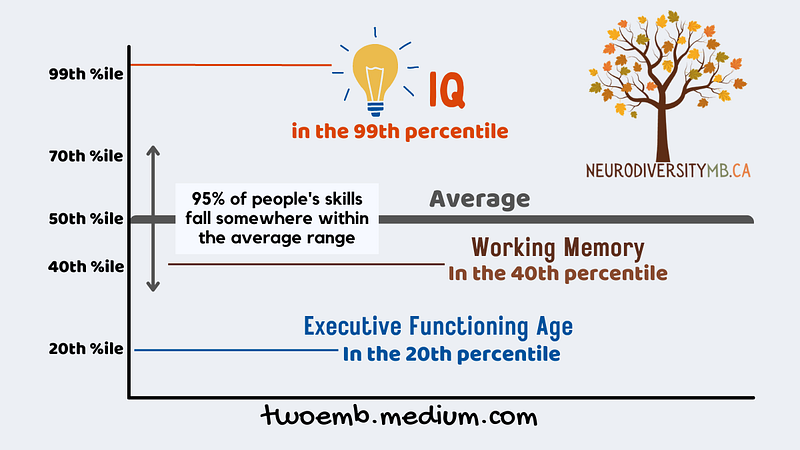
Twice exceptional and neurodivergent (ND) students have what we call a “spiky” (or asynchronous) cognitive profile. This means that they really excel at some things and really struggle with others.
These students have some skills in the exceptionally high range, and others in the very low range, whereas most people’s abilities vary within the average range.
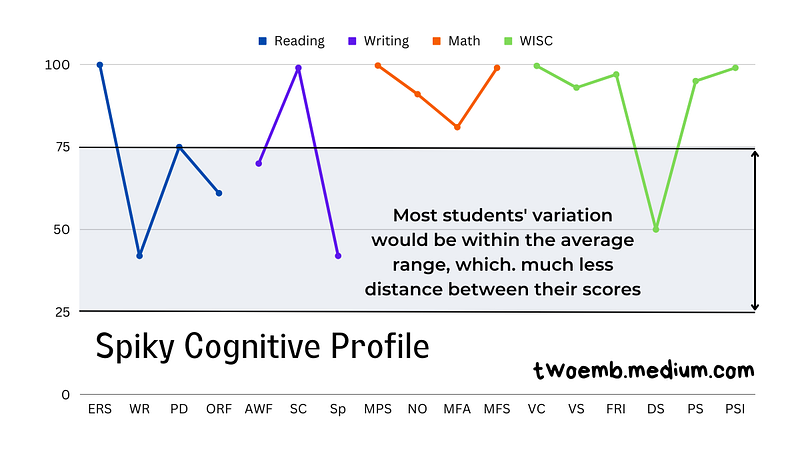
Schools teach to the statistical average, and this type of education is very frustrating for 2e and ND learners.
For example, Canada’s public schools (and many others) teach using a spiral curriculum, where they circle back to the same concepts each year, while adding layers of complexity and difficulty.
This is essentially the opposite of what most 2e and ND students need to thrive or succeed in school.
Twice exceptional learners tend to start with the big picture and move their way inward, where typical learners work in the opposite direction: beginning with the details and putting them together to develop the full concept.
When teachers are starting with the building blocks, 2e students will likely become impatient, wanting to first understand the overall concept, and then dive deeper once they understand why and where they’re going with it.
Traditional education discourages this, asking students to perform repetitive tasks, engage in memorization and rote learning — often without connecting these individual concepts to the larger picture, or even to real life applications.
“If their training didn’t even prepare them for the very existence of these asynchronous learners, how can they possibly be expected to effectively teach them?”
2e learners tend to think deeply and want to explore interesting subjects as far, and in as much detail, as possible. (And yes, plenty of other children can also be deep thinkers, this is just one many characteristics of 2e learners).
Touching on a subject for just long enough to meet curriculum requirements and then moving on is incredibly frustrating when these kids’ curiosity has been piqued.
This isn’t a teacher issue
To be clear, this isn’t an issue with the teachers: this is how they were trained, and this is how they are expected and required to teach. These approaches work for most students, so it’s assumed this should work for all students.
It doesn’t.
Recently my son was forgetting to bring home his agenda from school. I wasn’t too concerned, however I recognize that if he doesn’t develop organizational skills and strategies now when he’s young, then he’s really going to struggle in high school or university (we both have ADHD).
I asked the teacher if he could get a reminder at the end of the day, to ensure he had placed his agenda inside his backpack. What was happening was they were writing in their agendas a little before dismissal time, then putting them back in their desks to do other things.
The teacher insisted that she gave everybody a reminder at the end of the day when she said “pack up your things”.
I tried to explain that the gap between writing in the agenda and putting it in his bag was too long, due to working memory issues, he completely forgot by then. A general reminder to “pack your things” was obviously not working, since he was forgetting every day for nearly a month at this point.
ND students need specificity. “Pack your things” could refer to anything: his lunch bag, notebook, pencil case, anything. It’s too vague. I suggested they help my son develop his own strategy, with just a little support and scaffolding in the beginning, then they could gradually let him take over responsibility.
Apparently not. I was simply told the whole class gets one and that was that.
Sigh.
I sent my son to school with a sticky note, on which he wrote “remember your agenda”, and stuck it on the top of his desk. In the grand scheme of things this wasn’t a big deal (we’ve dealt with much worse).
My point is our traditional schooling approach assumes everyone learns the same way on approximately the same schedule. This is not the case for 2e learners: some skills develop well ahead of schedule, while others lag well behind.
If it’s not working…
Instead of recognizing that something isn’t working for a student, and trying a different approach, our traditional education system blames the child. He should be able to do this, all his classmates are doing it without issue.
Well, if he could, he would.
It’s easier to say he’s just not trying, not paying attention, rather than consider the possibility that a little more effort is needed on the part of the adult in the room.
I actually think my son has a really good teacher this year, that example was just one that illustrated my point. As I said, this isn’t a teacher issue. Teachers are not trained in supporting 2e learners unless they specifically choose to seek out continuing education or specialization opportunities.
I don’t think I’ve met a teacher who even knew what the term twice exceptional meant before I explained to them. If their training didn’t even prepare them for the very existence of these asynchronous learners, how can they possibly be expected to effectively teach them?
Presumed privilege
If someone says their child is gifted, they’re usually met with one of two reactions. It’s often assumed they’re bragging about their child and overstating their abilities to make themselves look good. Alternatively, they’re considered “lucky” to have a child born with a gifted brain, and it’s assumed everything comes easily to them.
Neither are true, but I want to address the second reaction.
Having an atypical brain, in whatever way that may be, does not make life easier. Our world was designed for the statistical ‘norm’, and our school system is designed to educate the statistical ‘average’.
People who don’t fit neatly into those rigid boxes often struggle because of their asynchronous development, and because we’re navigating life in a world not made with our needs in mind.
This bias is illustrated right in our appropriate education programming (AEP) regulations, which enforce accommodations for and inclusion of disabled students in our public schools.
There is no recognition of gifted or twice exceptional learners whatsoever anywhere in the AEP regulations, nor in Manitoba’s public schools act. In order to qualify for accommodations, or an IEP, a student must have a demonstrated disability, or significant difficulty meeting the curricular expectations without additional support.
“Without the requisite knowledge and skills for identifying and serving these students, educational systems will continue to fail to support 2e learners.” — Jennifer Metelski
© Jillian Enright, Neurodiversity MB
Related Articles
When you join medium, as a member you’ll have access to unlimited reads for only $5 per month. If you use my referral link, I’ll earn a small commission, and you’ll earn my undying gratitude.
If you’d prefer give a one-time tip, you can support my writing on Ko-Fi — also, it’s free to follow me on Facebook and LinkedIn!
Learn more
References
Baldwin, L., Omdal, S. N., & Pereles, D. (2015). Beyond Stereotypes: Understanding, Recognizing, and Working With Twice-Exceptional Learners. TEACHING Exceptional Children, 47(4), 216–225. https://doi.org/10.1177/0040059915569361
Illich, Ivan. (1970). Deschooling Society. Marion Boyars Publishing Ltd.
Kaufman, S. B. (Ed). (2018). Twice exceptional: Supporting and educating bright and creative students with learning difficulties. Oxford University Press.
Kovacs, K., & Conway, A. R. (2019). A Unified Cognitive/Differential Approach to Human Intelligence: Implications for IQ Testing. Journal of Applied Research in Memory and Cognition, 8(3), 255–272. https://doi.org/10.1016/j.jarmac.2019.05.003
Lovecky, D.V. (2004) Different Minds. Gifted Children with AD/HD, Asperger Syndrome, and Other Learning Deficits. Jessica Kingsley Publishers.
Metelski, J. (2022). Erasure of Exceptionality: How Manitoba’s Twice-Exceptional Learners Lose Out. Brandon University Journal of Graduate Studies in Education, 14(2). https://eric.ed.gov/?id=EJ1350799


