
Education & Local Politics
Manitoba Education Needs Stronger Legislation
Laws to protect students with disabilities, but also to mandate government support for teachers and schools

Regulations written in a way that are clear and comprehensive reduce conflict when expectations become consistent and equitable across the board.
Canadian Students Lack Protection
Manitoba needs formal special needs education legislation to protect our children and all vulnerable students, and to hold schools accountable for following individualized plans and for providing required accommodations. Like, yesterday.
I will try not to let this blog post turn into a rant, but I do hope you’ll forgive me if I do have a little soap box under my feet today.
The U.S. Department of Education has a law called I.D.E.A. that is intended to do just that. Attorney Andrew Lee explained it better than I could in an article on Understood.org.
In short, the Individuals with Disabilities Education Act is a law that makes available a free appropriate public education (FAPE) to eligible children with disabilities throughout the United States and ensures special education and related services to those children.
Under this law, there are certain protections for students with disabilities, and safeguards in place to compel schools to follow individualized education plans (IEPs).
Because education is a provincial responsibility, the procedures and regulations can differ from one Canadian province to another. For example, Ontario recognizes IEPs as legal working documents.

Meanwhile, in Manitoba…
Manitoba? Does not.
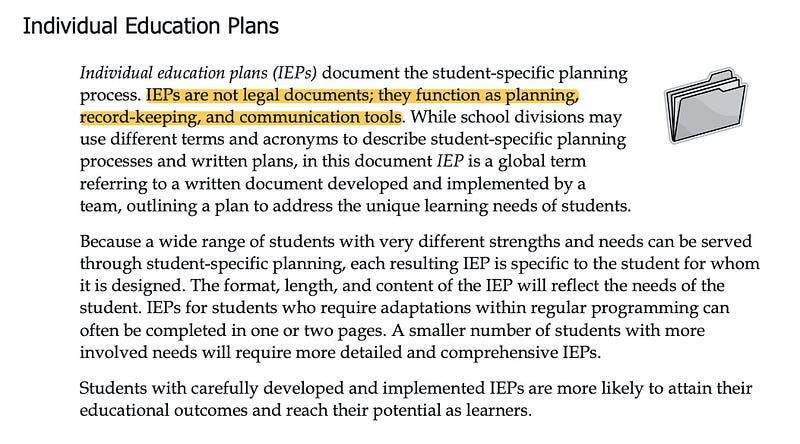
Here in Manitoba parents just have to cross their fingers and hope the school will follow their child’s individualized plan. If the school does not, parents and caregivers have to do all of the leg work themselves: making phone calls, requesting meetings, advocating for their children, begging and pleading. Some families also have to pay for independent professional assessments, professional supports, or professional advocates out of their own pockets. These services are incredibly expensive and can have long waitlists. There is no teeth to these documents, and little recourse for families if their child’s school refuses to follow the student’s IEP/SSP.
And all of that leg work? That can only happen when families actually know and understand what an IEP/SSP is intended for, only for families who have the resources to educate themselves, and only for families who have the time and resources to dedicate to advocating for their child. If not, the child is the one who suffers. It can be more than a full-time job just advocating and supporting a child with a disability, even if they are in school full-time, if the school isn’t following their IEP. Attending meetings, writing emails, making phone calls, attending appointments and consulting with outside professionals… If the parent is a single-parent, or both parents work outside of the home, or other personal circumstances don’t allow them the time or financial resources to do all of this, then it’s left up to the school to do what they feel is best. Unfortunately this is often what is best for the school instead of what is best for the student.
I don’t mean that school staff don’t care or want to do their absolute best for their students. Most absolutely do, and many are as frustrated as we are. Unfortunately resources and funding to schools are so poor that if no one is really pushing them to find a way, then they will end up putting their institutional needs first. There unfortunately remain some administrators and educators with archaic ideas about how students should behave and how behavioural challenges should be dealt with, which creates yet another layer of difficulty for the students and their families.
Given all this, we need legislation. We need Canada-wide legislation that holds administrators accountable equally across the country, that holds schools accountable for following student’s education and support plans, and for providing appropriate accommodations. Too many children are falling through the cracks because their parents don’t have the resources to fight for them and because our public schools are so under-funded that the schools don’t have the proper resources to provide for the needs of their students.
To learn more about how schools are funded in Manitoba, visit Manitoba’s Ministry of Education website.
Click here to learn more about the (inadequate) laws that govern Education in Manitoba. These laws are incredibly general, and quotes from the Charter of Human Rights, which “guarantees all Canadians equality before and under the law, the right to equal protection and benefit before and under the law, and the right to equal protection and benefit of the law without discrimination, in particular, without discrimination based on race, national or ethnic origin, colour, religion, sex, age or mental or physical disability”. That’s it.
The only specific rights afforded to students with disabilities by law are through the Appropriate Educational Programming Regulation, which is 16 years old (2005), which states that a principal must do the following:
- Ensure the IEP is prepared with the assistance of the pupil’s teacher and other in-school personnel, as directed by the principal;
- The IEP must take into account a pupil’s behavioural or health care needs, if any;
- The IEP must be updated annually or sooner if required by a change in a pupil’s behaviour or needs;
- Ensure that the pupil’s parents, and the pupil if appropriate, are given opportunity to participate in preparing and updating the pupil’s plan.
That’s it. If a principal is choosing a path that clinicians, parents, or the student disagree with, the principal can move forward with the plan so long as it meets the above requirements. There is little protection for the student, and no significant way to hold anyone accountable if they are not following the plan.
That said, there are steps that parents can take. Please click here to read our blog post with recommendations and suggestions for effectively advocating for children in school.
There are Student Services Information for Parents posted on the Manitoba Education website as well, which again makes very broad and general statements such as “all students want to feel they belong and are valued”, but nothing specific and concrete for parents to turn to when needed.
Another way you can advocate for your child, and all students with disabilities, is to make your — and their — voices heard. Share your experiences with those who have the ability to change policy and provide training, connect with other families so that you can join together and know you are not alone.
Teachers are doing the best they can
I want to make clear that I do not fault teachers for large, systemic issues within our education system. Most teachers just want to go to school and educate children. They want to help their students grow and achieve. Most teachers are doing the absolute best they can with incredibly inadequate resources.
I am also not advocating for a more adversarial system where teachers are scared to make mistakes and school administrators fear being sued. Schools are already incredibly risk-averse for this very reason. School staff should never have to work in an environment where they are afraid of making mistakes, that would not serve anyone. In fact, if legislation were written in a way that is clear and comprehensive, then this would reduce conflict because expectations would be consistent and equitable across the board.
An IEP or SSP must be a living document that changes and grows with the student.
I would also never want to turn education plans into a static, inflexible document. An IEP or SSP must be a living document that changes and grows with the student. It is imperative that goals be set with the best interests of the student in mind and that those goals and accommodations adapt to the student as their needs change.
Currently SSPs/IEPs are intended to inform and guide school staff. Unfortunately, if they are not following the student’s plan, the onus is entirely on the caregivers to pressure the school to do so. This creates an unnecessarily adversarial relationship; a relationship which is extremely important to the success of the student. This also creates a situation where the students whose parents have time and access to advocate will receive more services, while students whose parents do not have those resources may be left behind. There needs to be equity in how these standards are applied.
When the onus is on caregivers to pressure schools to follow their children’s education plans, this creates an unnecessarily adversarial relationship between the school and home; a relationship which is extremely important to the success of the student.
One of the main sources of conflict is limited resources. Around the world, entire wars are fought over resources. If a system pits one side against another and makes them fight for access this will inevitably cause conflict. What needs to happen is all schools need much greater support and funding from our provincial government so that resources are not so scarce.
It often takes many families pushing for change over many years to get administrators, MLAs, and other politicians to take notice. We have to keep bringing these issues to their attention and show them how important these issues are to Manitoba families. The greater the number of parents that are speaking up, the louder our voices will become.

2021 Update
As of January 2021, Cliff Cullen became Manitoba’s Minister of Education. You can contact his office by email at [email protected] by phone at (204) 945–3720, or by mail at Room 168, Legislative Building 450 Broadway Winnipeg, MB R3C 0V8. You can also contact your regional MLA and ask them to speak up for their constituents.
The issues with IEPs or SSPs are for the Lucky Ones.
Why do I say that?
These issues are encountered by families who were able to obtain IEPs or SSPs in the first place. Some schools resist providing accommodations and independent education and support plans for students, telling families that the child isn’t “struggling” enough, or that their needs aren’t significant enough to qualify.
Let the Experts Decide.
That may be true. However it is not up to a teacher or administrator to decide that and refuse to refer the student on to determine whether they qualify for support services, which unfortunately does happen sometimes. Educators are not the experts on assessments and disabilities, so they need to allow families access to these experts to determine whether their child does in fact need more help than they are receiving. If a parent is reaching the point where they’re asking for services, supports, and referrals, then it’s highly likely the student does need more.
In April, we wrote a follow-up post about just this problem, called “Struggling in School”.
If you need help advocating for your child at school, please feel free to contact us. We will help you understand your child’s rights and can help you collaborate with your school team to develop a child-centred plan that is supportive, positive, practical, and realistic.

About the Author
Jillian is an ADHD 2e Coach and Child Advocate in Manitoba, Canada.
Jillian has a diploma in Child & Youth Work and a Degree in Psychology, as well as being the parent of an amazing 2e/ADHD child.
Visit and Facebook.com/ADHD2ePro to learn more.
If you need help educating your child’s school, your family, or with general ADHD coaching or advocacy, please feel free to contact us.
Originally published at https://adhd2e.blogspot.com on October 19, 2020.


