
Why I Prefer Identity-First Language
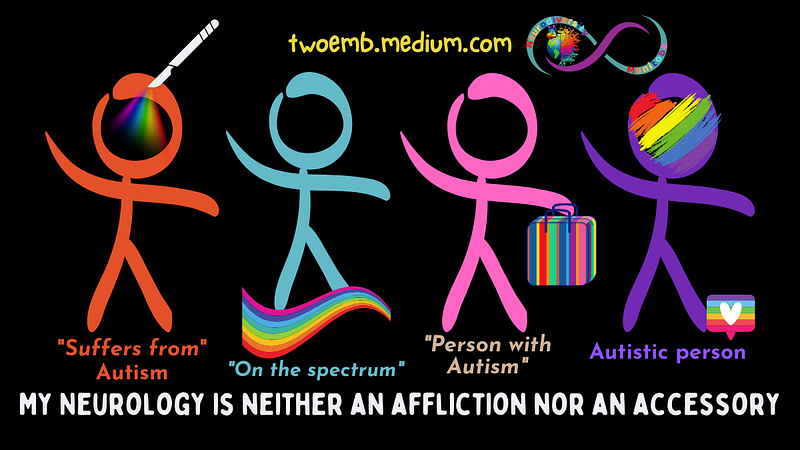
I’m Autistic, not “on the spectrum”
Originally published November, 2021
First off, I am newly self-identified, so I am still learning about myself and about the wider neurodivergent community.
Secondly, I speak only for myself. Autistic people are not a homogenous group, there exist a variety of perspectives, opinions, and experiences amongst individuals. I do not speak for others.
It’s up to the individual to decide what terminology they feel fits them best, so please respect that person’s choice.
Why I use identity-first language
Why I say I’m Autistic, rather than I have ASD, or Autism, or Autism Spectrum Disorder.
Many Autistics do not feel they are disordered, so ASD or “spectrum disorder” does not sit well. I’m divergent, as in my neurobiology diverges from the statistical norm, that’s all.
Note that when people speak about “having” a condition, it’s usually in reference to something negative. Somebody might have cancer or asthma or diabetes, because those are medical conditions that negatively impact a person’s life.
“Some people resent the suggestion that the word for their disability is so distasteful that they should hold it at arm’s length, like it’s a dead fish.” — C.L. Lynch
Many of us consider autism another neurotype in a world full of various neurotypes. The world needs variety, it’s important for the health of the species, just like biodiversity. That’s one of the ways the neurodiversity movement got its name: based on work by Judy Singer, Harvey Blume, and other Autistic advocates.
My son and I are both 2e, meaning gifted with a disability. We say he’s gifted, we don’t say he has giftedness. Why? A lot of it likely has to do with the positive connotations associated with gifted intellect. This despite the fact that it’s a neurodivergence, just like ADHD or Autism, that comes with its own set of struggles (but I digress).
If you think of a bell curve, approximately 5% of the population are considered outliers. Well, approximately 6–9% of people are thought to have ADHD, it’s estimated 2–3% of people are Autistic, and only 2.5% of the population is considered highly or profoundly gifted.
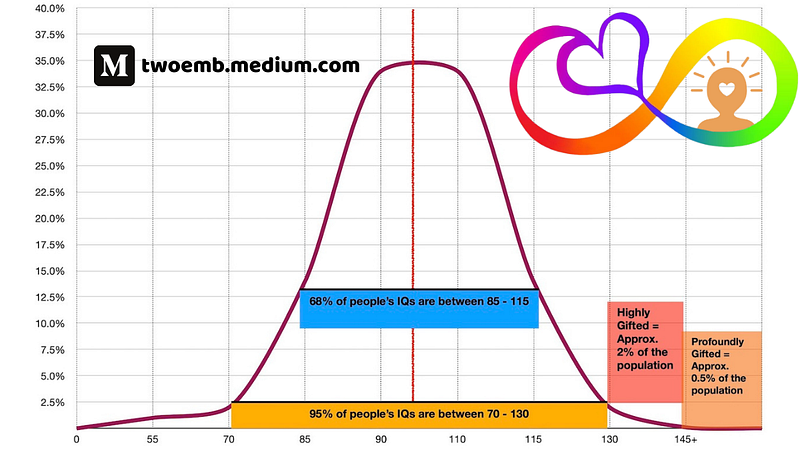
So why are some neurotypes valued and idealized, while others are considered less-than?
No really, I’m asking.
Why are some neurotypes valued while others are considered less-than?
The spectrum concept has been misunderstood
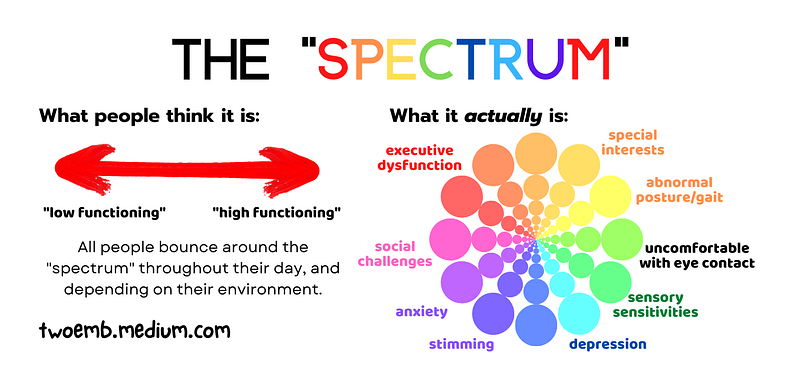
I don’t like to use the term “spectrum” because the concept is largely misunderstood and has become a way to over-simplify and pigeonhole people and their needs. It’s also been used to create inaccurate, ableist labels such as high and low functioning.
A person is not simply “low functioning” or “high functioning”. Everybody varies between high, medium, and low-functioning throughout their day depending on a large number of factors.
My husband and son are both low functioning if they don’t get enough sleep, whereas I am used to sleep deprivation, and can get by on less sleep. I might seem low functioning at a party or large social gathering because I’m socially awkward, introverted, and despise small talk.
My son seemed low functioning at his former school because they did a terrible job of supporting him and he was miserable there. At his new school he is flourishing and doing well, and so he now appears high functioning.
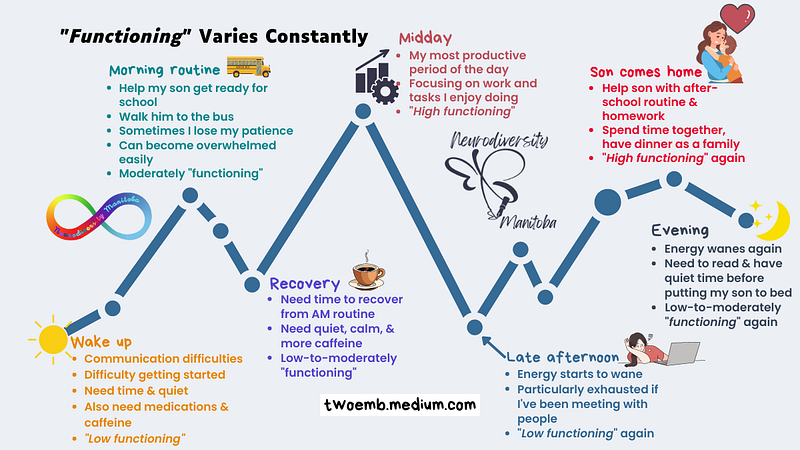
It’s neither binary nor fixed — it’s fluctuating and highly complex. Different people have a variety of different needs, and those needs change frequently, depending on the context and the environment.
“Disability is understood as always being contingent upon the context in which the individual is currently operating.”
— Dr. Nick Walker
I am self-employed and have run a successful business for over 11 years now. I appear high functioning in that role because I know what accommodations I need and how to provide them so I can do my best work.
My neurotype is part of who I am
Being neurodivergent isn’t something I “have”, it’s someone I am. It shapes everything about me and impacts every part of my life, sometimes in positive ways, and sometimes in ways that make my life harder.
Such is a reality of life for everyone, neurotypical people also have struggles and obstacles to overcome. We don’t say they have “neurotypicalism” or allism — although perhaps we should start.
In fact, some NTs have greater challenges than others, so perhaps we can identify high and low functioning neurotypicals as well.
Like I mentioned earlier, this is my point of view, and I only speak for myself.
That said, if you’re not very familiar with autism — or even if you are — the next time you meet an Autistic person, catch yourself when you make assumptions about them. Try to see beyond the stereotypes and pigeonholes and see a complex human being.
© Jillian Enright, Neurodiversity MB
When you join medium, as a member you’ll have access to unlimited reads for only $5 per month. If you use my referral link, I’ll earn a small commission.
Related Stories
Reference
Lynch, C.L. (2019). Person-First Language: What It Is, and When Not To Use It. Neuroclastic. https://neuroclastic.com/person-first
Walker, N. (2021). Neuroqueer Heresies: Notes on the neurodiversity paradigm, Autistic empowerment, and postnormal possibilities. Autonomous Press.


