avatarJillian Enright

Free AI web copilot to create summaries, insights and extended knowledge, download it at here

2903

Abstract

ble with it at very specific times or under very specific circumstances)</li><li>Sensitive vision, finds visual clutter overwhelming</li><li>Becomes overstimulated, irritable, or anxious in loud, busy environments</li><li>Sensitive to food flavours and textures</li><li>Particular about the material and fit of clothing; may find tags irritating and dislike seams or tight clothes</li></ul><figure id="3cc9"><img src="https://cdn-images-1.readmedium.com/v2/resize:fit:800/1*kgLlQFEQjCzFxQP6R55hqg.png"><figcaption>Created by author</figcaption></figure><h2 id="ace0">Sensory experiences are not choices</h2><p id="4a34">If someone becomes irritable due to over-stimulation, or expresses needing a break because they are overwhelmed, they are not trying to be “difficult” or high-maintenance.</p><p id="8b35">Our sensory systems are determined by our nervous systems. These are not something we choose. Although there is neuroplasticity, and there is some room for adaptation and change, our neurobiology is not a conscious choice or behaviour.</p><p id="45ff">People who are “picky” eaters may genuinely have incredibly strong reactions to certain tastes or textures.</p><p id="598d">If a child struggles with potty training due to hypo-sensitive interoception, this is not willful or intentional behaviour, this is their brain and body struggling to communicate effectively with each other.</p><p id="9599">People who <i>cannot</i> wear certain types of clothing are not being “fussy”, they may experience significant discomfort due to seams, tight clothing, or from the feeling of certain fabrics against their skin.</p><p id="edc1">If your partner is not as affectionate as you’d like, or their sex drive does not match yours, this is not necessarily a choice they are consciously making.</p><p id="febb">People who feel overwhelmed in crowded environments are not simply “choosing” to be anti-social. Their brain and body may pick up on the sights and sounds around them with such intensity that it becomes painful.</p><p id="f567">We don’t choose to have sensory systems which differ from the statistical average, that’s just what we’ve been born with. It’s important to be considerate of <i>everyone’s</i> sensory needs, and not just the majority.</p><p id="8290">© Jillian Enright, Neurodiversity MB</p><h1 id="222f">Related Articles</h1><div id="fb68" class="link-block"> <a href="https://readmedium.com/sensory-overload-double-trouble-acb79533b255"> <div> <div> <h2>Help For Sensory Overload & Overwhelm</h2> <div><h3>Triple trouble: Covid, a blizzard, then flooding — oh my!</h3></div> <div><p>medium.com</p></div> </div> <div> <div style="background-image: url(https://miro.readmedium.com/v2/resize:fit:320/1*Ay97Fhr7pMfxiTS3w7zXPQ.png)"></div> <

Options

/div> </div> </a> </div><div id="7f6c" class="link-block"> <a href="https://readmedium.com/loud-introverts-unite-5a261dfe4f40"> <div> <div> <h2>Loud Introverts Unite!</h2> <div><h3>Exploring the relationships between Neurodivergence, Social Anxiety, Sensory Processing Sensitivity, and Introversion.</h3></div> <div><p>medium.com</p></div> </div> <div> <div style="background-image: url(https://miro.readmedium.com/v2/resize:fit:320/1*OzYD1nefkG4aa9hGHKnPAg.jpeg)"></div> </div> </div> </a> </div><div id="deb6" class="link-block"> <a href="https://readmedium.com/avoiding-holiday-burnout-c9c07d8f3ded"> <div> <div> <h2>Avoiding Holiday Burnout</h2> <div><h3>Advice for my fellow Autistic-ADHD-anxious-introverts</h3></div> <div><p>medium.com</p></div> </div> <div> <div style="background-image: url(https://miro.readmedium.com/v2/resize:fit:320/1*BSjCSVZS4RJHd9zNZw97GA.png)"></div> </div> </div> </a> </div><p id="a8c3"><i>When you join medium, as a member you’ll have access to unlimited reads for only $5 per month. If you use <a href="https://twoemb.medium.com/membership">my referral link</a>, I’ll earn a small commission, and you’ll earn my undying gratitude.</i></p><p id="7417"><i>If you’d prefer give a one-time tip, you can <a href="https://ko-fi.com/neurodiversitymb">support my writing on Ko-Fi</a> — also, it’s free to <a href="https://facebook.com/NeurodiversityMB">follow me on Facebook</a>!</i></p><figure id="be4b"><img src="https://cdn-images-1.readmedium.com/v2/resize:fit:800/1*aJ-Tc--UEAjJOM70kdPr3A.png"><figcaption></figcaption></figure><h2 id="5e41">References</h2><p id="86ca">Chang, Y. S., Owen, J. P., Desai, S. S., Hill, S. S., Arnett, A. B., Harris, J., Marco, E. J., & Mukherjee, P. (2014). Autism and sensory processing disorders: shared white matter disruption in sensory pathways but divergent connectivity in social-emotional pathways. <i>PloS one</i>, <i>9</i>(7), e103038. <a href="https://doi.org/10.1371/journal.pone.0103038">https://doi.org/10.1371/journal.pone.0103038</a></p><p id="5595">Ghanizadeh A. (2011). Sensory processing problems in children with ADHD, a systematic review. <i>Psychiatry investigation</i>, <i>8</i>(2), 89–94. <a href="https://doi.org/10.4306/pi.2011.8.2.89">https://doi.org/10.4306/pi.2011.8.2.89</a></p><p id="8315">Kong, M., & Moreno, M.A. (2018). Sensory Processing in Children. <i>JAMA Pediatrics, 172</i>(12), 1208. <a href="https://doi.org/10.1001/jamapediatrics.2018.3774">https://doi.org/10.1001/jamapediatrics.2018.3774</a></p></article></body>

Understanding Sensory Processing Disorder

What is SPD and how is it related to Autism and ADHD?

Created by author

The basics

SPD is defined as difficulty processing information we receive from our various senses. SPD is not recognized as a formal diagnosis, however sensory issues are listed as symptoms of various neurodevelopmental differences.

The two primary ways this manifests is either hypo (under) or hyper (over) sensitivity from one’s senses, and is extremely common in Autistics. Most people with SPD have hypo-sensitivities in some senses and hyper-sensitivities in others, and most people are predominately hypo or hyper sensitive.
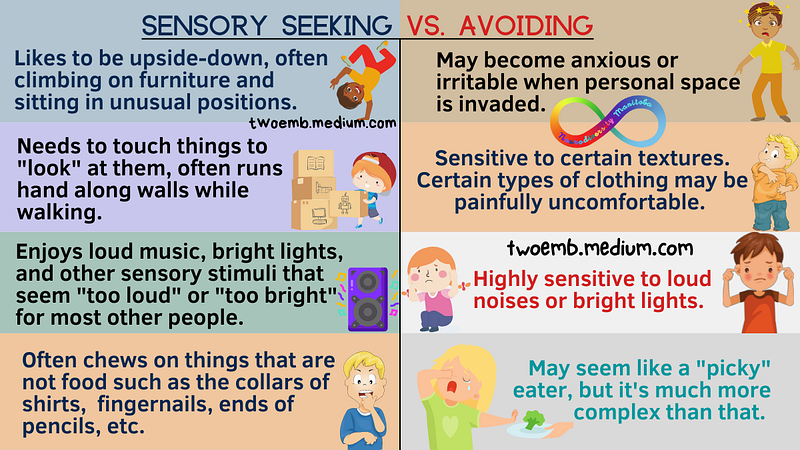
Created by author

Research suggests over 90% of Autistics have significant differences in sensory processing and approximately 40% of people with ADHD have Sensory Processing Disorder (SPD).

Sensory Seeking

Those with hypo-sensitivities are often sensory-seekers: seeking out ways to experience and stimulate those senses which are under-responsive.

Examples of sensory seeking:

  • Thumb-sucking
  • Hair twirling
  • Rubbing feet together
  • Finger tapping
  • Spinnig
  • Flapping arms
  • Wiggling fingers
  • Hanging upside-down
  • Climbing
  • Jumping & bouncing
  • Rocking
  • Smoking
  • Biting fingernails
  • Eating (especially foods with intense flavours)
  • Listening to very loud music
  • Enjoying bright, flashing lights
  • Cuddling, hugging
  • Sex
  • Singing or speaking loudly (vocal stimming & echolalia)

Sensory avoiding

People whose sensory systems are over-responsive may find certain sensory input to be overwhelming, unpleasant, or even distressing. In an effort to avoid discomfort, they may try to reduce the intensity of the input, or try to escape it altogether.

Examples of sensory avoiding:

  • Covering one’s ears
  • Disliking physical touch (or only being comfortable with it at very specific times or under very specific circumstances)
  • Sensitive vision, finds visual clutter overwhelming
  • Becomes overstimulated, irritable, or anxious in loud, busy environments
  • Sensitive to food flavours and textures
  • Particular about the material and fit of clothing; may find tags irritating and dislike seams or tight clothes
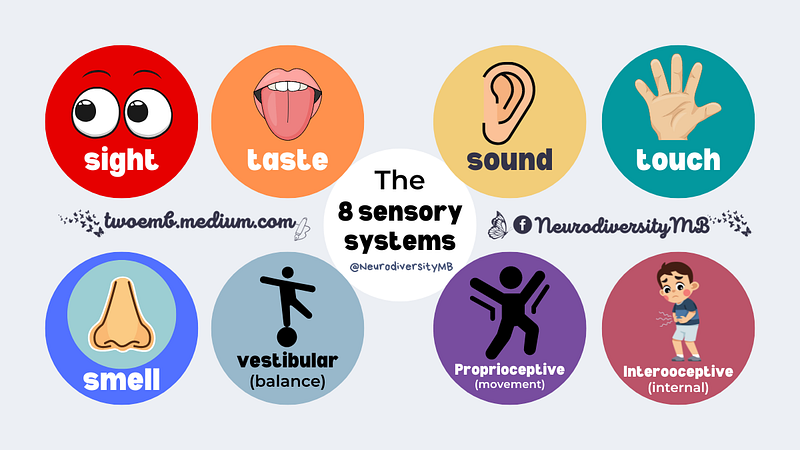
Created by author

Sensory experiences are not choices

If someone becomes irritable due to over-stimulation, or expresses needing a break because they are overwhelmed, they are not trying to be “difficult” or high-maintenance.

Our sensory systems are determined by our nervous systems. These are not something we choose. Although there is neuroplasticity, and there is some room for adaptation and change, our neurobiology is not a conscious choice or behaviour.

People who are “picky” eaters may genuinely have incredibly strong reactions to certain tastes or textures.

If a child struggles with potty training due to hypo-sensitive interoception, this is not willful or intentional behaviour, this is their brain and body struggling to communicate effectively with each other.

People who cannot wear certain types of clothing are not being “fussy”, they may experience significant discomfort due to seams, tight clothing, or from the feeling of certain fabrics against their skin.

If your partner is not as affectionate as you’d like, or their sex drive does not match yours, this is not necessarily a choice they are consciously making.

People who feel overwhelmed in crowded environments are not simply “choosing” to be anti-social. Their brain and body may pick up on the sights and sounds around them with such intensity that it becomes painful.

We don’t choose to have sensory systems which differ from the statistical average, that’s just what we’ve been born with. It’s important to be considerate of everyone’s sensory needs, and not just the majority.

© Jillian Enright, Neurodiversity MB

Related Articles

When you join medium, as a member you’ll have access to unlimited reads for only $5 per month. If you use my referral link, I’ll earn a small commission, and you’ll earn my undying gratitude.

If you’d prefer give a one-time tip, you can support my writing on Ko-Fi — also, it’s free to follow me on Facebook!
References

Chang, Y. S., Owen, J. P., Desai, S. S., Hill, S. S., Arnett, A. B., Harris, J., Marco, E. J., & Mukherjee, P. (2014). Autism and sensory processing disorders: shared white matter disruption in sensory pathways but divergent connectivity in social-emotional pathways. PloS one, 9(7), e103038. https://doi.org/10.1371/journal.pone.0103038

Ghanizadeh A. (2011). Sensory processing problems in children with ADHD, a systematic review. Psychiatry investigation, 8(2), 89–94. https://doi.org/10.4306/pi.2011.8.2.89

Kong, M., & Moreno, M.A. (2018). Sensory Processing in Children. JAMA Pediatrics, 172(12), 1208. https://doi.org/10.1001/jamapediatrics.2018.3774

Autism
Sensory Processing
Spd
Adhd
Mental Health
Recommended from ReadMedium