
Inclusion Benefits Everyone
Accommodations for neurodivergent students benefit all students

Is Inclusion “Inconvenient”?
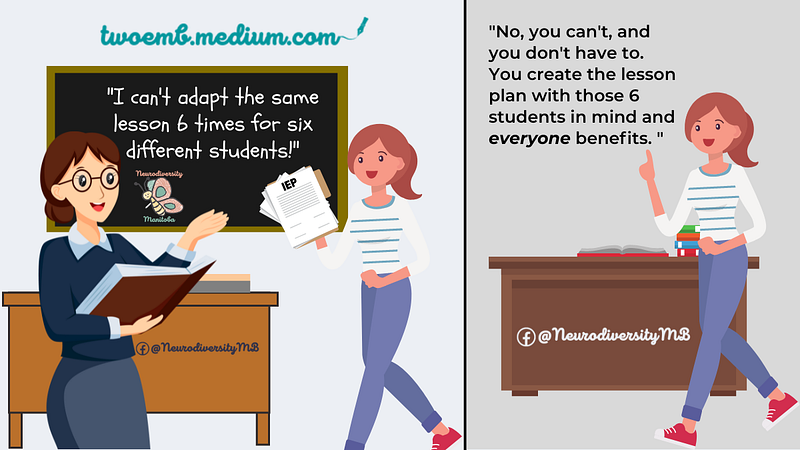
We often hear teachers and administrators push back against accommodations for students, citing the increased workload and an inability to give “special treatment” or individualized instruction to the 15-20% of students in their class needing some adaptations.
Broadly speaking, our public school system teaches to the 80–85% majority, the typical learners, and the other 20% either have to make do, or be taught in a separate environment, away from their peers. This is not inclusive in the least.
What some school staff fail to understand is that when you teach to the 20% of learners who may learn in an atypical way, you benefit all students. That’s inclusive.
“Quite often, teachers who are prepared to teach students with exceptional needs become more-skilful teachers of all students, because they develop deeper analytic skills and a wider repertoire of strategies useful for the many students who learn in different ways.” — Pamela LePage
This also teaches children that there are different ways of learning and to celebrate the diversity in one’s classroom and elsewhere, rather than seeing it as an inconvenience.
Unfortunately, even when school staff do try to go the extra mile and provide accommodations, adaptations, and modifications to benefit as many students as possible, they are met with resistance.
Parents want their children taught the “regular” way, administrators want teachers to stick with the status quo, and our governments consistently fail to provide adequate funding and resources to public schools.
No one person can facilitate this change alone, it requires cooperation and commitment from government policy-makers, to support staff, to parents.
With that in mind, I will list the most common and effective inclusion and teaching strategies for neurodiverse students, and will explain how they benefit all students in the classroom.
Relationship based education
Proactive teaching increases the probability that appropriate behaviour and school performance are more likely to occur for every student, not just neurodivergent students.
This is why it is incredibly important that all school staff dedicate time in the first few weeks of every school year to develop relationships with students.
“Students who live in caring relationships with teachers have greater academic success.”
— Josette & Ba Luvmour
Showing a genuine interest in children, their interests, and their strengths allows us to begin developing caring relationships with them.
Treating children as fairly and consistently as possible, and acknowledging and apologizing when you don’t, will help children to trust that you are true to your word.
“Children cooperate with trustworthy people.”
— Josette & Ba Luvmour
In getting to know the children in their classes, school staff should combine any formal information provided, such as assessments or individualized support plans, in addition to spending quality time with those students in order to get to know them beyond what is written in documents.
“Educators who have knowledge about their students are better able to teach them. In student-entered learning environments, teachers focus on the needs and interests of individual students. By doing so, we uncover each child’s innate talents.” — Josette & Ba Luvmour
Fortunately, individual education plans (IEPs) are evolving to become more strengths-based, however they still tend to be overly focused on the student’s “problem” behaviour and on their deficits.
This paints a pessimistic view of the child, and it is much more difficult to support students in their areas of struggle if we don’t know their strengths. Using a strengths-based model, we use the student’s interests, preferences, and strongest skills in order to help them develop in their areas of weakness.
Student-centred learning
“A significant problem is instruction that is too teacher-centred, where the role of the student is defined as sitting passively receiving information and answering questions when called on.” — Kirstin Olson
Teachers work extremely hard, and a lot of their work goes unseen, unappreciated, and unpaid. Many teachers spend their personal time grading, creating lesson plans, and preparing their classroom.
It is understandable, then, that they may become quite attached to their lesson plan, even if it is not entirely working for their students, or when their students could take it in a different direction.
The role of educators is to be flexible, to allow students’ curiosity guide their learning, and to provide students some autonomy and freedom of choice in their studies. Students learn best when they are interested in the topics of study.
Children with ADHD are more likely to do an assignment they have chosen than one imposed on them by another. This doesn’t have to mean giving a student carte blanche for designing their own classwork, but it can and should mean providing a number of options and variations to from which to choose.
Create a low-fear, high-trust atmosphere
“Student-centred learning requires mutual respect and trust of our students… Learning involves risk-taking, which requires safe and trusting relationships”
— Josette & Ba Luvmour
If an adult is overly critical or punitive towards children, this will cause them to fear repercussions for making mistakes. This is not a healthy environment, and experiencing fear and stress will significantly impede upon children’s ability to learn.
“Chronic stress can shut off the the areas of the brain responsible for learning, emotional regulation, attention, and working memory.”
— Dr. Lori L. Desautels
Encourage, rather than punishing, critical thinking and questioning authority. Be secure enough in yourself to allow children to respectfully question you or point out when you make a mistake. Role-model gracefully accepting responsibility for your behaviour and making amends, as this is one of the most powerful and effective ways for children to learn and utilize these skills for themselves.
Eliminate busy work
Decrease the total workload to what is essential rather than merely busy work assigned to fill class time.
This is true for all students, but is especially true for gifted and twice exceptional (2e) students. 2e children cannot tolerate boredom or busy work, and being subjected to menial tasks often leads to concerning or undesirable behaviours in gifted and 2e children.
Ask yourself, “How much work does this student need to demonstrate that he has acquired the concept I am teaching?” That should be enough.
Provide hands-on and project-based learning as much as possible, encourage curiosity, innovation, and initiative. These types of projects are more fun, have more flexibility and freedom of choice, and allow children to utilize their strengths and creativity to demonstrate their knowledge.
Research has shown that hands-on and project-based learning have positive effects on all students’ academic achievement when compared with traditional instruction.
Incorporate movement breaks
Allow some restlessness at or near student work areas, as long as they are not disturbing others. It is helpful to implement a sensory area within the classroom and to normalize brief brain breaks while doing desk work. Fidgeting and movement are very effective in helping children with ADHD concentrate.
Permit and facilitate movement while the student is concentrating. This not only reduces ADHD symptoms but it can also help to improve working memory.
Many studies have outlined the negative health, psychological, and academic impacts of prolonged sitting.
One such study found that students’ on-task behaviour decreased significantly after prolonged engagement in classroom instruction, while another found that the implementation of brain breaks had a positive effect on students’ engagement by decreasing off-task behaviours.
Use participatory teaching — give the student something useful and physically active to do to help you while teaching.
Give children the benefit of the doubt
All too often, adults misinterpret the behaviour of children as intentional opposition.
Many children with neurodivergent brains struggle with executive functioning and sensory processing issues.
For example, despite having perfect hearing, there are times when my son is sitting right beside me and he does not immediately register when I speak to him. This is due to an auditory processing issue, which is more common in neurodiverse children.
Auditory Processing Disorder (APD) causes difficulty translating messages received by the ears into information the brain can use and then act upon. A child with APD may appear to be ignoring you, or may appear to be refusing to follow your instructions. There remains the possibility that they could hear words being said, but their brains have not yet translated those words into a useful message.
There are a great many other reasons, aside from willful disobedience, that a child may not be doing what is expected of them. This could be due to stress, illness, distractions, undiagnosed disabilities, lacking skills, to name but a few.
© Jillian Enright, Neurodiversity MB
Learn More
I have complied my recommended books and articles about Education here:
I have created an entire catalogue of stories in my back-to-school series outlining many of the difficulties encountered by neurodivergent and disabled students in school:
“Inclusive education is not a one-size-fits-all approach, but rather one that is tailored to meet the needs of ALL students.”
— Kim Calder Stegemann & Angela Aucoin
Related Stories
When you join medium, as a member you’ll have access to unlimited reads for only $5 per month. If you use my referral link, I’ll earn a small commission, and you’ll earn my undying gratitude.
References
Armstrong, T. (2012). Neurodiversity in the Classroom: Strength-based strategies to help students with special needs succeed in school and life. ASCD. https://goodreads.com/book/show/16275200-neurodiversity-in-the-classroom
Aspiranti, K.B., Hulac, D.M. (2021). Using Fidget Spinners to Improve On-Task Classroom Behavior for Students With ADHD. Behaviour Analysis in Practice. https://doi.org/10.1007/s40617-021-00588-2
Barkley, Russell A. (2016). Managing ADHD in School: The best evidence-based methods for teachers. PESI Publishing. https://goodreads.com/book/show/28648626-managing-adhd-in-schools
Barkley, Russell A. (2015). Attention-Deficit Hyperactivity Disorder: A Handbook for Diagnosis & Treatment. The Guilford Press.
Berrigan, P., Scott, C.W.M. & Zwicker, J.D. (2020). Employment, Education, and Income for Canadians with Developmental Disability: Analysis from the 2017 Canadian Survey on Disability. Journal of Autism and Developmental Disorders. https://doi.org/10.1007/s10803-020-04603-3.
Calder Stegemann, K., Aucoin, A. (2018). Inclusive Education: Stories of Success and Hope in a Canadian Context. Pearson Education.
Chen, Cheng-Huan, & Yang, Yong-Cih. (2019). Revisiting the effects of project-based learning on students’ academic achievement: A meta-analysis investigating moderators. Educational Research Review, 26, 71–81. https://doi.org/10.1016/j.edurev.2018.11.001.
Dellapiazza, F., Michelon, C., Vernhet, C. et al. (2021). Sensory processing related to attention in children with ASD, ADHD, or typical development: results from the ELENA cohort. European Child & Adolescent Psychiatry 30, 283–291. https://doi.org/10.1007/s00787-020-01516-5
Desautels, L. (2020). Connections Over Compliance: Rewiring our perceptions of discipline. Wyatt-MacKenzie Publishing. https://goodreads.com/book/show/54985675-connections-over-compliance
Goh, Tan & Fu, You & Brusseau, Timothy & Hannon, James. (2018). Original Article On-task behavior of elementary students during movement integration. Journal of Physical Education and Sport, 18(1). https://doi.org/10.7752/jpes.2018.01013
Hallowell, E. & Ratey, J. (2021). ADHD 2.0. Ballantine Books. https://goodreads.com/book/show/53231680-adhd-2-0
Hirt, K. (2018). Boost: 12 Effective Ways to Lift Up Our Twice Exceptional Children. GHF Press. https://goodreads.com/book/show/37862039-boost
Kasparek, A. (2021). Brain Breaks and Student Engagement. (Master’s Thesis, Northwestern College, Iowa). Retrieved from NWC Theses & Capstone Projects: https://nwcommons.nwciowa.edu/education_masters/293.
Lanzetta-Valdo, B. P., Alves de Oliveira, G., Correa Ferreira, J. T., Nakamura Palacios, E. M. (2017). Auditory Processing Assessment in Children with Attention Deficit Hyperactivity Disorder: An Open Study Examining Methylphenidate Effects. International Archives of Otorhinolaryngology, 21(01), 72–78. https://doi.org/10.1055/s-0036–1572526
LePage, Pamela; Courey, Sue; Fearn, Emilene J.; Benson, Vicki; Cook, Ellen; Hartmann, Liz; Nielsen, Shelley. (2010). Curriculum Recommendations for Inclusive Teacher Education. International Journal of Whole Schooling, 6(2), 19–45. https://files.eric.ed.gov/fulltext/EJ912015.pdf
Luvmour, J., & Luvmour, B. (2019). Relationship Based Education: Relationships and partnerships in educational environments.
Olson, K. (2009). Wounded by school: Recapturing the joy in learning and standing up to old school culture. Teachers College Press.
Schultz, J. (2011). Nowhere to hide. Jossey-Bass. https://goodreads.com/book/show/12428586-nowhere-to-hide


