
Disability | APD
Neurodivergence and Auditory Processing Disorder
“I Can’t Hear You!”
Ferris?… Ferris… FERRIS… FERRIS!
HEY!
Ever feel like you’re talking to a wall?
Screaming into the void?
Okay, that may be a little dramatic, but it can be frustrating. You call your child’s name, they’re right in front of you, yet they don’t respond.
This happens multiple times a day over here. My son is hyperlexic and he’s always got his nose in a book. He’s often so engrossed in what he’s reading, he’s oblivious to the world around him.
As parents, we sometimes get frustrated with our son when he’s reading and doesn’t acknowledge when we’re speaking to him, but we’ve come to recognize that it’s an auditory processing issue called “inattentional deafness”.
His information processing is maxed out with what he’s reading, so he’s unable to also process incoming information in that moment.
Teachers, parents, and coaches often complain about children not “listening” because they don’t immediately follow verbal directions, despite the fact that their hearing has been tested and is perfect.
It’s usually not that simple.
What is auditory processing disorder?
Simply put, auditory processing disorder (APD) impedes a person’s ability to manage and process information they hear. It is estimated that 50% of children with ADHD also have APD.
An over-simplified explanation of this process as it relates to ADHD is that executive dysfunction causes difficulty filtering out irrelevant or unimportant incoming information.
The thalamus is part of this process. It filters through the aural information as it is heard through the ear and relays it to the auditory processing centre in the brain.
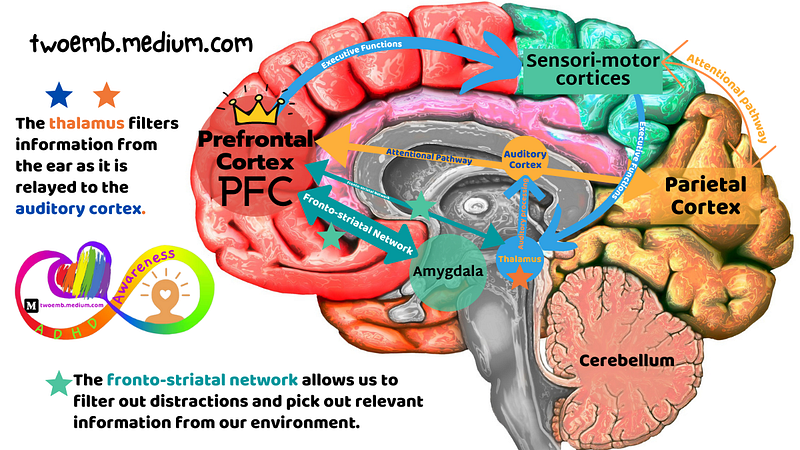
People with executive functioning impairments have greater difficulty filtering through information. In a classroom, workplace, or social environment where there is background noise, a person with ADHD may be distracted by those sounds and have trouble ignoring them in order to concentrate on the person speaking to them.
This may look like they’re not listening or not paying attention, but as I said, it’s not that simple. While they are trying to listen, their ears are picking up on all the other sounds in the surrounding environment, and their brains treat all the sounds as equally important.
A typically functioning brain would filter out irrelevant information and treat the speaker’s words as the most important stimuli to receive, process, and pass along the applicable neural pathways.
Fun fact: The ability for our brains to focus on one stimulus (i.e. a person speaking) while filtering out background noise is colloquially known as The Cocktail Party Effect.
APD and Neurodivergence
Not only are neurodivergent people often assumed to not be listening, many children are deemed “defiant” when they don’t immediately follow instructions.
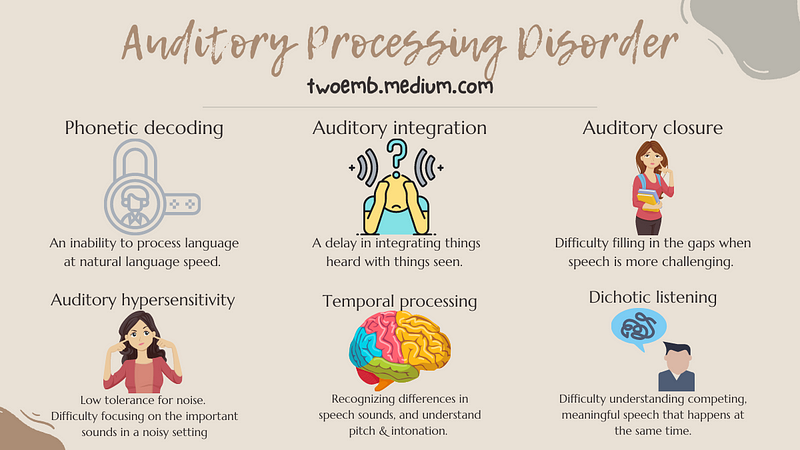
APD can manifest differently in different people and actually has various categories:
- Auditory closure: Difficulty filling in the gaps of speech when it is more challenging.
- Dichotic listening: Difficulty understanding competing, meaningful speech that happens at the same time.
- Temporal processing: Recognizing differences in speech sounds, and understand pitch & intonation.
- Binaural interaction: This is the ability to know which side speech or sounds are coming from, and to localize sound in a room.
- Phonetic decoding: An inability to process language at natural language speed.
- Auditory integration: A delay in integrating things heard with things seen.
- Auditory hypersensitivity: Low tolerance for noise. Difficulty focusing on the important sounds in a noisy setting.
Knowing this, people need to be patient and give others a moment to process what has been said, filter through the incoming stimuli, and turn it into information their brain can actually use in the present context.
This happens so quickly and easily for most people, they have a hard time understanding this isn’t the case for everyone.

APD and externalizing behaviours
Many people with APD may become frustrated when trying to process, especially if others are becoming impatient with them, or if people keep throwing more information their way before they’ve had a chance to mentally sort things out.
For me personally, my processing issues fall into the last category, hypersensitivity — which is ironic, because I’m hard of hearing. (This is also a recognized issue in people with hearing loss, but that’s a story for another day).
People who have sensory hypersensitivity may become irritable when they feel overwhelmed or overloaded by external stimuli. If I am in a loud environment for very long, my anxiety increases, and I can begin to feel disoriented.
I wrote more about this in a previous article:
All you need is just a little patience
Give people the benefit of the doubt, especially children who usually don’t have adequate insight into their own neurology to understand what is happening, let alone explain it to an adult.
Believe people. If someone is telling you they heard you, but it didn’t compute, or that it takes them a little longer to process verbal instructions, don’t assume they’re making up excuses.
If you’re the person who has APD, or for whom auditory processing seems to create challenges, Neurodiversified author Kristy Westaway has published an article that offers advice for coping when you feel overwhelmed by sounds.
© Jillian Enright, Neurodiversity MB

When you join medium, as a member you’ll have access to unlimited reads for only $5 per month. If you use my referral link, I’ll earn a small commission, and you’ll earn my undying gratitude.
Related Stories
References
Mesgarani, N., Chang, E. (2012). Selective cortical representation of attended speaker in multi-talker speech perception. Nature 485, 233–236. https://doi.org/10.1038/nature11020
Riccio, C. A., Hynd, G. W., Cohen, M. J., Hall, J., & Molt, L. (1994). Comorbidity of central auditory processing disorder and attention-deficit hyperactivity disorder. Journal of the American Academy of Child and Adolescent Psychiatry, 33(6), 849–857. https://doi.org/10.1097/00004583-199407000-00011
Rodolfo, S., Petronilla, B., Francesco, P., Madia, L., Chiara, G., Fabio, Capozzo, R., Maria, R… Nicola, Q. et al. (2019). The Age-Related Central Auditory Processing Disorder: Silent Impairment of the Cognitive Ear. Frontiers in Neuroscience, 619. https://doi.org/10.3389/fnins.2019.00619
Scheer, M., Bülthoff, H. H., & Chuang, L. L. (2018). Auditory Task Irrelevance: A Basis for Inattentional Deafness. Human factors, 60(3), 428–440. https://doi.org/10.1177/0018720818760919
Tien, YM., Chen, V.CH., Lo, TS. et al. (2019). Deficits in auditory sensory discrimination among children with attention-deficit/hyperactivity disorder. European Child & Adolescent Psychiatry 28, 645–653. https://doi.org/10.1007/s00787-018-1228-7
Wallaerta, N. (2017). Sensorineural hearing loss enhances auditory sensitivity and temporal integration for amplitude modulation. The Journal of the Acoustical Society of America 141, 971. https://doi.org/10.1121/1.4976080


